Begin of page section:
Page sections:

  • Go to contents (Accesskey 1)
  • Go to position marker (Accesskey 2)
  • Go to main navigation (Accesskey 3)
  • Go to sub navigation (Accesskey 4)
  • Go to additional information (Accesskey 5)
  • Go to page settings (user/language) (Accesskey 8)
  • Go to search (Accesskey 9)

End of this page section. Go to overview of page sections

Begin of page section:
Page settings:

English en
Deutsch de
Search
Login

End of this page section. Go to overview of page sections

Begin of page section:
Search:

Search for details about Uni Graz
Close

End of this page section. Go to overview of page sections


Search

Begin of page section:
Main navigation:

Page navigation:

  • University

    University
    • About the University
    • Organisation
    • Faculties
    • Library
    • Working at University of Graz
    • Campus
    Developing solutions for the world of tomorrow - that is our mission. Our students and our researchers take on the great challenges of society and carry the knowledge out.
  • Research Profile

    Research Profile
    • Our Expertise
    • Research Questions
    • Research Portal
    • Promoting Research
    • Research Transfer
    • Ethics in Research
    Scientific excellence and the courage to break new ground. Research at the University of Graz creates the foundations for making the future worth living.
  • Studies

    Studies
    • Prospective Students
    • Students
  • Community

    Community
    • International
    • Location
    • Research and Business
    • Alumni
    The University of Graz is a hub for international research and brings together scientists and business experts. Moreover, it fosters the exchange and cooperation in study and teaching.
  • Spotlight
Topics
  • Sustainable University
  • Researchers answer
  • Work for us
Close menu

End of this page section. Go to overview of page sections

Begin of page section:
You are here:

University of Graz News Europameister Wissenschaft

End of this page section. Go to overview of page sections

Thursday, 30 June 2016

Europameister Wissenschaft

Die TeilnehmerInnen des 4. steirischen Science Slam mit Bernhard Weingartner und KPH-Rektor Siegfried Barones. Foto: cp-pictures ©CP-PICTURES

Die TeilnehmerInnen des 4. steirischen Science Slam mit Bernhard Weingartner und KPH-Rektor Siegfried Barones. Foto: cp-pictures

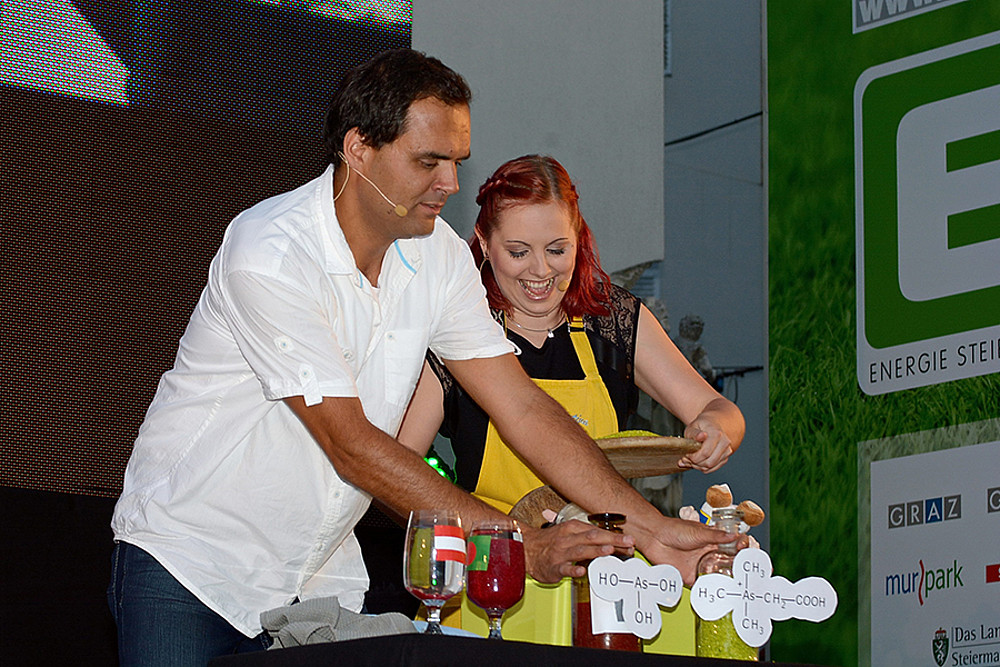
Uni-Graz Slammerin Chemikerin Simone Bräuer klärte über giftiges und gutes Arsen auf, mit Science-Slam-Macher Bernhard Weingartner. ©CP-PICTURES

Uni-Graz Slammerin Chemikerin Simone Bräuer klärte über giftiges und gutes Arsen auf, mit Science-Slam-Macher Bernhard Weingartner.

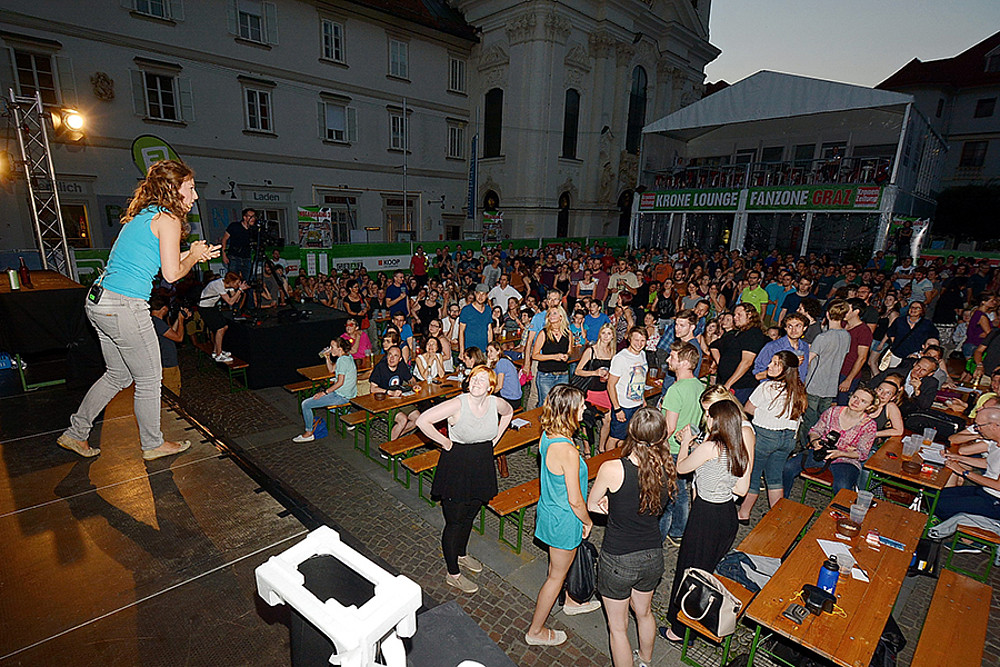
Volltreffer: Mit 850 BesucherInnen stellte der 4. Science Slam einen Rekord auf! ©CP-PICTURES

Volltreffer: Mit 850 BesucherInnen stellte der 4. Science Slam einen Rekord auf!

Der steirische Open Air-Science Slam in der KRONE Public-Viewing-Zone begeisterte 850 Fans

Wo sonst die Fußball-Fans den Kickern der EURO 2016 zujubeln, begeisterten junge WissenschafterInnen auf Europameister-Niveau. 850 Fans verfolgten den 4. steirischen Science Slam am 29. Juni 2016 in der KRONE Public-Viewing Zone auf dem Mariahilferplatz– erstmals als Open Air, mit bewährter Unterstützung des BMWFW sowie unter der Schirmherrschaft der Steirischen Hochschulkonferenz.
Science-Slam-Motor und -Moderator Bernhard Weingartner präsentierte wieder eine bunte Forschungspalette steirischer Unis und Hochschulen. Diese reichte heuer von geheimnisvollen Hundeaugen bis zum kollektiven Diffusions-Verhalten von Biertrinkern, vom Blind Date mit Smartphone über Arsen in unserer Nahrung bis zur abenteuerlichen Reise einer Schmerztablette durch den Körper.
Je sechs Minuten hatten die fünf KandidatInnen Zeit, um ihre Forschungen kurz und knackig vorzustellen – und das Publikum, das als Jury fungierte, zu beeindrucken. Am besten konnte dies Team Melanoscience der Med Uni Graz. Rainer Hoffmann-Wellenhof, Katharina Schwab, Christoph Schwab und Hund Georgi verwandelten sich in Pigmentzellen in Haut und Auge und erklärten mit einer schauspielerischen Glanzleistung die Entstehung von Melanomen.

KPH-Rektor Siegfried Barones, aktuell Vorsitzender der steirischen Hochschulkonferenz, überreichte den vom BMWFW gestifteten Preis (Wellnessgutscheine) und gratulierte den GewinnerInnen, die 2017 bei der Science Slam-Staatsmeisterschaft um den Österreich-Titel in den Ring steigen werden.

Die weiteren Slammer

  • Simone Bräuer, Uni Graz, Analytische Chemie: „Internationale Arsenküche“
  • Oliver Wollner, TU Graz / Joanneum Research, Biomedizinische Analytik: „Über ein kleines Voltaren, das sich im Mensch verirrt“
  • Angelina Orthacker, Elektronenmikroskopie & Nanoanalytik,TU Graz /ZFE: „Get the Nano-Party Started!“
  • Elmar Krainz, FH Joanneum, Kapfenberg, Informatik: „Blind Date mit Smartphone“

www.scienceslam.at


Alle Fotos von der Veranstaltung gibt's im Online-Album:
cp-pictures.at/gallery2/v/2016_Open+Air_Slam+in+Graz/

created by Andreas Schweiger

Related news

Simon Benal completes a voluntary environmental year at the University of Graz

Committing to the planet, getting to know exciting fields of activity and discovering possible paths for your own future – these are the opportunities offered by the Freiwilliges Umweltjahr (FUJ), a voluntary environmental year. One person who has chosen this option is Simon Benal. He has been working in the environmental management team at the University of Graz since September 2025.

From Iowa to Graz: US researcher puts “angry” algorithms to the test

Researcher Hussam Habib is investigating how social media platforms use algorithms to evoke emotions, capture attention, and disseminate content in a targeted manner. Born in Pakistan, he came to the University of Graz on an APART-USA scholarship from the Austrian Academy of Sciences. Thanks to new EU regulations, the scientist hopes to gain deeper insight into the mechanisms behind YouTube, Instagram, Reddit, and other platforms.

Lightbulb moments: How two young physicists are working for tomorrow

They shed light on unresolved questions – and use it in their work in physics. Diana Shakirova is using light to distinguish different chiral molecules, which can have both healing and toxic effects. Christoph Stockinger, on the other hand, uses light to develop high-precision sensors. But it is not only light that connects the two physicists. The doctoral students took part in the NanoGraz Careers & Ideas Days to prepare themselves in good time for the next steps in their careers as young scientists.

Rector Peter Riedler: Starting the year with confidence

In 2026, we will continue to work consistently on positioning the University of Graz as a relevant player in Europe, while at the same time focusing on a modern, sustainable and climate-friendly university campus. When new digital applications are rolled out in January, we will not only create a stable and secure IT environment, but also modern working and studying conditions for future generations. Peter Rielder, Rector of the University of Graz

Begin of page section:
Additional information:

University of Graz
Universitaetsplatz 3
8010 Graz
Austria
  • Contact
  • Web Editors
  • Moodle
  • UNIGRAZonline
  • Imprint
  • Data Protection Declaration
  • Accessibility Declaration
Weatherstation
Uni Graz

End of this page section. Go to overview of page sections

End of this page section. Go to overview of page sections

Begin of page section:

End of this page section. Go to overview of page sections