Begin of page section:
Page sections:

  • Go to contents (Accesskey 1)
  • Go to position marker (Accesskey 2)
  • Go to main navigation (Accesskey 3)
  • Go to sub navigation (Accesskey 4)
  • Go to additional information (Accesskey 5)
  • Go to page settings (user/language) (Accesskey 8)
  • Go to search (Accesskey 9)

End of this page section. Go to overview of page sections

Begin of page section:
Page settings:

English en
Deutsch de
Search
Login

End of this page section. Go to overview of page sections

Begin of page section:
Search:

Search for details about Uni Graz
Close

End of this page section. Go to overview of page sections


Search

Begin of page section:
Main navigation:

Page navigation:

  • University

    University
    • About the University
    • Organisation
    • Faculties
    • Library
    • Working at University of Graz
    • Campus
    Developing solutions for the world of tomorrow - that is our mission. Our students and our researchers take on the great challenges of society and carry the knowledge out.
  • Research Profile

    Research Profile
    • Our Expertise
    • Research Questions
    • Research Portal
    • Promoting Research
    • Research Transfer
    • Ethics in Research
    Scientific excellence and the courage to break new ground. Research at the University of Graz creates the foundations for making the future worth living.
  • Studies

    Studies
    • Prospective Students
    • Students
  • Community

    Community
    • International
    • Location
    • Research and Business
    • Alumni
    The University of Graz is a hub for international research and brings together scientists and business experts. Moreover, it fosters the exchange and cooperation in study and teaching.
  • Spotlight
Topics
  • Our digital Advent calendar
  • Sustainable University
  • Researchers answer
  • Work for us
Close menu

End of this page section. Go to overview of page sections

Begin of page section:
You are here:

University of Graz News Europa und die Demokratie

End of this page section. Go to overview of page sections

Friday, 05 May 2017

Europa und die Demokratie

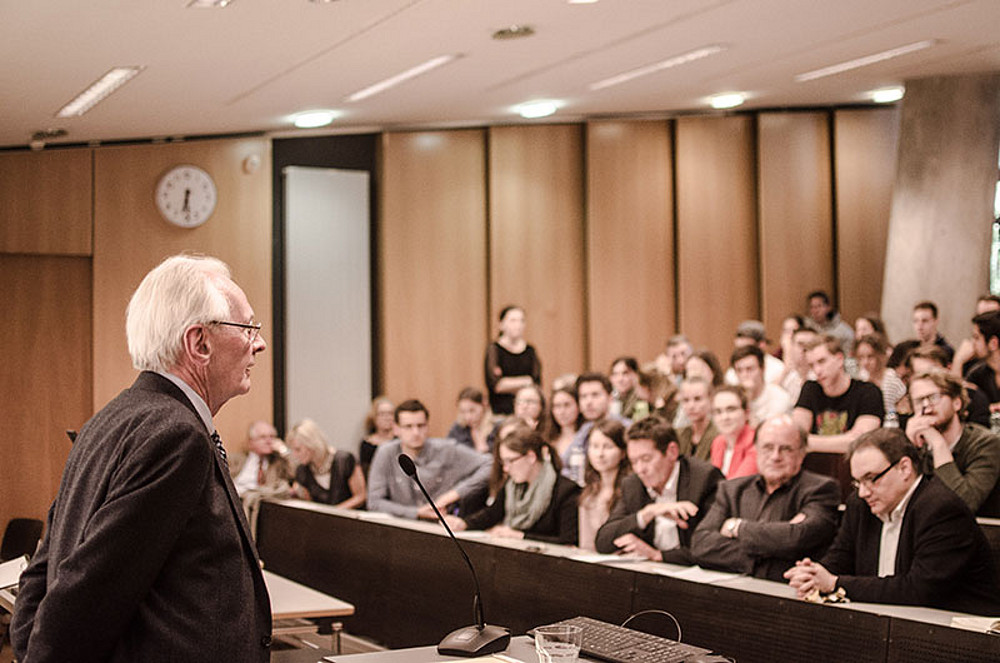
Dieter Grimm, ehemaliger Richter des Bundesverfassungsgerichts, war zu Gast bei den Graz Jurisprudence Lectures. Foto: Héctor A. Morales Zúñiga.

Dieter Grimm, ehemaliger Richter des Bundesverfassungsgerichts, war zu Gast bei den Graz Jurisprudence Lectures. Foto: Héctor A. Morales Zúñiga.

Dieter Grimm, ehemaliger Richter des Bundesverfassungsgerichts, war zu Gast bei den Graz Jurisprudence Lectures

Bereits zum zweiten Mal lud der Fachbereich Rechtsphilosophie und Rechtssoziologie der Karl-Franzens-Universität zu einer „Graz Jurisprudence Lecture“ (GJ), in deren Rahmen jährlich namhafte Persönlichkeiten der internationalen Rechtsphilosophie an die Uni Graz geholt werden. Für die GJ Lecture 2017 konnte Univ.-Prof. Dr. Matthias Klatt den renommierten Professor für öffentliches Recht und ehemaligen Richter des Bundesverfassungsgerichts Dr. Dieter Grimm gewinnen. Der emeritierte Berliner Universitätsprofessor trägt mehrere Ehrendoktorwürden und lehrt als Gastprofessor an angesehenen Universitäten wie Harvard, Yale und der New York University.


Mit seiner Forschungsarbeit zur europäischen Verfassung und zum Demokratiedefizit in der Europäischen Union trifft Dieter Grimm den Nerv der Zeit. Es mangele sowohl an der allgemeinen Akzeptanz des Projekts Europa als auch an der demokratischen Beteiligung daran, unterstrich Grimm in seinem Vortrag. Der Forscher sieht das Problem dieser Entwicklung vor allem an der Verfassungswirkung, die den europäischen Verträgen durch die langjährige Rechtsprechung des Europäischen Gerichtshofs zugesprochen wird. Im Gegensatz zu nationalen Verfassungen wurden diese Verträge nämlich nicht wie eine Verfassung geschrieben, die bloß den Rahmen für die Politik legen soll, sondern enthalten zahlreiche Einzelbestimmungen, die das politische Geschehen im Detail vorzeichnen. Die politischen Entscheidungen werden dadurch dem demokratischen Abstimmungsprozess entzogen und durch richterliche Auslegung getroffen. „Je mehr Verfassung, desto weniger Demokratie“, resümierte Grimm.


Trotz all seiner Kritik gab der Wissenschafter zu verstehen, dass er ein Verfechter des europäischen Projekts ist. „Es muss die Macht des Europäischen Gerichtshofs geschmälert und auf demokratiefreundlichere Organe, wie den Rat und das Europaparlament, übertragen werden“, legte Grimm seinen Grundgedanken dar. Er plädierte daher sogar für ein „Mehr“ an Europa, in welchem die Rahmenbedingungen für die europäische Politik wie in einer nationalen Verfassung definiert werden und das Europaparlament sowie dessen Einbettung in den Prozess der gesellschaftlichen Meinungsbildung gestärkt werden.


Die Graz Jurisprudence Lecture mit Dieter Grimm weckte großes Interesse bei den Lehrenden, Studierenden und über die rechtswissenschaftliche Fakultät hinaus. Am Ende des Abends entwickelte sich eine rege Diskussion, bei welcher nicht zuletzt auch die politische Machbarkeit des von Dieter Grimm vorgeschlagenen stärkeren Europas hinterfragt wurde. Der Professor schloss den Diskussionsabend mit dem Gedanken, dass die Aufgabe der Wissenschaft nicht darin besteht, immer nur politisch akzeptierte Lösungen vorzuschlagen. „Ihre Lösungen sollten daher auch nicht an diesem Maßstab gemessen werden“, so Grimm.

created by Lisa Sonnleitner & Gerhild Kastrun

Related news

Rector Peter Riedler: Starting the year with confidence

In 2026, we will continue to work consistently on positioning the University of Graz as a relevant player in Europe, while at the same time focusing on a modern, sustainable and climate-friendly university campus. When new digital applications are rolled out in January, we will not only create a stable and secure IT environment, but also modern working and studying conditions for future generations. Peter Rielder, Rector of the University of Graz

Uni Vibes 2026: the campus festival that transcends borders again

On 29 May 2026, it's that time again: the University of Graz celebrates, dances and vibrates. The campus will become a stage for art, science and music.

Setback: Austria's greenhouse gas emissions rise in 2025

Climate protection is currently facing an uphill battle. The United Nations have recently been unable to agree on a roadmap for phasing out fossil fuels, even though global warming continues to accelerate. Also Austria still does not have a national climate law with a clear target path for reducing emissions. This is evidently taking its toll: Austria’s greenhouse gas emissions rose again in 2025 for the first time in years, by around two and a half percent, according to calculations by researchers at the University of Graz. In addition to overly cautious climate action measures, this is due to somewhat colder winter months compared to 2024, which are driving up natural gas consumption.

Profound: Geoscientist Marko Bermanec deciphers processes of the Earth's plates

What happens deep down is very important to us above ground. Especially when hidden chemical processes between tectonic plates have serious consequences. Earth scientist Marko Bermanec investigates these processes in depth.

Begin of page section:
Additional information:

University of Graz
Universitaetsplatz 3
8010 Graz
Austria
  • Contact
  • Web Editors
  • Moodle
  • UNIGRAZonline
  • Imprint
  • Data Protection Declaration
  • Accessibility Declaration
Weatherstation
Uni Graz

End of this page section. Go to overview of page sections

End of this page section. Go to overview of page sections

Begin of page section:

End of this page section. Go to overview of page sections