
Begin of page section:
Page sections:

  • Go to contents (Accesskey 1)
  • Go to position marker (Accesskey 2)
  • Go to main navigation (Accesskey 3)
  • Go to sub navigation (Accesskey 4)
  • Go to additional information (Accesskey 5)
  • Go to page settings (user/language) (Accesskey 8)
  • Go to search (Accesskey 9)

End of this page section. Go to overview of page sections

Begin of page section:
Page settings:

English en
Deutsch de
Search
Login

End of this page section. Go to overview of page sections

Begin of page section:
Search:

Search for details about Uni Graz
Close

End of this page section. Go to overview of page sections


Search

Begin of page section:
Main navigation:

Page navigation:

  • University

    University
    • About the University
    • Organisation
    • Faculties
    • Library
    • Working at University of Graz
    • Campus
    Developing solutions for the world of tomorrow - that is our mission. Our students and our researchers take on the great challenges of society and carry the knowledge out.
  • Research Profile

    Research Profile
    • Our Expertise
    • Research Questions
    • Research Portal
    • Promoting Research
    • Research Transfer
    • Ethics in Research
    • Commission for Scientific Integrity
    Scientific excellence and the courage to break new ground. Research at the University of Graz creates the foundations for making the future worth living.
  • Studies

    Studies
    • Prospective Students
    • Students
    • Welcome Weeks for First Year Students
  • Community

    Community
    • International
    • Location
    • Research and Business
    • Alumni
    The University of Graz is a hub for international research and brings together scientists and business experts. Moreover, it fosters the exchange and cooperation in study and teaching.
Topics
  • Sustainable University
  • Researchers answer
  • Work for us
Close menu

End of this page section. Go to overview of page sections

Begin of page section:
You are here:

University of Graz News Erweiterte Realität

End of this page section. Go to overview of page sections

Monday, 27 May 2013

Erweiterte Realität

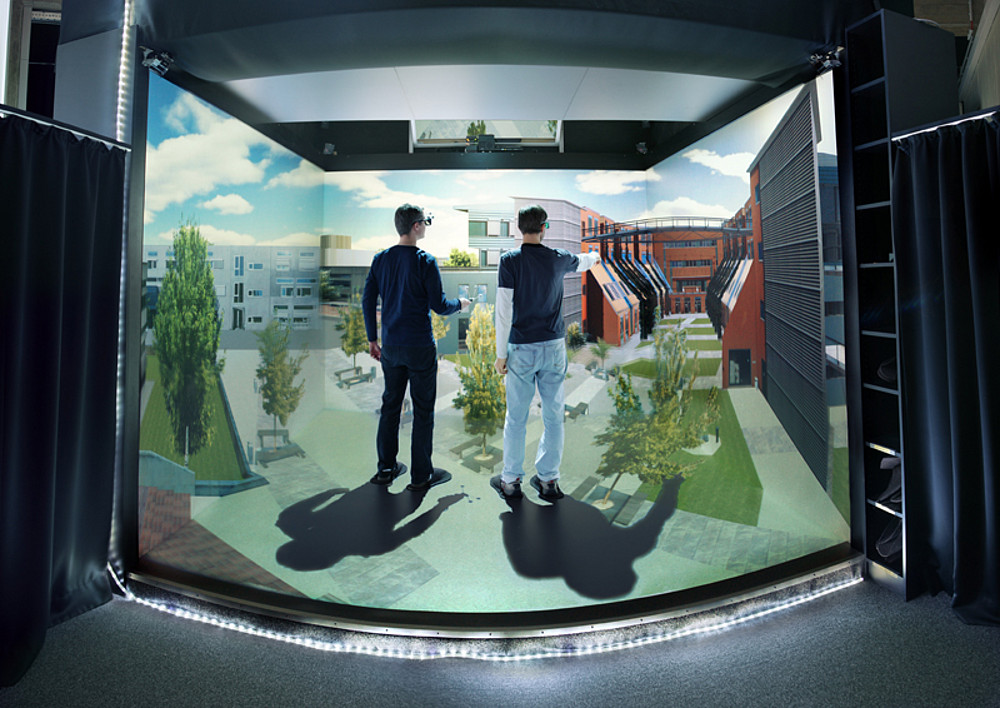
Augmented Reality - erweiterte Realität - ist bereits Teil des Alltags. Was hinter der Interaktion zwischen Mensch und Computer steht, erfahren Sie diese Woche im Webradio. Foto: Science Space Styria/Lancelle.

Augmented Reality - erweiterte Realität - ist bereits Teil des Alltags. Was hinter der Interaktion zwischen Mensch und Computer steht, erfahren Sie diese Woche im Webradio. Foto: Science Space Styria/Lancelle.

Unsere Beiträge werden mit dem kostenlosen Web-Service von <a href="https://auphonic.com">Auphonic</a> nachbearbeitet.

Unsere Beiträge werden mit dem kostenlosen Web-Service von <a href="https://auphonic.com">Auphonic</a> nachbearbeitet.

Verborgenes sichtbar machen: Das & vieles mehr in dieser Webradio-Woche

Smartphones, i-pads und Tablets sind heute so einfach und günstig zu haben wie nie zuvor. Dieser rasante Fortschritt der Technik ermöglicht gleichzeitig auch die Entwicklung von Technologien, die früher wohl noch an eine Wunder gegrenzt hätten. Unsichtbare oder verborgene Dinge können heute schon auf dem Bildschirm in Echtzeit und ganz genau dargestellt werden – „augmented reality“, also „erweiterte Realität“, heißt das Zauberwort. Wie diese Interaktion zwischen Mensch und Computer funktioniert und wo sie schon jetzt angewandt ist, verrät uns Univ.-Prof. Dr. Dieter Schmalstieg vom Institut für Maschinelles Sehen und Darstellen der TU Graz.


Sieben mal drei ergibt? 13 weniger neun ist gleich? Wenn imstande sind, solche Rechnungen fehlerfrei zu lösen, leiden Sie NICHT - wie durchschnittlich zwei Kinder pro Schulklasse in Österreich - an einer Rechenschwäche, auch "Dyskalkulie" genannt. Univ.-Prof. Dr. Karin Landerl, Leiterin des Arbeitsbereiches Entwicklungspsychologie am Institut für Psychologie der Karl-Franzens-Universität Graz, erforscht die Rechenschwäche und verrät, wie man ihr eventuell beikommen könnte.


Medizinische Forschung zu betreiben ist aufgrund von finanziellen Schwierigkeiten nicht immer leicht. Mit einem eigens gegründeten Verein zur Forschungsförderung will die Med Uni Graz hier Abhilfe schaffen. So wie auch schon vergangenes Jahr veranstaltete dieser auch heuer wieder ein Fundraising Dinner im Schloßbergrestaurant. Diesmal mit einem besonderen Rahmenprogramm des Geschichtenerzählers Folke Tegetthoff. Mit dem Webradio hat er sich über Medizin und Literatur unterhalten.


Die Diplomarbeit stellt mitunter die größte Herausforderung des gewählten Studiums dar, vor allem dann wenn man sein Thema zu Papier bringen muss. Doch auf der Kunstuniversität bekommt die Abschlussarbeit noch eine weitere Facette hinzu - die der Bühnenpräsenz. Wie so ein Diplomabschluss für das Fach Schauspiel aussehen kann schildert uns Josephine Mayer, eine Studentin kurz vor ihrem großen Tag.


Das Webradio der Grazer Universitäten liefert jeden Montag, ab 9 Uhr, vier neue Beiträge rund um das Geschehen an allen Grazer Universitäten, die auf http://webradio.uni-graz.at online zu hören sind bzw. zum Download bereit stehen.

Natürlich stehen alle Beiträge - bis zurück zum Start des Webradios als Einzelprojekt an der Uni Graz im Oktober 2009 - auch im online Archiv zum Nachhören zur Verfügung. Auch itunesU sind die Beiträge des Webradios vertreten.
 
Jeden Dienstag von 9:30 bis 10 Uhr sind die Info-Beiträge des Webradios außerdem auf Radio Helsinki 92,6 MHz im Rahmen der Sendung "Hör-Saal" auch auf analoge Weise zu hören - und natürlich über den Radio-Helsinki-Livestream: http://helsinki.at/livestream
created by Gerhild Kastrun

Related news

A fresh start, a calling, holidays: what draws people from other career paths to teaching

They used to develop software; now they teach maths in the classroom. Career changers are expected to help address the shortage of qualified teachers in Austria’s schools. In their doctoral theses at the Institute for Educational Research and Teacher Training at the University of Graz, Melanie Gürentz and Claudia Mair examined how these new teachers perceive their new professional roles.

Talent Talks bridge the gap in career guidance

The Styrian Chamber of Commerce (WKO Steiermark), the Styrian Chamber of Labour (AK Steiermark) and the AMS are joining forces when it comes to training young people and, through the “Talent Talks”, are creating a seamless pathway to career guidance. This takes preparation and follow-up support – just in time for the start of the term and the scheme’s tenth anniversary – to a whole new level. A new survey conducted by the Talent Centre among 2,687 former participants to mark the anniversary shows just how important this development is. Of the young people who received follow-up support from the Talent Report, 74.6 per cent stated that they had a good understanding of their own strengths and talents following the Talent Check. Without follow-up support, the figure was 66.5 per cent – a significant difference of 8.1 percentage points.

ERC Starting Grants: three million euros for two researchers at the University of Graz

Two researchers from the University of Graz have secured prestigious and generously funded grants from the EU. Starting Grants from the European Research Council (ERC), each worth 1.5 million euros, have been awarded to the human geographer Heide Bruckner and the social scientist Silvana Weiss.

Austria’s emissions rose in 2025: University of Graz researchers analyse the causes

The Environment Agency Austria has today published the figures for the country’s greenhouse gas emissions in 2025. While emissions fell sharply year on year from 2022 to 2024, they rose again by just under 0.7 per cent in 2025. Researchers at the University of Graz have analysed how much of this increase was due to structural changes in the economy and how much was attributable to external factors over which there is little control. “In 2025, the colder winter compared with 2024 increased emissions by 0.81 per cent, while the weak economy reduced them by 0.38 per cent. If we factor out these influences, we find an underlying increase of 0.26 per cent compared with the previous year,” reports economist Karl Steininger. “This clearly means that Austria is not on track to meet its climate targets, which require a substantial reduction in emissions by 2030.”

Begin of page section:
Additional information:

University of Graz
Universitaetsplatz 3
8010 Graz
Austria
  • Contact
  • Web Editors
  • Moodle
  • UNIGRAZonline
  • Imprint
  • Data Protection Declaration
  • Accessibility Declaration
Weatherstation
Uni Graz

End of this page section. Go to overview of page sections

End of this page section. Go to overview of page sections

Begin of page section:

End of this page section. Go to overview of page sections