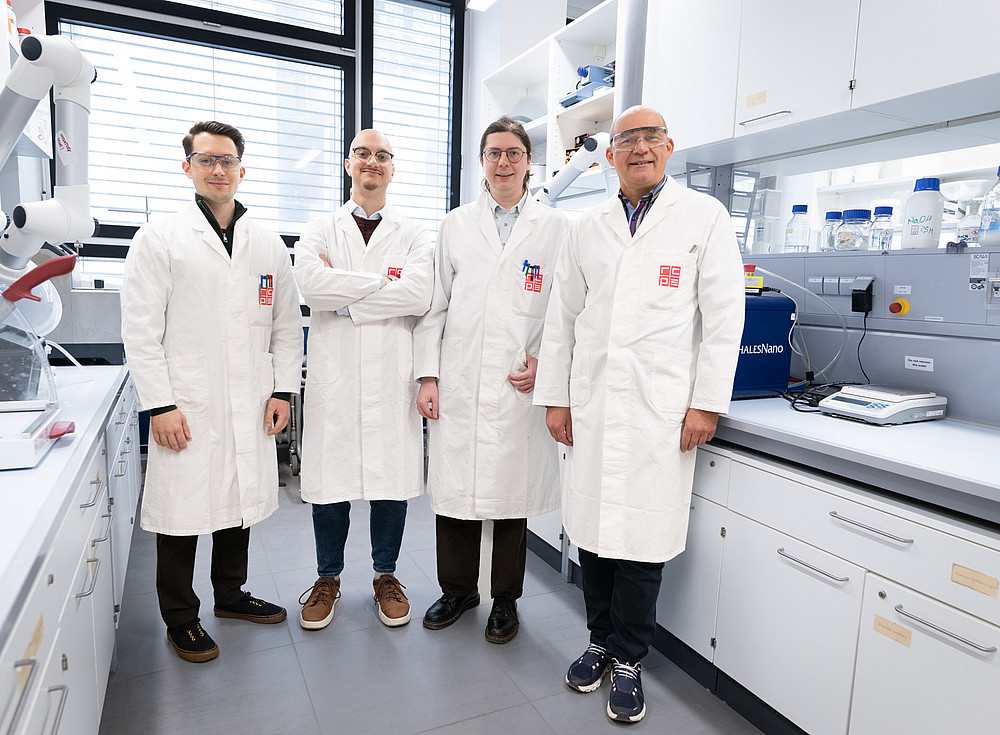
A chemistry laboratory full of delicate powders and liquids is often the starting point in the search for new medicines. This is because discovering new active ingredient molecules requires complex reaction chains involving substances that can be highly problematic. An alternative to this is electrochemistry. It uses electrons to trigger chemical reactions and thus specifically produce new molecules that could later be used in medicines.
That sounds simple, but it is very challenging, as Gabriele Laudadio explains: “It’s like a highly complex jigsaw puzzle. We have to optimise a multitude of parameters.” What are the right electrodes, and what current strength is required? The researcher at the Institute of Organic Chemistry at the University of Graz aims to solve this puzzle. “To do this, we have to carry out hundreds of trials using the trial-and-error method until we succeed.”
AI-Optimiziation
To improve this process, he is now taking a new approach together with scientists from the Research Centre for Pharmaceutical Engineering (RCPE) and Merck KGaA: combining chemistry with artificial intelligence. Using what is known as Bayesian optimisation, the series of experiments is optimised to such an extent that only 20 to 30 attempts are required. But it is not just the time spent in the laboratory that is reduced. “We also gain certainty that we have found the optimal conditions for our experiment,” explains Laudadio.
“We have been able to prove that this approach works and can actually produce molecules in this way.” Numerous further steps and test series are still required before drugs can be produced using this method. But: “This method represents a huge step forward for the development of new active ingredients,” the researcher is convinced.
This process is not only faster, but also much more environmentally friendly and safer than the previous approach. There is no hazardous waste and energy consumption is reduced. “Very soon we will have drugs in initial clinical trials that have been developed using AI systems. We are currently witnessing the beginning of a scientific revolution,” Laudadio is convinced.
Interested? You can gain an insight into the world of molecules through a Bachelor’s degree in Chemistry, Pharmaceutical Sciences or Molecular Biology.
The Paper
Electrochemical self-optimization for the synthesis of densely functionalized molecules; Eduardo Rial-Rodríguez, Florian L. Wagner, Thomas Fuchß, Alena Sommer, Johannes Krieger, Hans-Michael Eggenweiler, C. Oliver Kappe, Gabriele Laudadio. https://doi.org/10.1016/j.chempr.2026.102952