Begin of page section:
Page sections:

  • Go to contents (Accesskey 1)
  • Go to position marker (Accesskey 2)
  • Go to main navigation (Accesskey 3)
  • Go to sub navigation (Accesskey 4)
  • Go to additional information (Accesskey 5)
  • Go to page settings (user/language) (Accesskey 8)
  • Go to search (Accesskey 9)

End of this page section. Go to overview of page sections

Begin of page section:
Page settings:

English en
Deutsch de
Search
Login

End of this page section. Go to overview of page sections

Begin of page section:
Search:

Search for details about Uni Graz
Close

End of this page section. Go to overview of page sections


Search

Begin of page section:
Main navigation:

Page navigation:

  • University

    University
    • About the University
    • Organisation
    • Faculties
    • Library
    • Working at University of Graz
    • Campus
    Developing solutions for the world of tomorrow - that is our mission. Our students and our researchers take on the great challenges of society and carry the knowledge out.
  • Research Profile

    Research Profile
    • Our Expertise
    • Research Questions
    • Research Portal
    • Promoting Research
    • Research Transfer
    • Ethics in Research
    Scientific excellence and the courage to break new ground. Research at the University of Graz creates the foundations for making the future worth living.
  • Studies

    Studies
    • Prospective Students
    • Students
  • Community

    Community
    • International
    • Location
    • Research and Business
    • Alumni
    The University of Graz is a hub for international research and brings together scientists and business experts. Moreover, it fosters the exchange and cooperation in study and teaching.
  • Spotlight
Topics
  • Our digital Advent calendar
  • Sustainable University
  • Researchers answer
  • Work for us
Close menu

End of this page section. Go to overview of page sections

Begin of page section:
You are here:

University of Graz News Eine bessere Welt für Mensch und Tier

End of this page section. Go to overview of page sections

Tuesday, 23 May 2017

Eine bessere Welt für Mensch und Tier

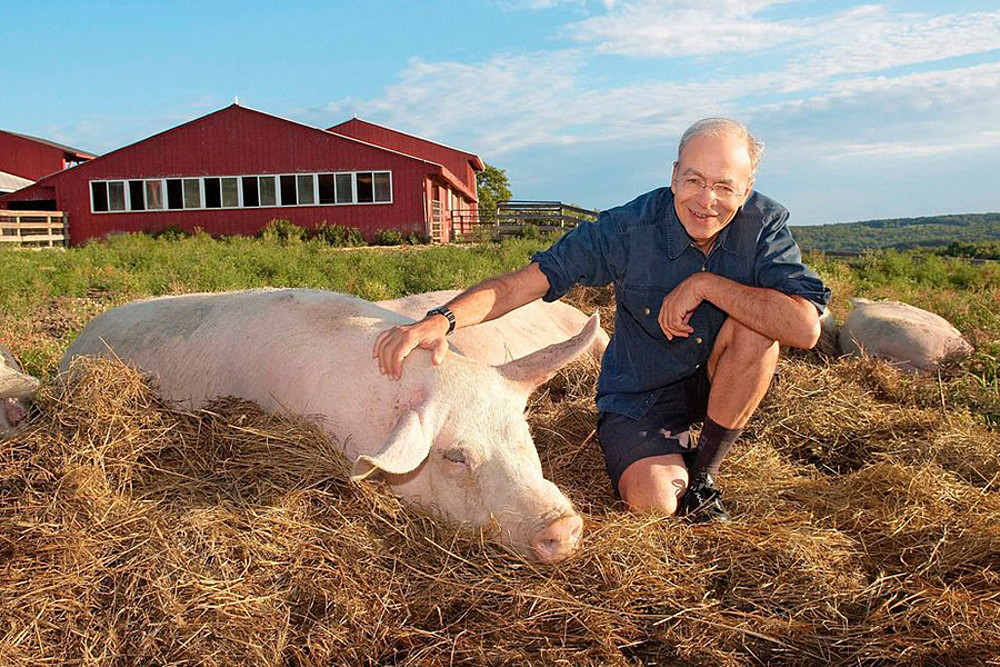
Philosoph Peter Singer hält im Rahmen des Projekts „Denkzeitraum“ einen öffentlichen Vortrag über eine „bessere Welt für Mensch und Tier“. Foto: KK

Philosoph Peter Singer hält im Rahmen des Projekts „Denkzeitraum“ einen öffentlichen Vortrag über eine „bessere Welt für Mensch und Tier“. Foto: KK

Philosoph Peter Singer am 7. Juni in Graz zu Gast

Er ist einer der meist gelesenen zeitgenössischen Philosophen, einer der führenden öffentlich wirksamen Intellektuellen, dessen Argumente kontrovers diskutiert werden. Peter Singer, der seit 1999 als Professor an der US-amerikanischen Universität Princeton lehrt, ist vor allem als Vorreiter für die Rechte der Tiere bekannt. Am 7. Juni 2017 ist der prominente Philosoph in Graz zu Gast, wo er zum Thema „Eine bessere Welt für Mensch und Tier“ einen öffentlichen Vortrag hält.
Die Veranstaltung findet – unterstützt vom FWF-Doktoratskolleg Klimawandel – im Rahmen des Projekts „Denkzeitraum“, einer Kooperation von Uni Graz und Stadt Graz, statt. Nach bereits erörterten Fragen „Wem gehört das Glück?“ oder „Wem gehört die Arbeit?“ setzen sich WissenschafterInnen, Studierende und BürgerInnen in einem breit angelegten Lernprozess heuer mit dem Thema „Wem gehört der öffentliche Raum?“ auseinander.

Lukas Meyer, Professor für Philosophie, Sprecher des Doktoratskollegs und Ko-Leiter des „Denkzeitraum“, erklärt die Verbindung zu Peter Singers Überlegungen: „Vom Standpunkt des Universums aus betrachtet, können wir erkennen, dass unsere eigenen Interessen, bloß weil sie unsere sind, nicht wichtiger sind als die Interessen von irgendjemandem sonst. Singer untersucht, wie diese Auffassung eine rationale Basis für die öffentliche Auseinandersetzung um eine bessere Welt für Mensch und Tier bilden kann.“

Zur Person
Peter Singer, dessen jüdische Eltern 1938 von Wien nach Australien auswanderten, vertritt eine moderne Form des Utilitarismus. Diese von Jeremy Bentham und John Stuart Mill begründete Aufklärungsphilosophie erörtert und entwickelt Peter Singer in seinen Büchern wie „Praktische Ethik“ und „The Point of View of the Universe“. Singer ist besonders bekannt als Autor von „Die Befreiung der Tiere“ und gilt mit Tom Regan als Begründer der Tierethik. Der Philosoph ist Befürworter der sozialen Bewegung des Effektiven Altruismus, deren Grundlagen und Anliegen er im Buch „Effektiver Altruismus. Eine Anleitung zum ethischen Leben“ erläutert.

Eine bessere Welt für Tier und Mensch.
My Life in Philosophy: The Point of View of the Universe and Its Implications for Ethics, Animal Liberation and Effective Altruism.
Vortrag in englischer Sprache von Prof. Peter Singer
WANN: Mittwoch, 7. Juni 2017, 18 Uhr
WO: Dom im Berg, Schloßbergplatz 1, 8010 Graz

Der Eintritt ist frei, eine Anmeldung ist erforderlich:
E-Mail: denkzeitraum(at)uni-graz.at
Tel.: 0316 380-2299
https://denkzeitraum.uni-graz.at

created by Andreas Schweiger

Related news

Chemical Christmas show at the University of Graz: An explosive evening at the Schauspielh

At the beginning of December, the University of Graz transformed the theater into a laboratory: as part of “Chemical Life,” teacher training students staged a chemical Christmas show for Styrian school classes—complete with ethanol rockets, nitrogen snow, and glowing effects. An evening designed to inspire interest in studying chemistry.

Train by train: Koralm railway accelerates exchange between the Universities

Lectures at the University of Klagenfurt in the morning, seminars at the University of Graz in the afternoon: Austria's longest tunnel and a journey time of around 45 minutes make it easy. The Koralm railway increases the speed of networking between the two university locations. The collaboration builds on existing cooperation - for example in the areas of teacher training, Slavic studies and as employers, the universities are well coordinated.

On the trail of the Big Bang: University of Graz receives 1.5 million euros for doctoral programmes

The Austrian Science Fund FWF has selected the Doctoral Programme in Theoretical Particle Physics at the University of Graz for funding from the Doc.funds. Six young scientists will be funded for 3.5 years. They will gain fundamentally new insights into the origins of the world.

From trans women and knee prostheses: sports science prizes awarded

Walking better with a prosthesis, successfully getting rid of excess weight, training more effectively, more fairness for trans people in sport: these were the topics addressed by the students at the University of Graz who were awarded the sports science prizes for their Master's theses on 3 December 2025.

Begin of page section:
Additional information:

University of Graz
Universitaetsplatz 3
8010 Graz
Austria
  • Contact
  • Web Editors
  • Moodle
  • UNIGRAZonline
  • Imprint
  • Data Protection Declaration
  • Accessibility Declaration
Weatherstation
Uni Graz

End of this page section. Go to overview of page sections

End of this page section. Go to overview of page sections

Begin of page section:

End of this page section. Go to overview of page sections