Begin of page section:
Page sections:

  • Go to contents (Accesskey 1)
  • Go to position marker (Accesskey 2)
  • Go to main navigation (Accesskey 3)
  • Go to sub navigation (Accesskey 4)
  • Go to additional information (Accesskey 5)
  • Go to page settings (user/language) (Accesskey 8)
  • Go to search (Accesskey 9)

End of this page section. Go to overview of page sections

Begin of page section:
Page settings:

English en
Deutsch de
Search
Login

End of this page section. Go to overview of page sections

Begin of page section:
Search:

Search for details about Uni Graz
Close

End of this page section. Go to overview of page sections


Search

Begin of page section:
Main navigation:

Page navigation:

  • University

    University
    • About the University
    • Organisation
    • Faculties
    • Library
    • Working at University of Graz
    • Campus
    Developing solutions for the world of tomorrow - that is our mission. Our students and our researchers take on the great challenges of society and carry the knowledge out.
  • Research Profile

    Research Profile
    • Our Expertise
    • Research Questions
    • Research Portal
    • Promoting Research
    • Research Transfer
    • Ethics in Research
    Scientific excellence and the courage to break new ground. Research at the University of Graz creates the foundations for making the future worth living.
  • Studies

    Studies
    • Prospective Students
    • Students
  • Community

    Community
    • International
    • Location
    • Research and Business
    • Alumni
    The University of Graz is a hub for international research and brings together scientists and business experts. Moreover, it fosters the exchange and cooperation in study and teaching.
  • Spotlight
Topics
  • Our digital Advent calendar
  • Sustainable University
  • Researchers answer
  • Work for us
Close menu

End of this page section. Go to overview of page sections

Begin of page section:
You are here:

University of Graz News Einblicke voll Energie

End of this page section. Go to overview of page sections

Monday, 03 March 2014

Einblicke voll Energie
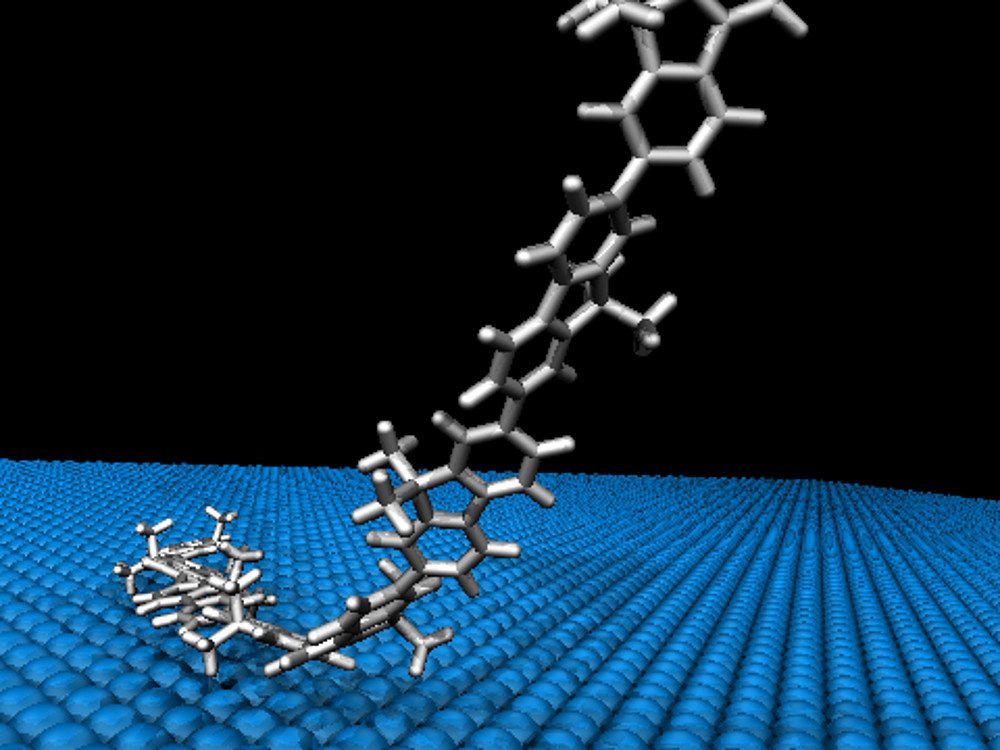
Sensationelles Experiment: ChemikerInnen der Uni Graz lösten eine Polymer-Kette von einer Oberfläche. Foto: Grill

Sensationelles Experiment: ChemikerInnen der Uni Graz lösten eine Polymer-Kette von einer Oberfläche. Foto: Grill

ChemikerInnen der Uni Graz erforschen Bewegung einzelner Moleküle

Einzigartige Einblicke erhielten ChemikerInnen der Karl-Franzens-Universität Graz in Zusammenarbeit mit KollegInnen der Universität Basel: Es gelang ihnen, die mechanische Bewegung einzelner Moleküle zu untersuchen. Diese Experimente geben Aufschluss über fundamentale chemische Eigenschaften von einzelnen Polymeren sowie der Wechselwirkung mit ihrer Umgebung. Die Resultate werden heute, am 3. März 2014, in der renommierten Fachzeitschrift PNAS publiziert. Die neuen Erkenntnisse können in Zukunft auf verschiedene chemische und biologische Systeme angewendet werden.
„Wir lösten mit der Spitze eines Rasterkraftmikroskops eine einzelne Polymerkette von einer Goldoberfläche ab. Dabei beobachteten wir verschiedene Kräfte, über die wir die Bindungsenergien des Moleküls mit der Oberfläche sowie die mechanischen Eigenschaften der Kette bestimmen konnten“, beschreibt Univ.-Prof. Dr. Leonhard Grill das Experiment. Der Chemiker leitet die Arbeitsgruppe „Single-Molecule Chemistry“ der Universität Graz. Mit seinem Team entwickelte er eigene Techniken, um solche schwierigen Experimente überhaupt durchführen zu können: Zuerst wurden Polymerketten auf einer Goldoberfläche kontrolliert zusammengebaut und anschließend mit der Spitze eines Rasterkraftmikroskops von dieser Oberfläche weggezogen. Dabei besteht die Herausforderung darin, tatsächlich nur ein einzelnes Molekül der mechanischen Überprüfung auszusetzen. Die Beobachtungen bestätigten exakt, was ein theoretisches Modell vorausgesagt hat. „Interessanterweise stellten wir auch fest, dass sich die molekularen Drähte praktisch reibungsfrei parallel zur Oberfläche bewegen, was nicht immer der Fall ist und mit ihren ganz speziellen Eigenschaften zu tun hat“, ergänzt Grill.
Die Entdeckung kann in Zukunft auf verschiedene chemische Systeme angewendet werden. „Die Idee, einzelne molekulare Ketten zu ziehen und damit mechanischen Kräften auszusetzen, ist für biologische Moleküle von großem Interesse und kann zum Beispiel wichtige Hinweise auf das Falten beziehungsweise Entfalten von Proteinen geben“, erläutert der Wissenschafter. Eine Oberfläche kann dabei als Katalysator dienen, also Reaktionen beeinflussen. An Stufen und Kanten ändern sich die Bedingungen im Vergleich zu ebenen Kristallflächen von Metallen, und es werden andere Energien benötigt, um die Prozesse in Gang zu setzen. „Katalytische Reaktionen sind essenziell für chemische Vorgänge. In künftigen Experimenten wird es interessant sein zu sehen, wie Katalysatoren oder Nanopartikel das mechanische  Verhalten von Molekülen beeinflussen“, so Grill.

Publikation:
Quantifying the atomic-level mechanics of single long physisorbed molecular chains
Shigeki Kawai, Matthias Koch, Enrico Gnecco, Ali Sadeghia, Rémy Pawlak, Thilo Glatzel, Jutta Schwarz, Stefan Goedecker, Stefan Hecht, Alexis Baratoff, Leonhard Grill and Ernst Meyer
http://www.pnas.org/content/early/2014/02/26/1319938111

created by Dagmar Eklaude

Related news

Chemical Christmas show at the University of Graz: An explosive evening at the Schauspielh

At the beginning of December, the University of Graz transformed the theater into a laboratory: as part of “Chemical Life,” teacher training students staged a chemical Christmas show for Styrian school classes—complete with ethanol rockets, nitrogen snow, and glowing effects. An evening designed to inspire interest in studying chemistry.

Train by train: Koralm railway accelerates exchange between the Universities

Lectures at the University of Klagenfurt in the morning, seminars at the University of Graz in the afternoon: Austria's longest tunnel and a journey time of around 45 minutes make it easy. The Koralm railway increases the speed of networking between the two university locations. The collaboration builds on existing cooperation - for example in the areas of teacher training, Slavic studies and as employers, the universities are well coordinated.

On the trail of the Big Bang: University of Graz receives 1.5 million euros for doctoral programmes

The Austrian Science Fund FWF has selected the Doctoral Programme in Theoretical Particle Physics at the University of Graz for funding from the Doc.funds. Six young scientists will be funded for 3.5 years. They will gain fundamentally new insights into the origins of the world.

From trans women and knee prostheses: sports science prizes awarded

Walking better with a prosthesis, successfully getting rid of excess weight, training more effectively, more fairness for trans people in sport: these were the topics addressed by the students at the University of Graz who were awarded the sports science prizes for their Master's theses on 3 December 2025.

Begin of page section:
Additional information:

University of Graz
Universitaetsplatz 3
8010 Graz
Austria
  • Contact
  • Web Editors
  • Moodle
  • UNIGRAZonline
  • Imprint
  • Data Protection Declaration
  • Accessibility Declaration
Weatherstation
Uni Graz

End of this page section. Go to overview of page sections

End of this page section. Go to overview of page sections

Begin of page section:

End of this page section. Go to overview of page sections