Begin of page section:
Page sections:

  • Go to contents (Accesskey 1)
  • Go to position marker (Accesskey 2)
  • Go to main navigation (Accesskey 3)
  • Go to sub navigation (Accesskey 4)
  • Go to additional information (Accesskey 5)
  • Go to page settings (user/language) (Accesskey 8)
  • Go to search (Accesskey 9)

End of this page section. Go to overview of page sections

Begin of page section:
Page settings:

English en
Deutsch de
Search
Login

End of this page section. Go to overview of page sections

Begin of page section:
Search:

Search for details about Uni Graz
Close

End of this page section. Go to overview of page sections


Search

Begin of page section:
Main navigation:

Page navigation:

  • University

    University
    • About the University
    • Organisation
    • Faculties
    • Library
    • Working at University of Graz
    • Campus
    Developing solutions for the world of tomorrow - that is our mission. Our students and our researchers take on the great challenges of society and carry the knowledge out.
  • Research Profile

    Research Profile
    • Our Expertise
    • Research Questions
    • Research Portal
    • Promoting Research
    • Research Transfer
    • Ethics in Research
    • Commission for Scientific Integrity
    Scientific excellence and the courage to break new ground. Research at the University of Graz creates the foundations for making the future worth living.
  • Studies

    Studies
    • Prospective Students
    • Students
  • Community

    Community
    • International
    • Location
    • Research and Business
    • Alumni
    The University of Graz is a hub for international research and brings together scientists and business experts. Moreover, it fosters the exchange and cooperation in study and teaching.
  • Spotlight
Topics
  • Sustainable University
  • Researchers answer
  • Work for us
Close menu

End of this page section. Go to overview of page sections

Begin of page section:
You are here:

University of Graz News Ein Herz für Sammlungen

End of this page section. Go to overview of page sections

Thursday, 28 April 2016

Ein Herz für Sammlungen

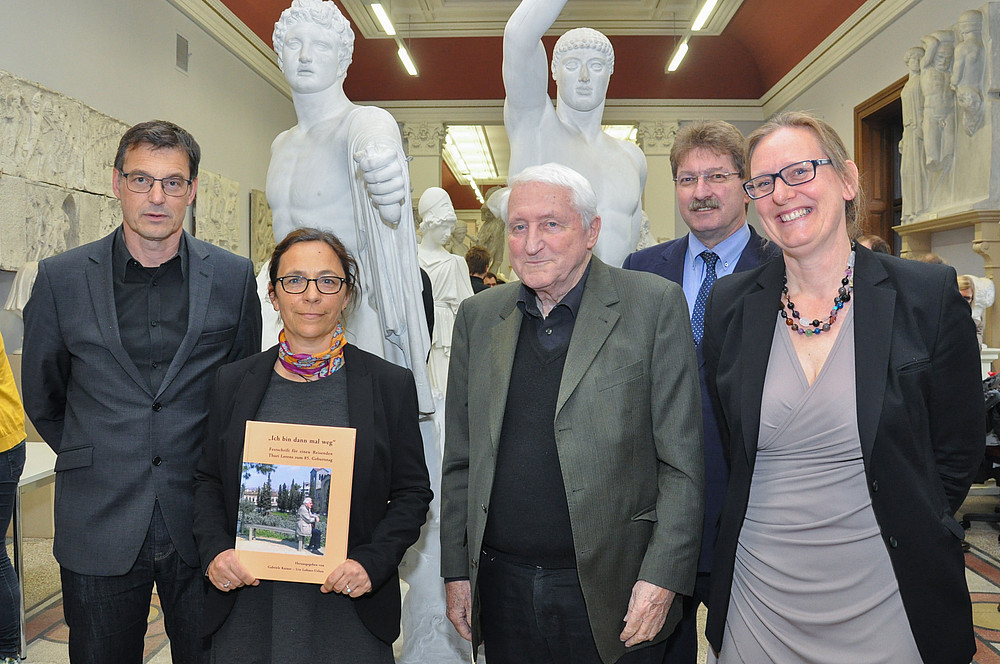
Feierten gemeinsam den Geburtstag mit einer Festschrift: Ao.Univ.-Prof. Dr. Manfred Lehner, Dr. Ute Lohner-Urban, Jubilar Thuri Lorenz, Peter Scherrer und Dr. Gabriele Koiner (v.l.) Foto: Uni Graz/Tzivanopoulos ©Uni Graz/Tzivanopoulos

Feierten gemeinsam den Geburtstag mit einer Festschrift: Ao.Univ.-Prof. Dr. Manfred Lehner, Dr. Ute Lohner-Urban, Jubilar Thuri Lorenz, Peter Scherrer und Dr. Gabriele Koiner (v.l.) Foto: Uni Graz/Tzivanopoulos

Ein Fest für Hanns-Thuri Lorenz: 85 Jahre und eine Festschrift

Kein Ort hätte besser gepasst, um den Geburtstag des Archäologen Em. Univ.-Prof. Hanns-Thuri Lorenz zu feiern, als das Gipsmuseum der Uni Graz. Lorenz, der im August 85 Jahre wird, kam 1984 an die Universität Graz und trat die Nachfolge von Erna Diez an. Bis 1999 war er Professor und übergab den Lehrstuhl im Jahre 2008 an den Vizerektor für Forschung und Nachwuchsförderung Univ.-Prof. Dr. Peter Scherrer, der das Insitut heute leitet.

Lorenz ist es zu verdanken, dass das Institut umgebaut und um mehrere Arbeitsplätze erweitert wurde. Die Neuaufstellung der Bibliothek wurde dadurch ebenso ermöglicht. Er initiierte auch die Vicus-Forschung, also die Erforschung kleiner ländlicher Siedlungen in der Römerzeit, ein neues Forschungsfeld in der Steiermark und in Österreich. Mittels FWF-Projekten und praktischen Erfahrungen (Grabungen, Datenbankerstellung) ermöglichte er jungen KollegInnen, sich auf dem neuen Forschungsgebiet der provinzialrömischen Archäologie zu profilieren, das schließlich auch in den damaligen Studienplan der Klassischen Archäologie aufgenommen wurde und heute fester Bestandteil der Lehre ist. In seiner Zeit begann auch das digitale Zeitalter, die ersten Computer, Drucker und spezifisch archäologische Software wurden angeschafft.
 
Ganz besonders lagen  Lorenz auch die Sammlungen der Originale und Gipse am Herzen, die neu aufgestellt wurden. In dieser Zeit entstand der erste Katalog der Vasensammlung. Die Sammlungen wurden auch in der Lehre eingesetzt: Teile der Originalsammlung (Lampen, Keramik) wurden in Diplomarbeiten bearbeitet; die Gipssammlung wurde in die Lehrveranstaltungen über antike Plastik einbezogen. Lorenz hat ein großes zeichnerisches Talent und eine scharfe Beobachtungsgabe, die er den Studierenden zu vermitteln versuchte ("Schauen Sie mal"). Er förderte die Studierenden und jungen Kolleginnen aber auch in selbständigem und kritischem Denken und Arbeiten ("Machen Sie mal").

Im Rahmen der Veranstaltung, bei der neben Vizerektor Peter Scherrer auch viele Fach-KollegInnen anwesend waren, wurde dem Jubilar seine persönliche Festschrift "Ich bin dann mal weg. Festschrift für einen Reisenden. Thuri Lorenz zum 85. Geburtstag." feierlich übergeben. Herausgegeben wurde er von Dr. Gabriele Koiner und Ute Lohner-Urban


created by Gabriele Koiner & Konstantinos Tzivanopoulos

Related news

Studying at the University of Graz: How to enrol

Ready for a new chapter in your life with the start of your studies at the University of Graz in the winter semester 2026/27? Here you will find information on deadlines, admission procedures, registration, and everything else you need to successfully start your studies in the fall.

Interpreting data: Why studies sometimes get it wrong

Hilmar Brohmer and Ziva Korda from the Institute of Psychology, together with 500 international colleagues, have re-evaluated a hundred scientific publications and have often come to different conclusions.

Crystal-clear: AI method revolutionises solar observation

The Sun makes life on Earth possible. However, its magnetic fields can also cause massive disruption. This makes it all the more important to gain a better understanding of the processes taking place on our nearest star. A research team from the University of Graz and the High Altitude Observatory in Boulder (USA) has succeeded in doing just that. The astrophysicists have developed an AI-supported method that makes even the smallest structures on the Sun visible. The scientists are convinced that this will bring about a lasting change in solar observation and that the new method can be used for the planned European Solar Telescope.

Long Night of Research: How many languages are there in the world?

From a linguistic perspective, there are worlds of difference between Bern, Berlin and Vienna. A dialect impersonator will demonstrate live just how varied German can sound. How many languages are there in the world? What are their distinctive features? Which of these are spoken in Austria? These and other questions will be answered during the Long Night of Research at the University of Graz: on Friday, 24 April 2025, from 5 pm to 11 pm, in the University Library. Visitors can immerse themselves in the diversity of languages without travelling far by taking part in a quiz at the station.

Begin of page section:
Additional information:

University of Graz
Universitaetsplatz 3
8010 Graz
Austria
  • Contact
  • Web Editors
  • Moodle
  • UNIGRAZonline
  • Imprint
  • Data Protection Declaration
  • Accessibility Declaration
Weatherstation
Uni Graz

End of this page section. Go to overview of page sections

End of this page section. Go to overview of page sections

Begin of page section:

End of this page section. Go to overview of page sections