Begin of page section:
Page sections:

  • Go to contents (Accesskey 1)
  • Go to position marker (Accesskey 2)
  • Go to main navigation (Accesskey 3)
  • Go to sub navigation (Accesskey 4)
  • Go to additional information (Accesskey 5)
  • Go to page settings (user/language) (Accesskey 8)
  • Go to search (Accesskey 9)

End of this page section. Go to overview of page sections

Begin of page section:
Page settings:

English en
Deutsch de
Search
Login

End of this page section. Go to overview of page sections

Begin of page section:
Search:

Search for details about Uni Graz
Close

End of this page section. Go to overview of page sections


Search

Begin of page section:
Main navigation:

Page navigation:

  • University

    University
    • About the University
    • Organisation
    • Faculties
    • Library
    • Working at University of Graz
    • Campus
    Developing solutions for the world of tomorrow - that is our mission. Our students and our researchers take on the great challenges of society and carry the knowledge out.
  • Research Profile

    Research Profile
    • Our Expertise
    • Research Questions
    • Research Portal
    • Promoting Research
    • Research Transfer
    • Ethics in Research
    • Commission for Scientific Integrity
    Scientific excellence and the courage to break new ground. Research at the University of Graz creates the foundations for making the future worth living.
  • Studies

    Studies
    • Prospective Students
    • Students
  • Community

    Community
    • International
    • Location
    • Research and Business
    • Alumni
    The University of Graz is a hub for international research and brings together scientists and business experts. Moreover, it fosters the exchange and cooperation in study and teaching.
  • Spotlight
Topics
  • Sustainable University
  • Researchers answer
  • Work for us
Close menu

End of this page section. Go to overview of page sections

Begin of page section:
You are here:

University of Graz News Digital detectives

End of this page section. Go to overview of page sections

Tuesday, 18 August 2020

Digital detectives

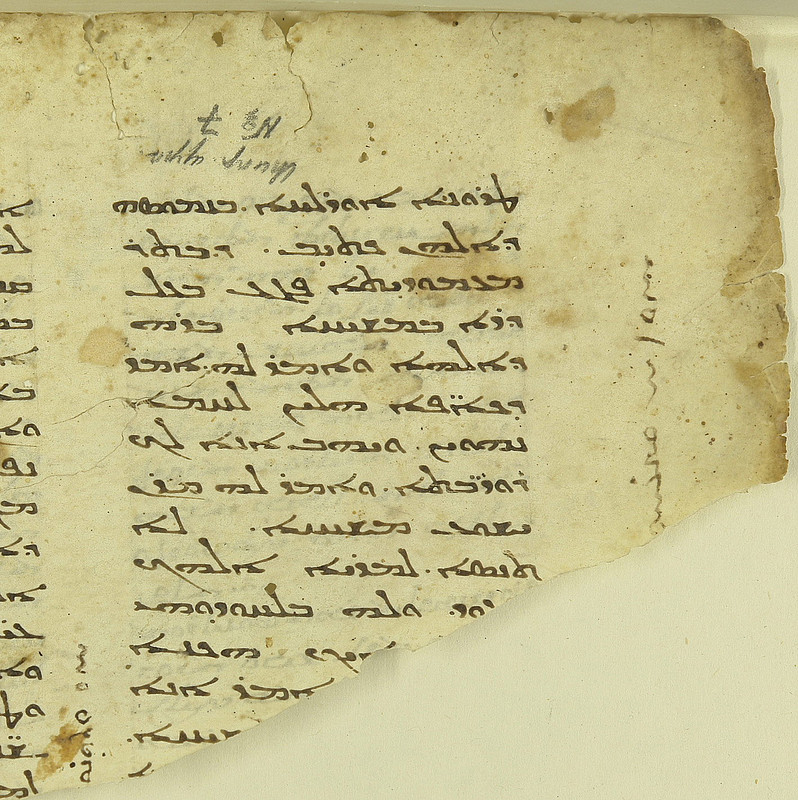
This fragment of a Syriac manuscript – previously presumed lost – was found by researchers of the University of Graz in Yerevan, Armenia. Photo: Matenadaran (Yerevan) / University of Graz, VESTIGIA

This fragment of a Syriac manuscript – previously presumed lost – was found by researchers of the University of Graz in Yerevan, Armenia. Photo: Matenadaran (Yerevan) / University of Graz, VESTIGIA

Graz researchers reunite fragment with manuscript after 1000 years

It is not often that researchers manage to attribute a fragment of manuscript – previously presumed lost – to a specific codex. Thanks to the latest digitisation techniques, University of Graz researchers Ephrem Aboud Ishac and Erich Renhart were able to match the upper half of a parchment sheet which is now in the Mesrop Mashtots Institute of Ancient Manuscripts in Yerevan, Armenia, to a Syriac manuscript from the 5th or 6th century, which is held at the British Library in London.

Ishac and Renhart are manuscript specialists at the VESTIGIA Manuscript Research Centre of the University of Graz, whose research is based on technology they have developed: their patented, mobile digitising table enables the researchers to scan valuable documents, no matter where they are, for instance in any monastic library anywhere in the world, without impact on the objects themselves, and with no need for the cultural asset to be removed from its location.
“Successes like this are unthinkable without the digitisation of repositories all over the world. Open access policies and rapid advances in the digital humanities enable researchers to work and network even in these times of travel restrictions, and to unearth some age-old treasures,” explains Prof. Erich Renhart, the head of VESTIGIA in Graz. The research centre is a significant contributor to the preservation of written cultural heritage, dedicated to the academic study and recording of documents and to making them accessible to a broad international public.

The pages of the London manuscript have already been digitised and are accessible online. Amongst other things the manuscript text includes the story of the martyrdom of Saint Alexander and Saint Theodolus. The Yerevan fragment is undoubtedly a section of the Passio Alexandri, and the only Syriac source for this text. The researchers believe the Yerevan fragment was separated from its codex a very long time ago. The manuscript originated in what is now northern Iraq, and was taken, probably in the 10th century, from the northern part of Mesopotamia to Deir el Surian, a Syrian monastery in the Egyptian desert. From there the manuscript made its way to London. The fragment is believed to have been removed before the manuscript made this long journey, and was then taken, most likely with other documents, to Armenia. Ephrem Aboud Ishac is particularly happy about this find: “Not only has a tiny piece of a puzzle fallen into place but this also enables us to document how cultural objects have been covering great distances for many centuries, and to reunite, at least on a virtual level, evidence of a culture that has also been scattered to the winds.”

>> VESTIGIA

created by Konstantin Tzivanopoulos

Related news

Studying at the University of Graz: How to enrol

Ready for a new chapter in your life with the start of your studies at the University of Graz in the winter semester 2026/27? Here you will find information on deadlines, admission procedures, registration, and everything else you need to successfully start your studies in the fall.

Interpreting data: Why studies sometimes get it wrong

Hilmar Brohmer and Ziva Korda from the Institute of Psychology, together with 500 international colleagues, have re-evaluated a hundred scientific publications and have often come to different conclusions.

Crystal-clear: AI method revolutionises solar observation

The Sun makes life on Earth possible. However, its magnetic fields can also cause massive disruption. This makes it all the more important to gain a better understanding of the processes taking place on our nearest star. A research team from the University of Graz and the High Altitude Observatory in Boulder (USA) has succeeded in doing just that. The astrophysicists have developed an AI-supported method that makes even the smallest structures on the Sun visible. The scientists are convinced that this will bring about a lasting change in solar observation and that the new method can be used for the planned European Solar Telescope.

Long Night of Research: How many languages are there in the world?

From a linguistic perspective, there are worlds of difference between Bern, Berlin and Vienna. A dialect impersonator will demonstrate live just how varied German can sound. How many languages are there in the world? What are their distinctive features? Which of these are spoken in Austria? These and other questions will be answered during the Long Night of Research at the University of Graz: on Friday, 24 April 2025, from 5 pm to 11 pm, in the University Library. Visitors can immerse themselves in the diversity of languages without travelling far by taking part in a quiz at the station.

Begin of page section:
Additional information:

University of Graz
Universitaetsplatz 3
8010 Graz
Austria
  • Contact
  • Web Editors
  • Moodle
  • UNIGRAZonline
  • Imprint
  • Data Protection Declaration
  • Accessibility Declaration
Weatherstation
Uni Graz

End of this page section. Go to overview of page sections

End of this page section. Go to overview of page sections

Begin of page section:

End of this page section. Go to overview of page sections