Begin of page section:
Page sections:

  • Go to contents (Accesskey 1)
  • Go to position marker (Accesskey 2)
  • Go to main navigation (Accesskey 3)
  • Go to sub navigation (Accesskey 4)
  • Go to additional information (Accesskey 5)
  • Go to page settings (user/language) (Accesskey 8)
  • Go to search (Accesskey 9)

End of this page section. Go to overview of page sections

Begin of page section:
Page settings:

English en
Deutsch de
Search
Login

End of this page section. Go to overview of page sections

Begin of page section:
Search:

Search for details about Uni Graz
Close

End of this page section. Go to overview of page sections


Search

Begin of page section:
Main navigation:

Page navigation:

  • University

    University
    • About the University
    • Organisation
    • Faculties
    • Library
    • Working at University of Graz
    • Campus
    Developing solutions for the world of tomorrow - that is our mission. Our students and our researchers take on the great challenges of society and carry the knowledge out.
  • Research Profile

    Research Profile
    • Our Expertise
    • Research Questions
    • Research Portal
    • Promoting Research
    • Research Transfer
    • Ethics in Research
    Scientific excellence and the courage to break new ground. Research at the University of Graz creates the foundations for making the future worth living.
  • Studies

    Studies
    • Prospective Students
    • Students
  • Community

    Community
    • International
    • Location
    • Research and Business
    • Alumni
    The University of Graz is a hub for international research and brings together scientists and business experts. Moreover, it fosters the exchange and cooperation in study and teaching.
  • Spotlight
Topics
  • Our digital Advent calendar
  • Sustainable University
  • Researchers answer
  • Work for us
Close menu

End of this page section. Go to overview of page sections

Begin of page section:
You are here:

University of Graz News Diese Woche im Webradio

End of this page section. Go to overview of page sections

Tuesday, 18 October 2016

Diese Woche im Webradio

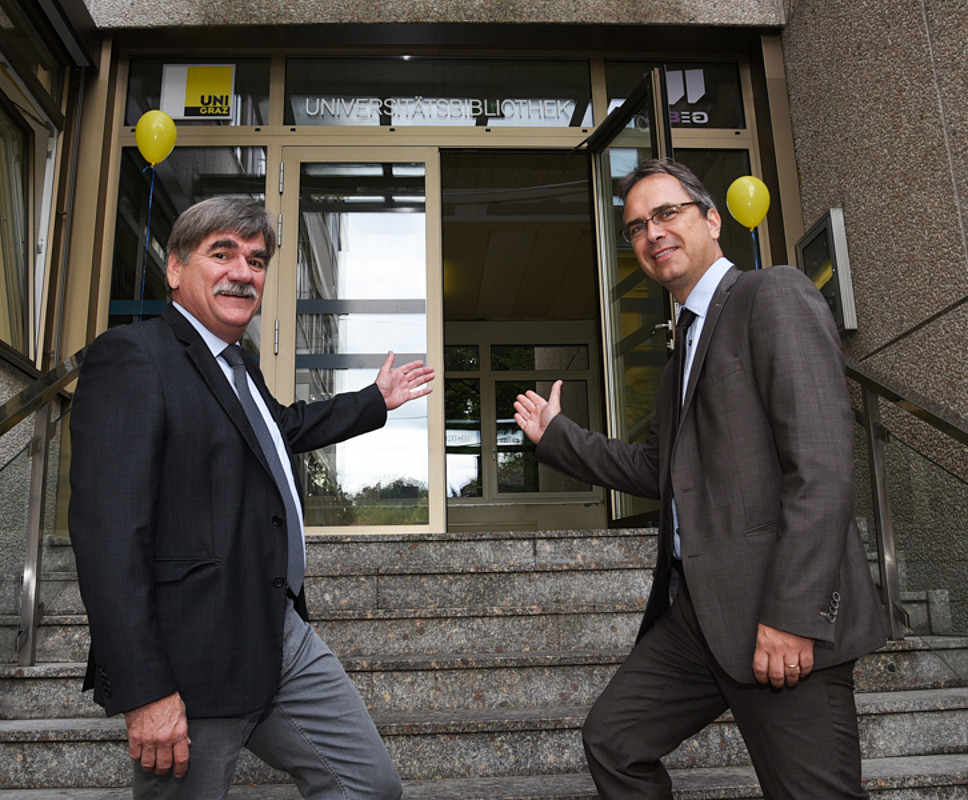
Vizerektor Peter Riedler (r.) und UB-Leiter Werner Schlacher eröffneten im September den Standort in der Beethovenstraße 8. Das Webradio hat sich dort umgesehen. Foto: Uni Graz/Tzivanopoulos.

Vizerektor Peter Riedler (r.) und UB-Leiter Werner Schlacher eröffneten im September den Standort in der Beethovenstraße 8. Das Webradio hat sich dort umgesehen. Foto: Uni Graz/Tzivanopoulos.

Uni Graz-Beitrag gibt Einblicke in das UB-Ersatzquartier in der Beethovenstraße 8

Das Webradio der Grazer Universitäten versorgt Studierende, MitarbeiterInnen, Lehrende, Forschende, Alumni sowie alle Interessierten wöchentlich mit vier Informationsbeiträgen. Diese Woche mit folgenden Beiträgen:


1) Forschung: "DNA-Detektive". Krebstherapien sollen in Zukunft durch einfache Blutanalysen optimiert werden. Am Institut für Humangenetik der Med Uni Graz haben ForscherInnen eine neue Prognosemethode entwickelt, die voraussagen soll, wie aktiv ein Tumor ist. Dadurch kann die Behandlung an mögliche Mutationen des Tumors angepasst werden.
 

2) Bildung: "Dirigent, Forscher und neuer Senatsvorsitzender: Wolfgang Hattinger". Mit Wolfgang Hattinger übernimmt im heurigen Studienjahr ein begeisterter Universitätsprofessor, Forscher und Dirigent den Senatsvorsitz an der KUG. Er berichtet von seinen Aufgaben im Senat, seiner Leidenschaft fürs Unterrichten und wie bei all dem noch Zeit fürs Dirigieren bleibt.

 
3) Campusleben: "Hereinspaziert! Ein Blick ins neue UB-Quartier". Seit 19. September müssen Studierende in die Beethovenstraße 8, um die Services der Hauptbibliothek nutzen zu können, denn am Gelände der alten UB sind die Vorbereitungen für den großen Umbau schon voll im Gange. Das Webradio verrät in einem Rundgang durch das Gebäude alles Wissenswerte über den neuen Standort.
 

4) Aktuell gefragt: "Zum Jubiläum: Wie war Nikola Tesla als Student?". Nikola Teslas Geburtstag jährt sich heuer zum 160. Mal. Wir stöbern in den Studienakten des bekannten Erfinders und Physikers und gehen dazu ins Archiv der TU Graz. Hier hat Tesla laut Archivleiter Bernhard Reismann einen wesentlichen Teil seiner Ausbildung absolviert, seine Graz-Zeit hat den Forscher zudem sehr geprägt.

Dank der erfolgreichen Kooperation mit Radio Soundportal sind die Webradio-Beiträge dort wieder täglich einmal vormittags und einmal nachmittags zu hören.

created by Gerhild Kastrun

Related news

Setback: Austria's greenhouse gas emissions rise in 2025

Climate protection is currently facing an uphill battle. The United Nations have recently been unable to agree on a roadmap for phasing out fossil fuels, even though global warming continues to accelerate. Also Austria still does not have a national climate law with a clear target path for reducing emissions. This is evidently taking its toll: Austria’s greenhouse gas emissions rose again in 2025 for the first time in years, by around two and a half percent, according to calculations by researchers at the University of Graz. In addition to overly cautious climate action measures, this is due to somewhat colder winter months compared to 2024, which are driving up natural gas consumption.

Profound: Geoscientist Marko Bermanec deciphers processes of the Earth's plates

What happens deep down is very important to us above ground. Especially when hidden chemical processes between tectonic plates have serious consequences. Earth scientist Marko Bermanec investigates these processes in depth.

Kink in the curve: Eleonore Faber researches the "fuzzy" parts of algebra

How can the movements of robotic arms be described using maths? And what does a computer need to understand in order to function? The magic word to answer these questions is algebra. Eleonore Faber has been a professor of this branch of mathematics at the University of Graz for two years. She is particularly interested in complex phenomena that cannot be fully understood using conventional rules or laws - where algebra becomes "fuzzy".

Jurist Jürgen Pirker erhält den Wissenschaftspreises der Margaretha Lupac-Stiftung

Wie kann der Staat nationale Minderheiten schützen? Wie kann er darauf achten, dass Mitglieder einer bestimmten ethnischen oder religiösen Gruppe nicht gezwungen werden, ihre persönlichen Freiheiten aufgrund dieser Zugehörigkeit aufzugeben? Und wie ging Österreich in den vergangenen 180 Jahren mit dieser Frage um?

Begin of page section:
Additional information:

University of Graz
Universitaetsplatz 3
8010 Graz
Austria
  • Contact
  • Web Editors
  • Moodle
  • UNIGRAZonline
  • Imprint
  • Data Protection Declaration
  • Accessibility Declaration
Weatherstation
Uni Graz

End of this page section. Go to overview of page sections

End of this page section. Go to overview of page sections

Begin of page section:

End of this page section. Go to overview of page sections