Begin of page section:
Page sections:

  • Go to contents (Accesskey 1)
  • Go to position marker (Accesskey 2)
  • Go to main navigation (Accesskey 3)
  • Go to sub navigation (Accesskey 4)
  • Go to additional information (Accesskey 5)
  • Go to page settings (user/language) (Accesskey 8)
  • Go to search (Accesskey 9)

End of this page section. Go to overview of page sections

Begin of page section:
Page settings:

English en
Deutsch de
Search
Login

End of this page section. Go to overview of page sections

Begin of page section:
Search:

Search for details about Uni Graz
Close

End of this page section. Go to overview of page sections


Search

Begin of page section:
Main navigation:

Page navigation:

  • University

    University
    • About the University
    • Organisation
    • Faculties
    • Library
    • Working at University of Graz
    • Campus
    Developing solutions for the world of tomorrow - that is our mission. Our students and our researchers take on the great challenges of society and carry the knowledge out.
  • Research Profile

    Research Profile
    • Our Expertise
    • Research Questions
    • Research Portal
    • Promoting Research
    • Research Transfer
    • Ethics in Research
    Scientific excellence and the courage to break new ground. Research at the University of Graz creates the foundations for making the future worth living.
  • Studies

    Studies
    • Prospective Students
    • Students
  • Community

    Community
    • International
    • Location
    • Research and Business
    • Alumni
    The University of Graz is a hub for international research and brings together scientists and business experts. Moreover, it fosters the exchange and cooperation in study and teaching.
  • Spotlight
Topics
  • Our digital Advent calendar
  • Sustainable University
  • Researchers answer
  • Work for us
Close menu

End of this page section. Go to overview of page sections

Begin of page section:
You are here:

University of Graz News It was the heat: researchers clarify the history of the Great Barrier Reef

End of this page section. Go to overview of page sections

Thursday, 05 December 2024

It was the heat: researchers clarify the history of the Great Barrier Reef

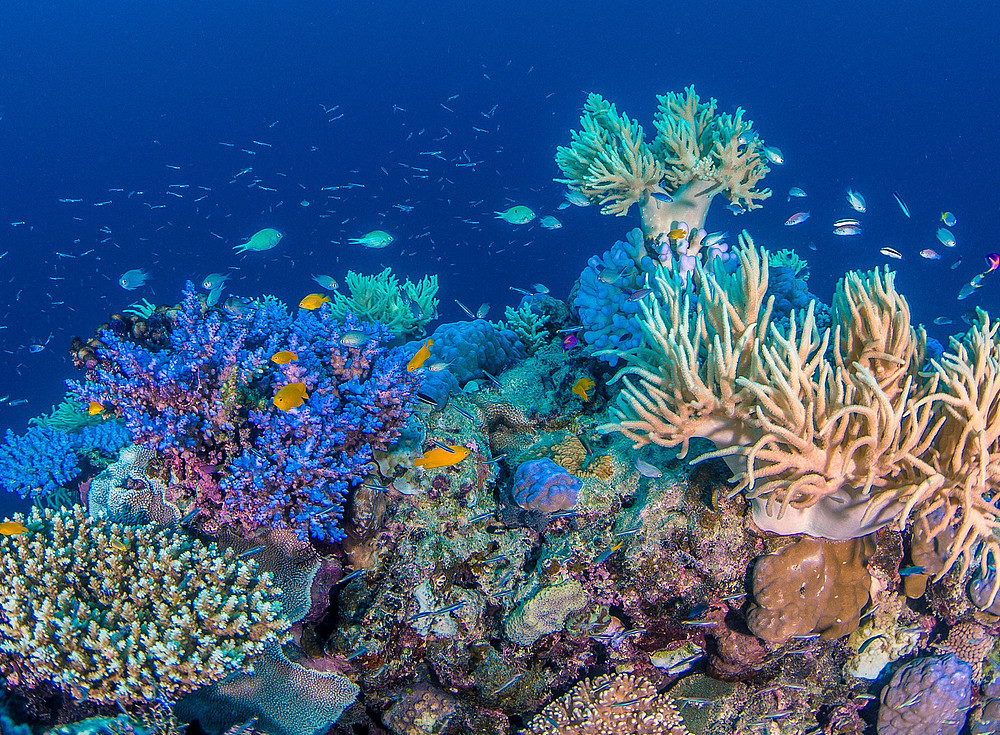
Underwater photo of the Great Barrier Reef with colourful corals and fish

The Great Barrier Reef is characterised by an extraordinary variety of colours and species. An international research team has now unravelled the history of this natural wonder. Photo: Adobe Stock/Andrea

400 coral species, 1500 different fish species and 4000 species of molluscs: This extraordinary diversity characterises the Great Barrier Reef off the coast of Australia. Researchers from the Universities of Kiel and Graz have now unravelled the story of how this natural wonder came into being: a rise in water temperature 700,000 years ago led to the spread of corals. The results of the study have just been published in the journal Science Advances.

Around 700,000 years ago, summer temperatures off the coast of Australia rose from an average of 26 to around 29 degrees Celsius and hardly fell below this level in the subsequent cold periods. "This ideal warm window favoured rapid coral growth and impressively demonstrates how sensitively a reef reacts to temperature," summarises Gerald Auer from the Department of Earth Sciences at the University of Graz. As part of an international team led by Kiel University, he examined sediment samples from the Ocean Drilling Program from a borehole in the immediate vicinity of the Great Barrier Reef. Thanks to a new method, the researchers were able to reconstruct the climatic conditions using chemical fossils from these samples. "We were also able to show that extremely stable temperatures over several millennia were necessary for the Great Barrier Reef to form in the first place," adds Auer, who carried out the age dating of the drill core data as part of the study.

However, the further warming of the sea due to man-made climate change is now the greatest threat to the cnidarians. Summer temperature peaks of over 30 degrees trigger coral bleaching and jeopardise the existence of reefs. "Many coral species will not be able to migrate away from the overheated regions, as they find it difficult to adapt to the cold and low-light winters at higher latitudes," notes the researcher.

Publication
Benjamin Petrick, Lars Reuning, Alexandra Auderset, Miriam Pfeiffer, Gerald Auer, Lorenz Schwark: High sea surface temperatures were a prerequisite for the development and expansion of the Great Barrier Reef, 2024, Science Advances 
DOI: 10.1126/sciadv.ado2058

created by Dagmar Eklaude

Related news

Chemical Christmas show at the University of Graz: An explosive evening at the Schauspielh

At the beginning of December, the University of Graz transformed the theater into a laboratory: as part of “Chemical Life,” teacher training students staged a chemical Christmas show for Styrian school classes—complete with ethanol rockets, nitrogen snow, and glowing effects. An evening designed to inspire interest in studying chemistry.

Train by train: Koralm railway accelerates exchange between the Universities

Lectures at the University of Klagenfurt in the morning, seminars at the University of Graz in the afternoon: Austria's longest tunnel and a journey time of around 45 minutes make it easy. The Koralm railway increases the speed of networking between the two university locations. The collaboration builds on existing cooperation - for example in the areas of teacher training, Slavic studies and as employers, the universities are well coordinated.

On the trail of the Big Bang: University of Graz receives 1.5 million euros for doctoral programmes

The Austrian Science Fund FWF has selected the Doctoral Programme in Theoretical Particle Physics at the University of Graz for funding from the Doc.funds. Six young scientists will be funded for 3.5 years. They will gain fundamentally new insights into the origins of the world.

From trans women and knee prostheses: sports science prizes awarded

Walking better with a prosthesis, successfully getting rid of excess weight, training more effectively, more fairness for trans people in sport: these were the topics addressed by the students at the University of Graz who were awarded the sports science prizes for their Master's theses on 3 December 2025.

Begin of page section:
Additional information:

University of Graz
Universitaetsplatz 3
8010 Graz
Austria
  • Contact
  • Web Editors
  • Moodle
  • UNIGRAZonline
  • Imprint
  • Data Protection Declaration
  • Accessibility Declaration
Weatherstation
Uni Graz

End of this page section. Go to overview of page sections

End of this page section. Go to overview of page sections

Begin of page section:

End of this page section. Go to overview of page sections