Begin of page section:
Page sections:

  • Go to contents (Accesskey 1)
  • Go to position marker (Accesskey 2)
  • Go to main navigation (Accesskey 3)
  • Go to sub navigation (Accesskey 4)
  • Go to additional information (Accesskey 5)
  • Go to page settings (user/language) (Accesskey 8)
  • Go to search (Accesskey 9)

End of this page section. Go to overview of page sections

Begin of page section:
Page settings:

English en
Deutsch de
Search
Login

End of this page section. Go to overview of page sections

Begin of page section:
Search:

Search for details about Uni Graz
Close

End of this page section. Go to overview of page sections


Search

Begin of page section:
Main navigation:

Page navigation:

  • University

    University
    • About the University
    • Organisation
    • Faculties
    • Library
    • Working at University of Graz
    • Campus
    Developing solutions for the world of tomorrow - that is our mission. Our students and our researchers take on the great challenges of society and carry the knowledge out.
  • Research Profile

    Research Profile
    • Our Expertise
    • Research Questions
    • Research Portal
    • Promoting Research
    • Research Transfer
    • Ethics in Research
    Scientific excellence and the courage to break new ground. Research at the University of Graz creates the foundations for making the future worth living.
  • Studies

    Studies
    • Prospective Students
    • Students
  • Community

    Community
    • International
    • Location
    • Research and Business
    • Alumni
    The University of Graz is a hub for international research and brings together scientists and business experts. Moreover, it fosters the exchange and cooperation in study and teaching.
  • Spotlight
Topics
  • Our digital Advent calendar
  • Sustainable University
  • Researchers answer
  • Work for us
Close menu

End of this page section. Go to overview of page sections

Begin of page section:
You are here:

University of Graz News Die Kunst des Lehrens

End of this page section. Go to overview of page sections

Wednesday, 28 June 2017

Die Kunst des Lehrens

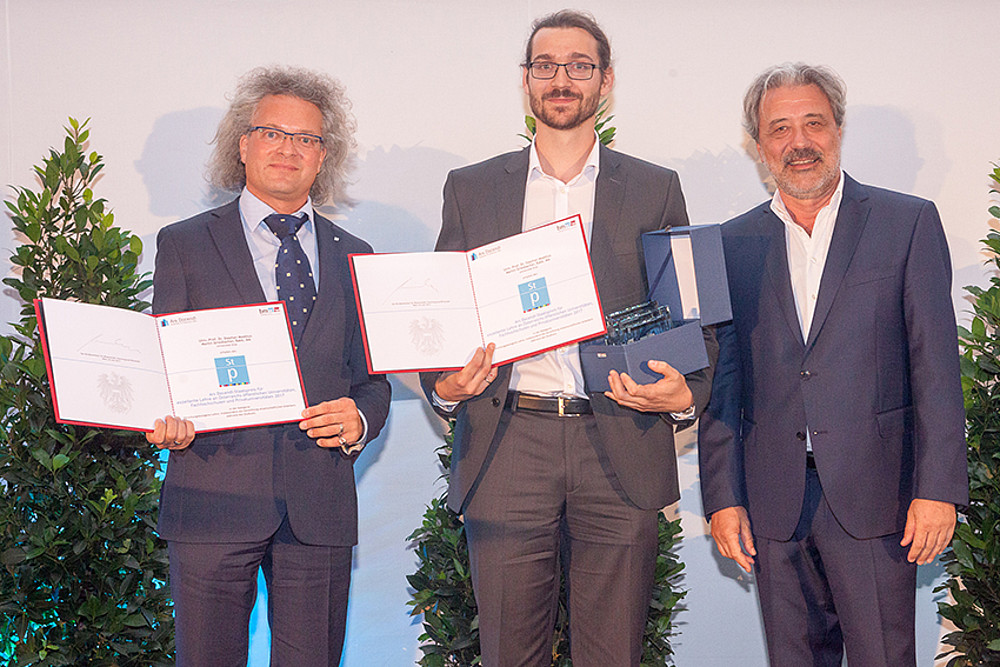
Preisträger Stephan Moebius (l.) und Martin Griesbacher (Mitte) mit Gerhard Pfeisinger, Leiter der Abteilung für Wissenschaftsvermittlung im Bundesministerium für Wissenschaft, Forschung und Wirtschaft. Foto: BMWFW/Martin Lusser.

Preisträger Stephan Moebius (l.) und Martin Griesbacher (Mitte) mit Gerhard Pfeisinger, Leiter der Abteilung für Wissenschaftsvermittlung im Bundesministerium für Wissenschaft, Forschung und Wirtschaft. Foto: BMWFW/Martin Lusser.

Ars docendi-Staatspreis für zwei Soziologen der Uni Graz

Der Ars docendi-Staatspreis für exzellente Lehre an den öffentlichen Universitäten Österreichs wurde 2013 erstmals vom Bundesministerium für Wissenschaft, Forschung und Wirtschaft vergeben und 2014 auf die Fachhochschulen und Privatuniversitäten ausgeweitet. Der Preis wird in fünf thematischen Kategorien ausgeschrieben, darunter war heuer auch die Rubrik „Forschungsbezogene Lehre, insbesondere die Vermittlung wissenschaftlichen Arbeitens während des Studiums“. In dieser wurden Univ.-Prof. Dr. Stephan Moebius und Martin Griesbacher, MA, vom Institut für Soziologie der Karl-Franzens-Universität am 26. Juni für ihre Lehrveranstaltung „Forschungspraktikum“ (Bachelor-Studium) ausgezeichnet.

Zwei Semester lang untersuchten die Soziologen gemeinsam mit den Studierenden die Virtualisierung der Gesellschaft, die sich zum Beispiel in der enormen Präsenz von Apps für fast alle Zwecke – Fitness, Selbstinszenierung oder Dating – bemerkbar macht. Das Praktikum hat am Institut für Soziologie bereits Tradition: Seit 2001 sind über 30 Berichte in Buchform entstanden, die davon zeugen, wie wichtig selbständig geführte Forschung im Feld für die Aneignung von wissenschaftlichen Kenntnissen und Fähigkeiten ist.

„Für uns war es besonders wichtig, den Studierenden auf Augenhöhe zu begegnen, weil wir alle wechselseitig voneinander lernen“, unterstreicht Stephan Moebius. Auf ein ausgewogenes Verhältnis zwischen Theorie und Empirie hätten sein Kollege Martin Griesbacher und er ebenfalls besonderen Wert gelegt. „Die Verankerung von Forschungspraktika im Lehrplan ist ganz wesentlich, weil die Studierenden in diesem Rahmen viele wertvolle Erfahrungen, zum Beispiel hinsichtlich von Selbstorganisation, sammeln können“, so Moebius. Besonders wichtig war es den beiden Wissenschaftern auch, den Studierenden die Gelegenheit zu geben, ihre eigenen Forschungsthemen zu entwickeln und die Konstruktion der Methoden sowie die Erhebung und Auswertung der Daten möglichst selbständig durchführen zu können.

Der Ars docendi-Staatspreis ist nicht die erste Auszeichnung, die Stephan Moebius für seine Lehrtätigkeit erhält. Im Studienjahr 2013/2014 nahm er der den Uni-Graz-Lehrpreis „Lehre: Ausgezeichnet!“, der damals unter dem Motto „Theorie spannend vermitteln“ stand, für sein Seminar „Soziologische Theorie I“ entgegen. Bereits 2011/2012 hatte er im Team mit Martin Griesbacher den „Lehre: Ausgezeichnet!“-Preis für das Forschungspraktikum I (Kultursoziologie des Alltags) bekommen. Auch damals war das Thema Forschungsbasierte Lehre gewesen.

created by Gerhild Kastrun

Related news

Chemical Christmas show at the University of Graz: An explosive evening at the Schauspielh

At the beginning of December, the University of Graz transformed the theater into a laboratory: as part of “Chemical Life,” teacher training students staged a chemical Christmas show for Styrian school classes—complete with ethanol rockets, nitrogen snow, and glowing effects. An evening designed to inspire interest in studying chemistry.

Train by train: Koralm railway accelerates exchange between the Universities

Lectures at the University of Klagenfurt in the morning, seminars at the University of Graz in the afternoon: Austria's longest tunnel and a journey time of around 45 minutes make it easy. The Koralm railway increases the speed of networking between the two university locations. The collaboration builds on existing cooperation - for example in the areas of teacher training, Slavic studies and as employers, the universities are well coordinated.

On the trail of the Big Bang: University of Graz receives 1.5 million euros for doctoral programmes

The Austrian Science Fund FWF has selected the Doctoral Programme in Theoretical Particle Physics at the University of Graz for funding from the Doc.funds. Six young scientists will be funded for 3.5 years. They will gain fundamentally new insights into the origins of the world.

From trans women and knee prostheses: sports science prizes awarded

Walking better with a prosthesis, successfully getting rid of excess weight, training more effectively, more fairness for trans people in sport: these were the topics addressed by the students at the University of Graz who were awarded the sports science prizes for their Master's theses on 3 December 2025.

Begin of page section:
Additional information:

University of Graz
Universitaetsplatz 3
8010 Graz
Austria
  • Contact
  • Web Editors
  • Moodle
  • UNIGRAZonline
  • Imprint
  • Data Protection Declaration
  • Accessibility Declaration
Weatherstation
Uni Graz

End of this page section. Go to overview of page sections

End of this page section. Go to overview of page sections

Begin of page section:

End of this page section. Go to overview of page sections