Begin of page section:
Page sections:

  • Go to contents (Accesskey 1)
  • Go to position marker (Accesskey 2)
  • Go to main navigation (Accesskey 3)
  • Go to sub navigation (Accesskey 4)
  • Go to additional information (Accesskey 5)
  • Go to page settings (user/language) (Accesskey 8)
  • Go to search (Accesskey 9)

End of this page section. Go to overview of page sections

Begin of page section:
Page settings:

English en
Deutsch de
Search
Login

End of this page section. Go to overview of page sections

Begin of page section:
Search:

Search for details about Uni Graz
Close

End of this page section. Go to overview of page sections


Search

Begin of page section:
Main navigation:

Page navigation:

  • University

    University
    • About the University
    • Organisation
    • Faculties
    • Library
    • Working at University of Graz
    • Campus
    Developing solutions for the world of tomorrow - that is our mission. Our students and our researchers take on the great challenges of society and carry the knowledge out.
  • Research Profile

    Research Profile
    • Our Expertise
    • Research Questions
    • Research Portal
    • Promoting Research
    • Research Transfer
    • Ethics in Research
    • Commission for Scientific Integrity
    Scientific excellence and the courage to break new ground. Research at the University of Graz creates the foundations for making the future worth living.
  • Studies

    Studies
    • Prospective Students
    • Students
    • Registration for Study Programme (Winter semester 2026/27)
    • Welcome Weeks for First Year Students
  • Community

    Community
    • International
    • Location
    • Research and Business
    • Alumni
    The University of Graz is a hub for international research and brings together scientists and business experts. Moreover, it fosters the exchange and cooperation in study and teaching.
Topics
  • Sustainable University
  • Researchers answer
  • Work for us
Close menu

End of this page section. Go to overview of page sections

Begin of page section:
You are here:

University of Graz News Der verhängnisvolle Irrtum

End of this page section. Go to overview of page sections

Thursday, 14 March 2013

Der verhängnisvolle Irrtum

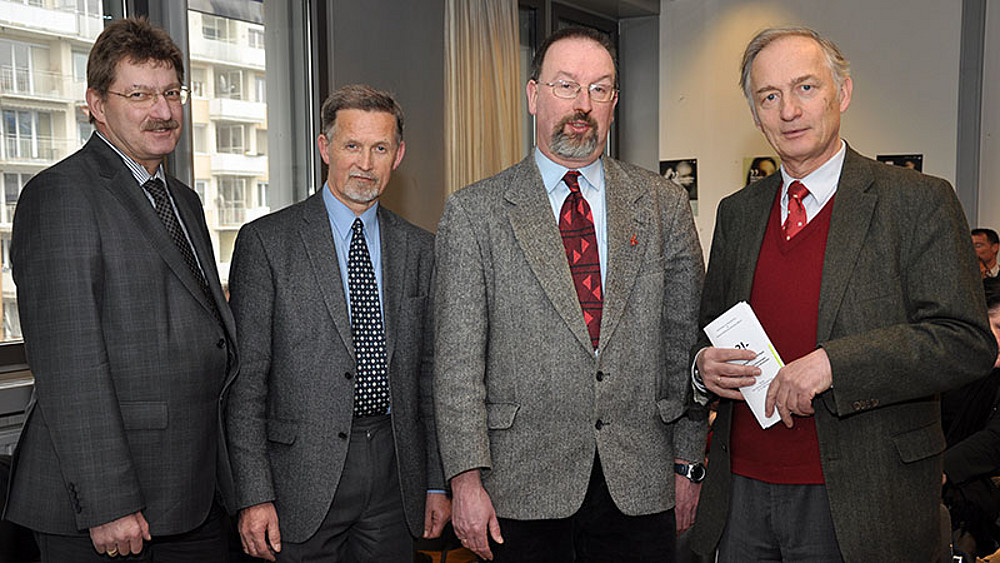
Vizerektor Peter Scherrer, Tagungs-Initiator Harald Heppner, Referent Oberstleutnant Harald Potempa aus Potsdam und Dekan Wolf Rauch (v.l.)

Vizerektor Peter Scherrer, Tagungs-Initiator Harald Heppner, Referent Oberstleutnant Harald Potempa aus Potsdam und Dekan Wolf Rauch (v.l.)

Eine Tagung des Centre for Military Studies analysiert Auswirkungen politisch-militärischer Fehler in Vergangenheit und Gegenwart

Falsche Strategien und Entscheidungen, Falschmeldungen und Fehlinterpretationen sowie personelle Fehlbesetzungen im politisch-militärischen Kontext haben im Lauf der Geschichte immer wieder weitreichende Folgen gehabt. Im Rahmen einer Tagung des Centre for Military Studies der Uni Graz analysieren WissenschafterInnen und ExpertInnen am 14. und 15. März 2013 Fallbeispiele aus Vergangenheit und Gegenwart.

Vizerektor Peter Scherrer und Dekan Wolf Rauch eröffneten die Veranstaltung im Resowi-Zentrum. "Demokratie braucht sowohl die Wissenschaft als auch die Sicherheit durch das Militär. Beide gehören zur nachhaltigen Infrastruktur einer Gesellschaft", betonte Wolf Rauch, der an der Tagung in seiner Funktion als Vorsitzender der Wissenschaftskommission des Österreichischen Bundesheeres teilnahm. Darüber hinaus brauche das Militär die Forschung und sei gleichzeitig der größte Sponsor der Wissenschaft, hob Rauch hervor.

Ao.Univ.-Prof. Dr. Dr.h.c.mult. Harald Heppner, Leiter des Instituts für Geschichte der Uni Graz und Obmann des Centre for Military Studies, führte anschließend ins Thema der Tagung ein.


Programm
Der verhängnisvolle Irrtum. Zur Analyse von Fehlleistungen in politisch-militärischen Kontexten


Donnerstag, 14. März 2013, Resowi-Zentrum, Bauteil B3


14:30-16:30 Uhr

Panel 1: Falsche Strategien

Moderation: Univ. Prof. Dr. Harald Heppner

  • Ao.Univ.-Prof. Mag. Dr. Klaus Tausend, Graz

„Gib die Legionen zurück!“ Roms militärisches Desaster in Germanien

  • Obstlt Dr. Harald Potempa, Potsdam

„Material oder Moral?“ – Die verhängnisvolle Wirkung eines (militärischen) Diskurses in Deutschland 1913-1945. Diskussion

  • MinR Mag. Dr. Friedrich Korkisch, Wien

General William Westmoreland – „Der überforderte General“ statt Strategie „Seach and Destroy“

Diskussion


17:00-19:00 Uhr

Panel 2: Falsche Nachrichten oder falsche Deutungen von Nachrichten

Moderation: HR Doz. Dr. Erwin Schmidl, Wien

  • Ass.-Prof. Mag. Dr. Johannes Gießauf, Graz

Gottes Geschenk oder doch seine Zuchtrute? Die Mongolen als Urheber von Irrtümern und enttäuschten Hoffnungen

  • Ao.Univ.-Prof. Dr. Siegfried Beer, Graz

Ist geheimdienstliches Versagen vermeidbar? Einige Fallbeispiele zur amerikanischen Erfahrung

  • Ao.Univ.-Prof. DDr. Christian Stadler, Wien

Zu Wesen und Wert der militärischen Hermeneutik


Freitag, 15. März 2013, Resowi-Zentrum, Bauteil A2


08:30-10:30  Uhr

Panel 3: Falsche Entscheidungen, falscher Zeitpunkt von Entscheidungen

Moderation: HR Doz. Dr. Wolfgang Etschmann, Wien

  • Univ.-Prof. Dr. Werner Maleczek, Wien

Der Vierte Kreuzzug (1202–1205): Ein logistisches Desaster

  • Mag. Dr. Richard Lein, Wien

Ruhe vor dem Sturm. Die Schlacht bei Zborów

  • Priv.-Doz. Dr. Wolfgang Müller, Wien

Chruschtschows Berlinkrise: Vom Verhängnis der fehlenden Exit-Strategie

Diskussion


11:00-13:00 Uhr

Panel 4: Personelle Fehlbesetzungen

Moderation: Ao.Univ. Prof. Dr. Klaus Tausend

  • Ao.Univ.-Prof. Dr. Dieter A. Binder, Graz

Conrad von Hötzendorf revisited

  • Univ.-Prof. Dr. Florian Bieber, Graz

War die Jugoslawische Volksarmee zum Scheitern verurteilt? Entscheidungen der JNA-Führung im Kontext des Ende Jugoslawiens

Diskussion
created by Gudrun Pichler

Related news

Commissioned by NATO: University of Graz tests high-tech textiles

As part of an international project, antimicrobial and fire-resistant fabrics with UV protection are being developed in Zagreb. Pharmacists from the University of Graz are ensuring that these fabrics are skin-friendly.

The Arctic up close: ORF special feature on the University of Graz’s research station in S

Students from the University of Graz are spending two weeks conducting research at the Univerisity of Graz research station at the Sermilik Fjord in Greenland, which has been operational for three years. They are measuring glacial runoff, tracking ice melt in real time and installing weather stations. ORF is following the expedition and will be reporting on the special feature ‘Arctic Adventure’ across its various channels from 20 July.

Medicine for ants: Caffeine prolongs the life of infected insects

Black coffee stimulates us and acts against bacteria. So, can caffeine also be good for insects? Yes, confirm biologists of the University of Graz. When ants suffer from a fungal disease, they consume more caffeine and remain active for longer.

How formulas are making medicine more personalised

When Federica Caforio talks about the heart, it doesn’t sound like an operating theatre, but rather like equations, parameters and simulations. Yet this is precisely where the medical promise of her research lies: one day, clinical data will be used to create a digital twin of the heart – a virtual model that will enable a better understanding of diseases and allow for more personalised treatment plans. She will be presenting her research at the ‘ECMTB 2026’ mathematics conference.

Begin of page section:
Additional information:

University of Graz
Universitaetsplatz 3
8010 Graz
Austria
  • Contact
  • Web Editors
  • Moodle
  • UNIGRAZonline
  • Imprint
  • Data Protection Declaration
  • Accessibility Declaration
Weatherstation
Uni Graz

End of this page section. Go to overview of page sections

End of this page section. Go to overview of page sections

Begin of page section:

End of this page section. Go to overview of page sections