
Begin of page section:
Page sections:

  • Go to contents (Accesskey 1)
  • Go to position marker (Accesskey 2)
  • Go to main navigation (Accesskey 3)
  • Go to sub navigation (Accesskey 4)
  • Go to additional information (Accesskey 5)
  • Go to page settings (user/language) (Accesskey 8)
  • Go to search (Accesskey 9)

End of this page section. Go to overview of page sections

Begin of page section:
Page settings:

English en
Deutsch de
Search
Login

End of this page section. Go to overview of page sections

Begin of page section:
Search:

Search for details about Uni Graz
Close

End of this page section. Go to overview of page sections


Search

Begin of page section:
Main navigation:

Page navigation:

  • University

    University
    • About the University
    • Organisation
    • Faculties
    • Library
    • Working at University of Graz
    • Campus
    Developing solutions for the world of tomorrow - that is our mission. Our students and our researchers take on the great challenges of society and carry the knowledge out.
  • Research Profile

    Research Profile
    • Our Expertise
    • Research Questions
    • Research Portal
    • Promoting Research
    • Research Transfer
    • Ethics in Research
    Scientific excellence and the courage to break new ground. Research at the University of Graz creates the foundations for making the future worth living.
  • Studies

    Studies
    • Prospective Students
    • Students
  • Community

    Community
    • International
    • Location
    • Research and Business
    • Alumni
    The University of Graz is a hub for international research and brings together scientists and business experts. Moreover, it fosters the exchange and cooperation in study and teaching.
  • Spotlight
Topics
  • Sustainable University
  • Researchers answer
  • Work for us
Close menu

End of this page section. Go to overview of page sections

Begin of page section:
You are here:

University of Graz News Der Mensch in der Begegnung mit der Medizin

End of this page section. Go to overview of page sections

Wednesday, 20 September 2017

Der Mensch in der Begegnung mit der Medizin

zwei Köpfe junger Frauen, liegend, Stirn an Stirn. Foto: Sabine Zgraggen

Das Verständnis des Menschen in der gegenwärtigen Medizin angesichts aktueller Herausforderungen ist Thema eines Symposiums am Universitätszentrum Theologie und im Franziskanerkloster Graz. Foto: Sabine Zgraggen

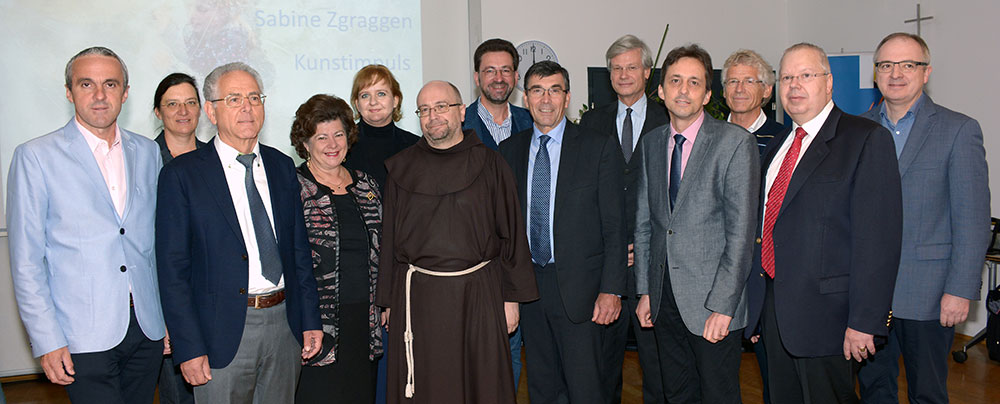
ReferentInnen und Verantwortliche. Foto: Uni Graz/Pichler ©cp-pictures

ReferentInnen und Verantwortliche – 1. Reihe v.l.: Prof. Josef Wilhelm Egger (Med Uni Graz), GR Elisabeth Potzinger, Franziskaner-Pater Paul Zahner, Prof. Walter Schaupp (Uni Graz), Dekan Reinhold Esterbauer, Prof. Wolfgang Kröll (Med Uni Graz); 2. Reihe v.l.: Univ.-Ass. Johann Platzer (Uni Graz), Verena Wetzstein (Kath. Akademie Freiburg), Fotokünstlerin und Klinikseelsorgerin Sabine Zgraggen (Zürich), Prof. Hans-Walter Ruckenbauer (Uni Graz), Prof. Matthias Beck (Uni Wien), Unfallchirurg Michael Hofmeister (Patergassen/Kärnten), Prof. Christoph Heil. Foto: Uni Graz/Pichler

Fachleute aus Wissenschaft und Praxis diskutieren über aktuelle Herausforderungen

Das Verständnis des Menschen in der gegenwärtigen Medizin angesichts aktueller Herausforderungen steht im Mittelpunkt des interdisziplinären Symposiums „Blickpunkt Mensch – Medizin – Begegnung“, das am 20. September 2017 am Universitätszentrum Theologie (UZT) der Uni Graz eröffnet wurde. „Das Besondere dieser Veranstaltung ist, dass sie die reflektierte Medizin mit der spirituellen Tradition zusammenbringt und aufzeigt, wie man gemeinsam Zukunftswege gestalten kann“, unterstrich Dekan Reinhold Esterbauer bei der Begrüßung der TeilnehmerInnen.

Der erste Tag des Symposiums widmet sich am UZT unter dem Thema „Medizin und Menschenbild“ Fragen wie etwa: Ist das „bio-psycho-soziale Modell“ seinem Anspruch gerecht geworden, die Medizin zu einer ganzheitlichen Sicht zurückzuführen? Oder: Wie viel vom Menschen ist angesichts des zunehmenden Einsatzes von Robotern im Gesundheitswesen technisch ersetzbar?

Am 21. September stehen im Franziskanerkloster Graz das franziskanische Menschenbild und Praxisorte im Fokus. Die franziskanische Tradition bemüht sich, kranke und an den Rand gedrängte Menschen ehrfurchtsvoll zu achten, ihnen liebevoll zu begegnen und durch medizinische Behandlung zu heilen. Der Studientag geht unter anderem der Frage nach, wie pflegerische Spiritualität in den Ordensspitälern heute spürbar gemacht werden kann.

Das Symposium wird von der Katholisch-Theologischen Fakultät und dem Institut für Moraltheologie der Uni Graz, der Franziskanerprovinz Austria, dem Krankenhaus der Elisabethinen Graz und der Universitätsklinik für Anästhesiologie und Intensivmedizin der Med Uni Graz veranstaltet.

>> mehr Informationen zum Symposium

created by Gudrun Pichler

Related news

AI in schools: Maria Bertel drafts legal guidelines for teachers

The legal expert and her team analysed the legal situation regarding the use of artificial intelligence in education as part of an EU project and answered open questions from practice.

Cosmetics in the environment: University of Graz proves danger to ants

Titanium dioxide, which is found in cosmetics, for example, is increasingly entering the environment in the form of nanoparticles. This could also put insects at risk. If ants ingest the substance in combination with the pesticide glyphosate, it disturbs the development of their offspring. Scientists at the University of Graz are drawing attention to the negative consequences of this toxic cocktail.

Varied and healthy: studies move

Exercise is the ideal way to balance out everyday stress, prevent illness and keep fit. Why this is the case, how to do it properly and what role human bodily functions and psychology play can be studied at the University of Graz.

Religious scholar Theresia Heimerl: Fasting as a spiritual boost

Fasting is not just a strategy for losing weight – it is a ritual dating back thousands of years with spiritual and evolutionary roots that has positive effects on the body. At the University of Graz, religious scholar Theresia Heimerl is investigating why fasting is a "spiritual boost".

Begin of page section:
Additional information:

University of Graz
Universitaetsplatz 3
8010 Graz
Austria
  • Contact
  • Web Editors
  • Moodle
  • UNIGRAZonline
  • Imprint
  • Data Protection Declaration
  • Accessibility Declaration
Weatherstation
Uni Graz

End of this page section. Go to overview of page sections

End of this page section. Go to overview of page sections

Begin of page section:

End of this page section. Go to overview of page sections