Begin of page section:
Page sections:

  • Go to contents (Accesskey 1)
  • Go to position marker (Accesskey 2)
  • Go to main navigation (Accesskey 3)
  • Go to sub navigation (Accesskey 4)
  • Go to additional information (Accesskey 5)
  • Go to page settings (user/language) (Accesskey 8)
  • Go to search (Accesskey 9)

End of this page section. Go to overview of page sections

Begin of page section:
Page settings:

English en
Deutsch de
Search
Login

End of this page section. Go to overview of page sections

Begin of page section:
Search:

Search for details about Uni Graz
Close

End of this page section. Go to overview of page sections


Search

Begin of page section:
Main navigation:

Page navigation:

  • University

    University
    • About the University
    • Organisation
    • Faculties
    • Library
    • Working at University of Graz
    • Campus
    Developing solutions for the world of tomorrow - that is our mission. Our students and our researchers take on the great challenges of society and carry the knowledge out.
  • Research Profile

    Research Profile
    • Our Expertise
    • Research Questions
    • Research Portal
    • Promoting Research
    • Research Transfer
    • Ethics in Research
    • Commission for Scientific Integrity
    Scientific excellence and the courage to break new ground. Research at the University of Graz creates the foundations for making the future worth living.
  • Studies

    Studies
    • Prospective Students
    • Students
  • Community

    Community
    • International
    • Location
    • Research and Business
    • Alumni
    The University of Graz is a hub for international research and brings together scientists and business experts. Moreover, it fosters the exchange and cooperation in study and teaching.
  • Spotlight
Topics
  • Sustainable University
  • Researchers answer
  • Work for us
Close menu

End of this page section. Go to overview of page sections

Begin of page section:
You are here:

University of Graz News Brain teasers: Almost 300 students at the Maths Mixed Doubles at the University of Graz

End of this page section. Go to overview of page sections

Wednesday, 26 February 2025

Brain teasers: Almost 300 students at the Maths Mixed Doubles at the University of Graz

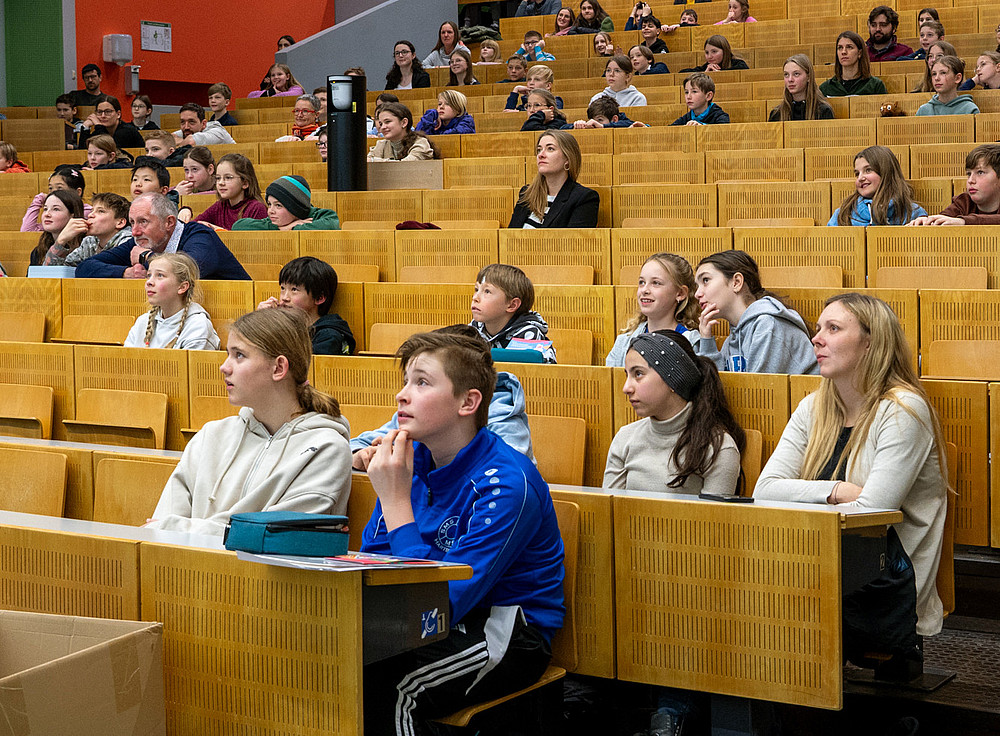
Pupils in the lecture theatre at the maths competition ©Uni Graz/Weber

Team maths fun: almost 300 students puzzled over the correct solutions in the final of the Maths Mix Double. Photo: Uni Graz/Weber

The University of Graz and the Styrian Department of Education jointly organised a maths competition for ten to twelve-year-olds. The final on 25 February 2025 for the fifth grade was won by Musikmittelschule Weiz, while MS/BG/BRG Klusemannstraße from Graz came out on top in the sixth grade.

Sporting ambition instead of fried brains: around 300 lower school pupils showed that arithmetic can be fun at the Maths Mix Doubles on 25 February. They competed in girl-boy duos in 20 tasks. The teams from Musikmittelschule Weiz and MS/BG/BRG Klusemannstraße in Graz scored the most points in their age group.

"Heidi Bergold and Michaela Kraker launched the competition as a mixed doubles event because they wanted to encourage girls to take part. Unfortunately, there is still a prevailing image that mathematics is difficult and more for boys," explains co-organiser Michael Fischer from the Department of Mathematics and Scientific Computing at the University of Graz. The fact alone that more than 2000 children from over 70 schools voluntarily took part in the preliminary round is a strong sign for him that the subject is better than its reputation. By focussing on fun and teamwork instead of performance pressure and grades, the initiators want to further increase the popularity of the subject. That's why they deliberately chose tasks outside the classroom. For example: The letters A, B, C, D and E each stand for one of the digits 1, 2, 3, 4 or 5. The following applies: A + A = B and C + C = A and C + B = D. Which digit does the letter E stand for?

Team challenge for teenagers
On 14 March, older students will have the opportunity to puzzle. They will be competing against Munich, Prague and Cambridge, among others, in the international Náboj competition for the advanced level of highschools. In 2024, locations from 14 countries took part.
"It's a very exciting event. The young people have to solve tasks very quickly in small groups and compete in real time with participants from other countries. The current ranking list is always displayed," reports Fischer, who will also be supervising this maths match at the University of Graz with his team.

created by Dagmar Eklaude

Related news

Studying at the University of Graz: How to enrol

Ready for a new chapter in your life with the start of your studies at the University of Graz in the winter semester 2026/27? Here you will find information on deadlines, admission procedures, registration, and everything else you need to successfully start your studies in the fall.

Interpreting data: Why studies sometimes get it wrong

Hilmar Brohmer and Ziva Korda from the Institute of Psychology, together with 500 international colleagues, have re-evaluated a hundred scientific publications and have often come to different conclusions.

Crystal-clear: AI method revolutionises solar observation

The Sun makes life on Earth possible. However, its magnetic fields can also cause massive disruption. This makes it all the more important to gain a better understanding of the processes taking place on our nearest star. A research team from the University of Graz and the High Altitude Observatory in Boulder (USA) has succeeded in doing just that. The astrophysicists have developed an AI-supported method that makes even the smallest structures on the Sun visible. The scientists are convinced that this will bring about a lasting change in solar observation and that the new method can be used for the planned European Solar Telescope.

Long Night of Research: How many languages are there in the world?

From a linguistic perspective, there are worlds of difference between Bern, Berlin and Vienna. A dialect impersonator will demonstrate live just how varied German can sound. How many languages are there in the world? What are their distinctive features? Which of these are spoken in Austria? These and other questions will be answered during the Long Night of Research at the University of Graz: on Friday, 24 April 2025, from 5 pm to 11 pm, in the University Library. Visitors can immerse themselves in the diversity of languages without travelling far by taking part in a quiz at the station.

Begin of page section:
Additional information:

University of Graz
Universitaetsplatz 3
8010 Graz
Austria
  • Contact
  • Web Editors
  • Moodle
  • UNIGRAZonline
  • Imprint
  • Data Protection Declaration
  • Accessibility Declaration
Weatherstation
Uni Graz

End of this page section. Go to overview of page sections

End of this page section. Go to overview of page sections

Begin of page section:

End of this page section. Go to overview of page sections