Begin of page section:
Page sections:

  • Go to contents (Accesskey 1)
  • Go to position marker (Accesskey 2)
  • Go to main navigation (Accesskey 3)
  • Go to sub navigation (Accesskey 4)
  • Go to additional information (Accesskey 5)
  • Go to page settings (user/language) (Accesskey 8)
  • Go to search (Accesskey 9)

End of this page section. Go to overview of page sections

Begin of page section:
Page settings:

English en
Deutsch de
Search
Login

End of this page section. Go to overview of page sections

Begin of page section:
Search:

Search for details about Uni Graz
Close

End of this page section. Go to overview of page sections


Search

Begin of page section:
Main navigation:

Page navigation:

  • University

    University
    • About the University
    • Organisation
    • Faculties
    • Library
    • Working at University of Graz
    • Campus
    Developing solutions for the world of tomorrow - that is our mission. Our students and our researchers take on the great challenges of society and carry the knowledge out.
  • Research Profile

    Research Profile
    • Our Expertise
    • Research Questions
    • Research Portal
    • Promoting Research
    • Research Transfer
    • Ethics in Research
    Scientific excellence and the courage to break new ground. Research at the University of Graz creates the foundations for making the future worth living.
  • Studies

    Studies
    • Prospective Students
    • Students
  • Community

    Community
    • International
    • Location
    • Research and Business
    • Alumni
    The University of Graz is a hub for international research and brings together scientists and business experts. Moreover, it fosters the exchange and cooperation in study and teaching.
  • Spotlight
Topics
  • Sustainable University
  • Researchers answer
  • Work for us
Close menu

End of this page section. Go to overview of page sections

Begin of page section:
You are here:

University of Graz News Den Stempel aufgedrückt

End of this page section. Go to overview of page sections

Friday, 15 December 2017

Den Stempel aufgedrückt

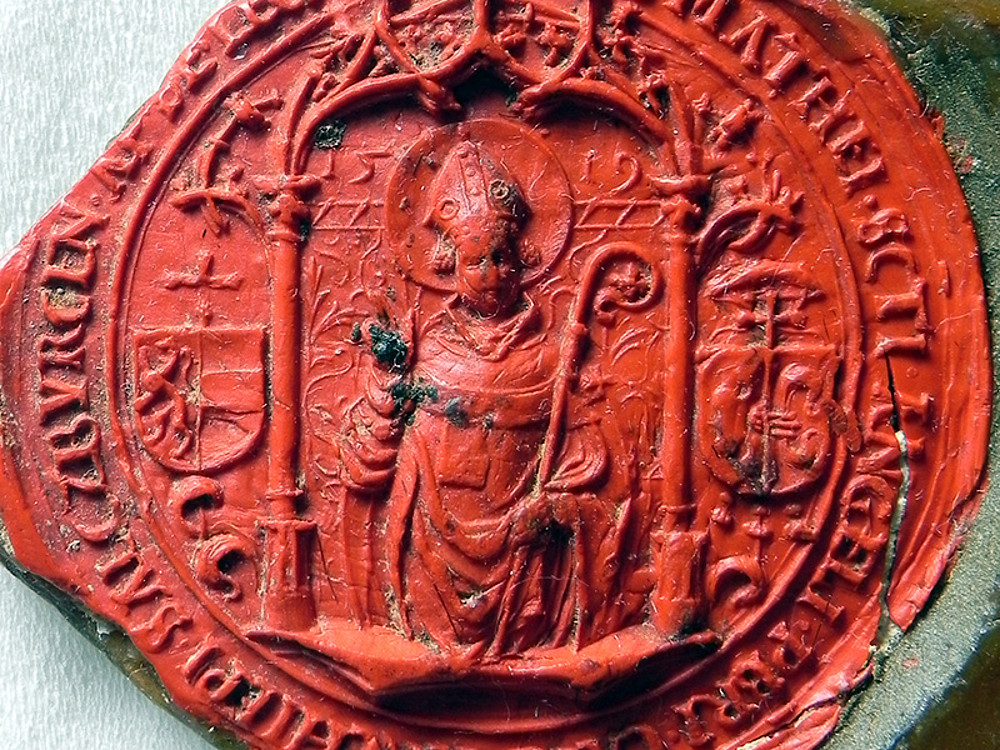
Vom ältesten Bischofssiegel bis zur Gegenwart (oben Kardinal M. Lang, 1519) sind 750 Siegel in einer neuen Datenbank dokumentiert und beschrieben. Foto: Uni Graz/Höfer

Vom ältesten Bischofssiegel bis zur Gegenwart (oben Kardinal M. Lang, 1519) sind 750 Siegel in einer neuen Datenbank dokumentiert und beschrieben. Foto: Uni Graz/Höfer

Erste umfassende Datenbank mit Bischofssiegeln ans Netz gegangen

819 Dokumente mit 750 Siegeln der Salzburger Erzbischöfe sowie der Bischöfe mehrerer Diözesen beinhaltet die umfangreiche Sammlung, die ab sofort WissenschafterInnen und Interessierten über die Webplattform GAMS zugänglich ist. Mehrere Jahre lang haben die Kirchenhistoriker Rudolf Höfer und Martin Feiner die Prägungen aufgespürt, analysiert, fotografiert und nachgezeichnet. Nun liegt erstmals eine umfassende Darstellung vor, welche die Siegel der Bischöfe von Gurk, Chiemsee, Seckau, Lavant-Marburg, Innsbruck und Feldkirch umfasst.
„Den Bischofssiegeln kommt aufgrund ihres hohen Alters und der reichen Überlieferung eine grundlegende Bedeutung zu. Das Salzburger Erzbistum nimmt wegen seiner geografischen Lage inmitten von Politik und Kunstwesen Europas eine besondere Stellung ein“, führt Höfer aus. Die Datenbank enthält alle bekannten Dokumente dieses Raums, vom ältesten erhaltenen Siegel des Salzburger Erzbischofs Friedrich I. (958–991) bis hin zu dem von Erzbischof Franz Lackner.

Mit der Online-Dokumentation, die das Zentrum für Informationsmodellierung in den Geisteswissenschaften realisierte, sind die wertvollen Prägungen auch für die Zukunft bewahrt. Für die Forschungen werden sie nach wie vor benötigt: Denn selbst heute tauchen im kirchlichen Zusammenhang immer wieder historische Versiegelungen auf, die die Echtheit und den Schutz vor einer Verfälschung des Inhalts von Reliquienkapseln gewährleisten sollten.

Details zum Forschungsprojekt finden sich auch in der UNIZEIT

created by Dagmar Eklaude

Related news

AI in schools: Maria Bertel drafts legal guidelines for teachers

The legal expert and her team analysed the legal situation regarding the use of artificial intelligence in education as part of an EU project and answered open questions from practice.

Cosmetics in the environment: University of Graz proves danger to ants

Titanium dioxide, which is found in cosmetics, for example, is increasingly entering the environment in the form of nanoparticles. This could also put insects at risk. If ants ingest the substance in combination with the pesticide glyphosate, it disturbs the development of their offspring. Scientists at the University of Graz are drawing attention to the negative consequences of this toxic cocktail.

Varied and healthy: studies move

Exercise is the ideal way to balance out everyday stress, prevent illness and keep fit. Why this is the case, how to do it properly and what role human bodily functions and psychology play can be studied at the University of Graz.

Religious scholar Theresia Heimerl: Fasting as a spiritual boost

Fasting is not just a strategy for losing weight – it is a ritual dating back thousands of years with spiritual and evolutionary roots that has positive effects on the body. At the University of Graz, religious scholar Theresia Heimerl is investigating why fasting is a "spiritual boost".

Begin of page section:
Additional information:

University of Graz
Universitaetsplatz 3
8010 Graz
Austria
  • Contact
  • Web Editors
  • Moodle
  • UNIGRAZonline
  • Imprint
  • Data Protection Declaration
  • Accessibility Declaration
Weatherstation
Uni Graz

End of this page section. Go to overview of page sections

End of this page section. Go to overview of page sections

Begin of page section:

End of this page section. Go to overview of page sections