Begin of page section:
Page sections:

  • Go to contents (Accesskey 1)
  • Go to position marker (Accesskey 2)
  • Go to main navigation (Accesskey 3)
  • Go to sub navigation (Accesskey 4)
  • Go to additional information (Accesskey 5)
  • Go to page settings (user/language) (Accesskey 8)
  • Go to search (Accesskey 9)

End of this page section. Go to overview of page sections

Begin of page section:
Page settings:

English en
Deutsch de
Search
Login

End of this page section. Go to overview of page sections

Begin of page section:
Search:

Search for details about Uni Graz
Close

End of this page section. Go to overview of page sections


Search

Begin of page section:
Main navigation:

Page navigation:

  • University

    University
    • About the University
    • Organisation
    • Faculties
    • Library
    • Working at University of Graz
    • Campus
    Developing solutions for the world of tomorrow - that is our mission. Our students and our researchers take on the great challenges of society and carry the knowledge out.
  • Research Profile

    Research Profile
    • Our Expertise
    • Research Questions
    • Research Portal
    • Promoting Research
    • Research Transfer
    • Ethics in Research
    • Commission for Scientific Integrity
    Scientific excellence and the courage to break new ground. Research at the University of Graz creates the foundations for making the future worth living.
  • Studies

    Studies
    • Prospective Students
    • Students
    • Welcome Weeks for First Year Students
  • Community

    Community
    • International
    • Location
    • Research and Business
    • Alumni
    The University of Graz is a hub for international research and brings together scientists and business experts. Moreover, it fosters the exchange and cooperation in study and teaching.
Topics
  • Sustainable University
  • Researchers answer
  • Work for us
Close menu

End of this page section. Go to overview of page sections

Begin of page section:
You are here:

University of Graz News Den Kopf wieder flott machen

End of this page section. Go to overview of page sections

Monday, 24 June 2013

Den Kopf wieder flott machen
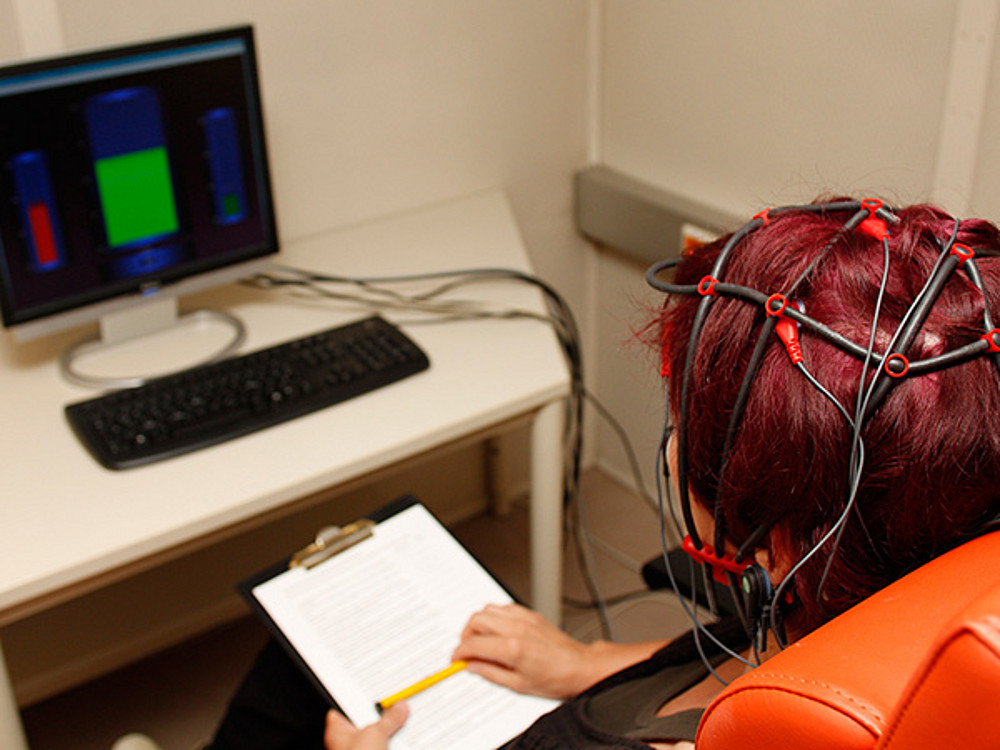
Ein einfaches Training mittels Neurofeedback hilft, die Gehirnleistung zu steigern.
Ein einfaches Training mittels Neurofeedback hilft, die Gehirnleistung zu steigern.

Uni Graz entwickelt einzigartiges Rehabilitations-Programm für Schlaganfall-PatientInnen

Ein Laptop, ein kleines Kästchen und ein Headset: Diese einfachen Utensilien sollen kognitiv beeinträchtigte Schlaganfall-PatientInnen in ein selbstbestimmtes Leben zurückbegleiten. Die Karl-Franzens-Universität Graz entwickelt im Rahmen des von der EU geförderten Projekts CONTRAST mit sieben PartnerInnen aus sechs Ländern ein weltweit einzigartiges Trainingsprogramm, das die Hirnleistung verbessert. In Krankenhäusern wurde die Methode bereits erfolgreich getestet und optimiert. Die Grazer WissenschafterInnen suchen nun StudienteilnehmerInnen in der post-akuten Phase, die das Programm zu Hause anwenden.

Alle sechs Minuten passiert in Österreich ein Schlaganfall. Die kognitive Rehabilitation, also das Training von Aufmerksamkeit, Orientierung, Problemlösung und die Verbesserung des Gedächtnisses, sind durch die Therapie im Krankenhaus oder Rehabilitationszentrum aus Kostengründen derzeit nicht ausreichend abgedeckt. „Ein kontinuierliches und möglichst heimbasiertes Training ist oft unabdingbar, damit Menschen nicht als Folge eines Schlaganfalls in ihrer Mobilität und Unabhängigkeit eingeschränkt bleiben“, weiß Assoz.Univ.-Prof. Dr. Guilherme Wood vom Institut für Psychologie, Leiter des CONTRAST-Projekts am Standort Graz. „Ohne entsprechende Übungen verbessert sich die geistige Verfassung der PatientInnen kaum oder nur sehr langsam, sodass die Betroffenen unter Umständen einen anspruchsvollen Job nicht mehr ausführen können“, erklärt der Experte.

Das an der Universität Graz entwickelte Programm basiert auf Neurofeedback. Die Testpersonen setzen sich eine einfache Elektrodenkappe auf, die mit einem kleinen Messgerät und einem Laptop verbunden ist, und starten mit wenigen Klicks das Training. Das Gerät misst eine bestimmte Frequenz der Gehirnströme, die es – je nach Störung – zu senken oder zu erhöhen gilt. Das aktuelle Messergebnis wird binnen Millisekunden am Laptop angezeigt. „Die ProbandInnen sehen einen beweglichen Balken, den sie in den angestrebten Frequenzbereich steuern sollen“, erklärt Wood. Wie das gelingt, ist individuell verschieden. „Manche entwickeln eine Strategie und denken an bestimmte Dinge, andere konzentrieren sich einfach auf den Balken und warten, dass er sich hebt oder senkt.“ Den meisten Personen gelingt es, ihre Gehirnströme zu beeinflussen und damit spezifische mentale Funktionen zu verbessern. „Bereits nach zehn Sitzungen zu je einer halben Stunde haben wir deutliche Erfolge festgestellt, selbst bei starken neurologischen Beeinträchtigungen“, so der Experte. „Die Lernprozesse werden ohne große Anstrengung in Gang gesetzt, rein durch Entspannung und Konzentration.“ Durch das unmittelbare Feedback seien die PatientInnen auch mit Begeisterung dabei.
Ziel des Projekts ist es nun, das Programm für die Anwendung zu Hause zu optimieren. Dafür sucht die Uni Graz nun dringend Schlaganfall-PatientInnen in Graz und Umgebung, die bereit sind, mit Unterstützung von ExpertInnen alle zwei bis drei Tage eine derartige Übung durchzuführen.

Bisherige Trainingsprogramme sind Computerspielen nachempfunden und oft zu schwer oder zu leicht für die PatientInnen. Die weltweit einzigartige Methode mittels Neurofeedback lässt sich den individuellen Bedürfnissen perfekt anpassen und ist darüber hinaus mit herkömmlichen Trainings kombinierbar. Die Therapie ist von den Betroffenen selbst einfach anzuwenden und damit eine kostengünstige und enorm wichtige Ergänzung im Spektrum der kognitiven Rehabilitationsmöglichkeiten.

Das Projekt CONTRAST ist in den Forschungsschwerpunkt „Gehirn und Verhalten“ der Karl-Franzens-Universität Graz eingebunden.

created by Dagmar Eklaude

Related news

A fresh start, a calling, holidays: what draws people from other career paths to teaching

They used to develop software; now they teach maths in the classroom. Career changers are expected to help address the shortage of qualified teachers in Austria’s schools. In their doctoral theses at the Institute for Educational Research and Teacher Training at the University of Graz, Melanie Gürentz and Claudia Mair examined how these new teachers perceive their new professional roles.

Talent Talks bridge the gap in career guidance

The Styrian Chamber of Commerce (WKO Steiermark), the Styrian Chamber of Labour (AK Steiermark) and the AMS are joining forces when it comes to training young people and, through the “Talent Talks”, are creating a seamless pathway to career guidance. This takes preparation and follow-up support – just in time for the start of the term and the scheme’s tenth anniversary – to a whole new level. A new survey conducted by the Talent Centre among 2,687 former participants to mark the anniversary shows just how important this development is. Of the young people who received follow-up support from the Talent Report, 74.6 per cent stated that they had a good understanding of their own strengths and talents following the Talent Check. Without follow-up support, the figure was 66.5 per cent – a significant difference of 8.1 percentage points.

ERC Starting Grants: three million euros for two researchers at the University of Graz

Two researchers from the University of Graz have secured prestigious and generously funded grants from the EU. Starting Grants from the European Research Council (ERC), each worth 1.5 million euros, have been awarded to the human geographer Heide Bruckner and the social scientist Silvana Weiss.

Austria’s emissions rose in 2025: University of Graz researchers analyse the causes

The Environment Agency Austria has today published the figures for the country’s greenhouse gas emissions in 2025. While emissions fell sharply year on year from 2022 to 2024, they rose again by just under 0.7 per cent in 2025. Researchers at the University of Graz have analysed how much of this increase was due to structural changes in the economy and how much was attributable to external factors over which there is little control. “In 2025, the colder winter compared with 2024 increased emissions by 0.81 per cent, while the weak economy reduced them by 0.38 per cent. If we factor out these influences, we find an underlying increase of 0.26 per cent compared with the previous year,” reports economist Karl Steininger. “This clearly means that Austria is not on track to meet its climate targets, which require a substantial reduction in emissions by 2030.”

Begin of page section:
Additional information:

University of Graz
Universitaetsplatz 3
8010 Graz
Austria
  • Contact
  • Web Editors
  • Moodle
  • UNIGRAZonline
  • Imprint
  • Data Protection Declaration
  • Accessibility Declaration
Weatherstation
Uni Graz

End of this page section. Go to overview of page sections

End of this page section. Go to overview of page sections

Begin of page section:

End of this page section. Go to overview of page sections