Begin of page section:
Page sections:

  • Go to contents (Accesskey 1)
  • Go to position marker (Accesskey 2)
  • Go to main navigation (Accesskey 3)
  • Go to sub navigation (Accesskey 4)
  • Go to additional information (Accesskey 5)
  • Go to page settings (user/language) (Accesskey 8)
  • Go to search (Accesskey 9)

End of this page section. Go to overview of page sections

Begin of page section:
Page settings:

English en
Deutsch de
Search
Login

End of this page section. Go to overview of page sections

Begin of page section:
Search:

Search for details about Uni Graz
Close

End of this page section. Go to overview of page sections


Search

Begin of page section:
Main navigation:

Page navigation:

  • University

    University
    • About the University
    • Organisation
    • Faculties
    • Library
    • Working at University of Graz
    • Campus
    Developing solutions for the world of tomorrow - that is our mission. Our students and our researchers take on the great challenges of society and carry the knowledge out.
  • Research Profile

    Research Profile
    • Our Expertise
    • Research Questions
    • Research Portal
    • Promoting Research
    • Research Transfer
    • Ethics in Research
    Scientific excellence and the courage to break new ground. Research at the University of Graz creates the foundations for making the future worth living.
  • Studies

    Studies
    • Prospective Students
    • Students
  • Community

    Community
    • International
    • Location
    • Research and Business
    • Alumni
    The University of Graz is a hub for international research and brings together scientists and business experts. Moreover, it fosters the exchange and cooperation in study and teaching.
  • Spotlight
Topics
  • Our digital Advent calendar
  • Sustainable University
  • Researchers answer
  • Work for us
Close menu

End of this page section. Go to overview of page sections

Begin of page section:
You are here:

University of Graz News Countdown

End of this page section. Go to overview of page sections

Monday, 27 January 2020

Countdown

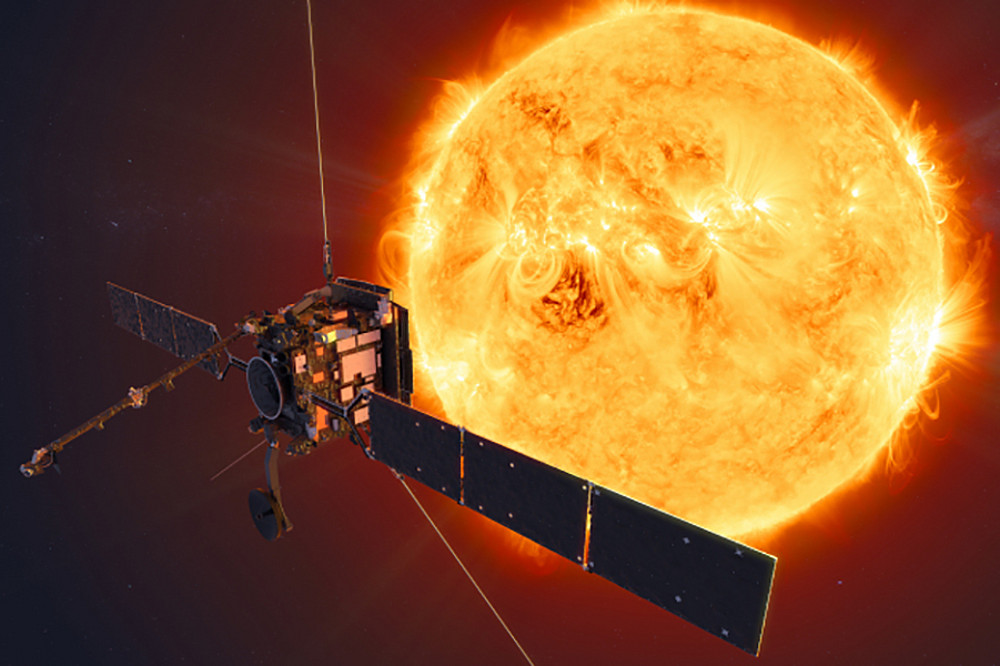
Künstlerische Darstellung der ESA-Raumsonde Solar Orbiter. Foto: © ESA/ATG medialab

Künstlerische Darstellung der ESA-Raumsonde Solar Orbiter. Foto: © ESA/ATG medialab

Am 8. Februar 2020 startet die Raumsonde Solar Orbiter ihre Reise zur Sonne

Am 8. Februar 2020, um 05:15 MEZ, wird eine Atlas-V-Trägerrakete vom amerikanischen Weltraumbahnhof Cape Canaveral in Florida abheben und die europäische Raumsonde Solar Orbiter auf ihren Weg zur Sonne bringen. Das Grazer Institut für Weltraumforschung (IWF) der Österreichischen Akademie der Wissenschaften und die Universität Graz sind an drei Messgeräten beteiligt. Das IWF lädt zur Startübertragung in der Morgendämmerung.

Solar Orbiter ist eine ESA-Mission mit amerikanischer Beteiligung, die das Wissen über unseren Mutterstern revolutionieren wird. Nach dem Start muss die Raumsonde mehrmals an Erde und Venus Schwung holen, um rund dreieinhalb Jahre später ihre operative Umlaufbahn zu erreichen: einen elliptischen Orbit, auf dem sich die Raumsonde in regelmäßigen Abständen der Sonne bis auf 42 Millionen Kilometer nähert und dann wieder bis 135 Millionen Kilometer von ihr entfernt. Während der geplanten Missionsdauer von sieben Jahren wird Solar Orbiter mehrmals an der Venus vorbeifliegen, um den Blickwinkel zu verändern. Die Anhebung der Bahnneigung von 0° auf 25° (bei Missionsverlängerung sogar 33°) ermöglicht eine bessere Sicht auf die Pole und erste Nahaufnahmen dieser Region.

Grazer Beteiligung und Einladung zur Startübertragung
Solar Orbiter hat zehn wissenschaftlichen Geräte an Bord, die sowohl In-Situ-Messungen als auch Fernerkundungen vornehmen werden. „Wir wollen in erster Linie mehr über die Heliosphäre erfahren und verstehen, wie unser Stern die riesige Plasmablase, in der unser Sonnensystem eingebettet ist, erzeugt und moduliert“, erläutert IWF-Direktor Wolfgang Baumjohann das Hauptziel von Solar Orbiter. Im Mittelpunkt der Untersuchungen stehen der Sonnenwind, das Magnetfeld der Sonne und ihre energiereichen Ausbrüche. „Flares und koronale Massenauswürfe sind die Ursache für starke Störungen des Weltraumwetters in Erdnähe,“ ergänzt Astrid Veronig vom Institut für Physik und Leiterin des Observatoriums Kanzelhöhe der Universität Graz. Sie zeichnet für die wissenschaftliche Leitung der Software-Entwicklung für das Röntgenteleskop STIX verantwortlich.

Das IWF war für die Antennenkalibrierung verantwortlich, baute den Bordcomputer für das Radiowelleninstrument RPW und ist Co-Investigator bei dem Magnetometer. Deshalb lädt das IWF FrühaufsteherInnen zur Live-Übertragung des Starts von Solar Orbiter ein. Astrid Veronig und IWF-Forscher Martin Reiss werden direkt aus Florida berichten, Kurzvorträge informieren über dieses ehrgeizige Projekt und die Sonnenforschung am IWF. Um Anmeldung bis 5. Februar 2020 wird gebeten. Die Beteiligung des IWF und der Uni Graz an Solar Orbiter wurde von der Forschungsförderungsgesellschaft (FFG) finanziert.

created by Alexandra Scherr/IWF & Gerhild Leljak

Related news

Semester abroad without barriers: University of Graz wins award for promoting inclusion

The University of Graz has been awarded the Internationalization Award for its new inclusion initiative. Students with fewer opportunities now also receive financial support for their semester abroad outside Europe.

Fair distribution: Researchers determine just greenhouse gas budgets for all EU regions

Ten years ago, on 12 December 2015, the Paris Climate Agreement was signed at the UN Climate Conference. In order to limit global warming to well below two degrees, only a certain amount of CO2 may be emitted worldwide. While the focus was originally on national emission targets, more than 200 subnational regions and almost 300 cities have now adopted their own targets. But how many emissions are they fairly entitled to? Researchers at the University of Graz have now developed transparent criteria for fair distribution at the subnational level for the first time and determined corresponding greenhouse gas budgets for all European regions. The paper was published today in the scientific journal Nature Communications.

Chemical Christmas show at the University of Graz: An explosive evening at the Schauspielh

At the beginning of December, the University of Graz transformed the theater into a laboratory: as part of “Chemical Life,” teacher training students staged a chemical Christmas show for Styrian school classes—complete with ethanol rockets, nitrogen snow, and glowing effects. An evening designed to inspire interest in studying chemistry.

Train by train: Koralm railway accelerates exchange between the Universities

Lectures at the University of Klagenfurt in the morning, seminars at the University of Graz in the afternoon: Austria's longest tunnel and a journey time of around 45 minutes make it easy. The Koralm railway increases the speed of networking between the two university locations. The collaboration builds on existing cooperation - for example in the areas of teacher training, Slavic studies and as employers, the universities are well coordinated.

Begin of page section:
Additional information:

University of Graz
Universitaetsplatz 3
8010 Graz
Austria
  • Contact
  • Web Editors
  • Moodle
  • UNIGRAZonline
  • Imprint
  • Data Protection Declaration
  • Accessibility Declaration
Weatherstation
Uni Graz

End of this page section. Go to overview of page sections

End of this page section. Go to overview of page sections

Begin of page section:

End of this page section. Go to overview of page sections