



Begin of page section:
Page sections:

  • Go to contents (Accesskey 1)
  • Go to position marker (Accesskey 2)
  • Go to main navigation (Accesskey 3)
  • Go to sub navigation (Accesskey 4)
  • Go to additional information (Accesskey 5)
  • Go to page settings (user/language) (Accesskey 8)
  • Go to search (Accesskey 9)

End of this page section. Go to overview of page sections

Begin of page section:
Page settings:

English en
Deutsch de
Search
Login

End of this page section. Go to overview of page sections

Begin of page section:
Search:

Search for details about Uni Graz
Close

End of this page section. Go to overview of page sections


Search

Begin of page section:
Main navigation:

Page navigation:

  • University

    University
    • About the University
    • Organisation
    • Faculties
    • Library
    • Working at University of Graz
    • Campus
    Developing solutions for the world of tomorrow - that is our mission. Our students and our researchers take on the great challenges of society and carry the knowledge out.
  • Research Profile

    Research Profile
    • Our Expertise
    • Research Questions
    • Research Portal
    • Promoting Research
    • Research Transfer
    • Ethics in Research
    • Commission for Scientific Integrity
    Scientific excellence and the courage to break new ground. Research at the University of Graz creates the foundations for making the future worth living.
  • Studies

    Studies
    • Prospective Students
    • Students
  • Community

    Community
    • International
    • Location
    • Research and Business
    • Alumni
    The University of Graz is a hub for international research and brings together scientists and business experts. Moreover, it fosters the exchange and cooperation in study and teaching.
  • Spotlight
Topics
  • Sustainable University
  • Researchers answer
  • Work for us
Close menu

End of this page section. Go to overview of page sections

Begin of page section:
You are here:

University of Graz News Corona Fictions

End of this page section. Go to overview of page sections

Monday, 26 April 2021

Corona Fictions

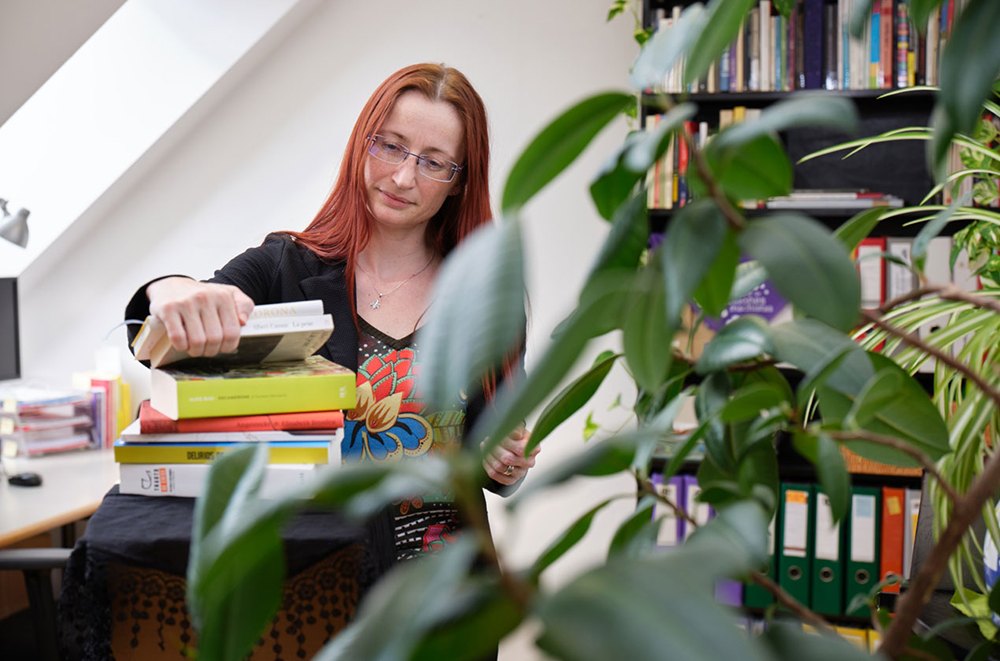
Corona Fictions als Bewältigungsstrategie? Eine Grazer Forschungsgruppe unter der Leitung von Yvonne Völkl sammelt Corona-Geschichten. Foto: Michael Rausch-Schott/FWF

Corona Fictions als Bewältigungsstrategie? Eine Grazer Forschungsgruppe unter der Leitung von Yvonne Völkl sammelt Corona-Geschichten. Foto: Michael Rausch-Schott/FWF

Literatur- und Kulturwissenschaftlerin Yvonne Völkl untersucht in einem FWF-Projekt, was ein Blick in die Literatur über die Zukunft sagt

Wie wir von Krisen erzählen, beeinflusst unser individuelles und kollektives Handeln. Literatur- und Kulturwissenschaftlerin Yvonne Völkl geht in einem neu gestarteten Grundlagenprojekt des österreichischen Wissenschaftsfonds FWF mit Unterstützung der Bevölkerung der Erzählfunktion des Coronavirus auf den Grund. Am Beispiel der Pandemie untersucht sie, wie literarische Erzählmuster das gesellschaftliche Miteinander beeinflussen und wie sich daraus sozialer Wandel ablesen lässt.

„Nous sommes en guerre“ – Frankreichs Präsident Emmanuel Macron hat dem Coronavirus in seiner TV-Ansprache zum ersten Lockdown den Krieg erklärt. Sechsmal wiederholte er das Wort vom Krieg in seiner Rede, aktivierte damit Bilder und Assoziationen in den Köpfen seiner Landsleute. In einer vernetzten Welt können sich nicht nur Viren innerhalb weniger Stunden verbreiten, auch Narrative gehen schnell viral. Sie erreichen ein Publikum über nationale Grenzen hinaus, wirken sinnstiftend und beeinflussen die Lebensrealität der Menschen.

Interpretationen dieser Corona-Erzählungen finden sich auch in kulturellen Produktionen aller Art wieder – in Romanen, Serien, Popsongs und Musikvideos. „Diese literarischen und audiovisuellen Produktionen lassen sich als ‚Corona Fictions‘ zusammenfassen“, erläutert Literatur- und Kulturwissenschaftlerin Yvonne Völkl vom Institut für Romanistik der Universität Graz. „Corona Fictions zeigen, welche Auswirkungen etwa gesundheitspolitische Maßnahmen auf die Gesellschaft haben, wie diese sie wahrnimmt und bewertet.“

„Wir möchten wissen, welche Themen besonders dominant sind: Ist es die Angst vor dem Erkranken oder vor dem Sterben, sind es die Auswirkungen der Isolation oder die Schwierigkeiten mit Betreuungspflichten, ist es häusliche Gewalt?“, sagt Völkl. Eine weitere Forschungsfrage beschäftigt sich mit den Gemeinsamkeiten zu früheren „Pandemic Fictions“. „Uns interessiert, welche Teile der Metaerzählung reaktiviert werden. Wir untersuchen konzeptionelle und begriffliche Strukturen, wie zum Beispiel Kriegsmetaphern, die das Virus als Feind darstellen. Denn diese Metaphern stimulieren das kollektive Gedächtnis des Publikums.“ Das Forschungsprojekt geht dabei auch darauf ein, wie Corona Fictions zu individueller und kollektiver Resilienz beitragen können. Auch der Repräsentation von sozialen Gruppen und Minderheiten in den Erzählungen soll auf den Grund gegangen werden.

>> Über das FWF-Projekt mehr erfahren

created by FWF & Andreas Schweiger

Related news

Career Booster: How the Research Careers Campus supports researchers

They are innovative, creative and productive – researchers who have not yet been appointed to a professorship make a massive contribution to a university’s research output. To provide them with even better support on their career path, the University of Graz has established the Research Careers Campus. The official launch took place on 22 April 2026 with a ‘festival’.

Greenery on the rise: over 500 new flowers, perennials and shrubs on campus

Bright blooms and fresh greenery make our hearts beat faster in spring. But it is not just us humans who delight in this colourful growth. For many animals, this splendour provides, above all, food and habitat. There has recently been an increase in this on the University of Graz campus. More than 500 native flowers, perennials and shrubs have been planted on strips of fallow land around Universitätsplatz 2.

Around the world in eight stops: the Long Night of Research at the University of Graz

On 24 April from 5 pm, you can take a short trip around the globe at the University of Graz, discovering pecularities of foreign countries or new local features in the entrance hall of the University Library. The itinerary takes you through introduced animal species, political attitudes and the omnipotence of algorithms. There will also be a programme in the historic reading hall, as well as at the UniGraz@Museum and the University Archive.

Building biological bridges: Chemist discovers an ecological tool for the pharmaceutical industry

Building a relationship on a solid foundation is also important in chemistry. To produce medicines, disinfectants or plant protection products, stable bonds between carbon atoms must be formed. Conventional chemical methods rely on environmentally harmful reagents and solvents to carry out the desired reaction. This process also produces unusable by-products. Chemist Lilla Gal has discovered an enzyme that enables the same process to take place efficiently and sustainably. The results of her research were recently published in the prestigious journal Angewandte Chemie.

Begin of page section:
Additional information:

University of Graz
Universitaetsplatz 3
8010 Graz
Austria
  • Contact
  • Web Editors
  • Moodle
  • UNIGRAZonline
  • Imprint
  • Data Protection Declaration
  • Accessibility Declaration
Weatherstation
Uni Graz

End of this page section. Go to overview of page sections

End of this page section. Go to overview of page sections

Begin of page section:

End of this page section. Go to overview of page sections


