Begin of page section:
Page sections:

  • Go to contents (Accesskey 1)
  • Go to position marker (Accesskey 2)
  • Go to main navigation (Accesskey 3)
  • Go to sub navigation (Accesskey 4)
  • Go to additional information (Accesskey 5)
  • Go to page settings (user/language) (Accesskey 8)
  • Go to search (Accesskey 9)

End of this page section. Go to overview of page sections

Begin of page section:
Page settings:

English en
Deutsch de
Search
Login

End of this page section. Go to overview of page sections

Begin of page section:
Search:

Search for details about Uni Graz
Close

End of this page section. Go to overview of page sections


Search

Begin of page section:
Main navigation:

Page navigation:

  • University

    University
    • About the University
    • Organisation
    • Faculties
    • Library
    • Working at University of Graz
    • Campus
    Developing solutions for the world of tomorrow - that is our mission. Our students and our researchers take on the great challenges of society and carry the knowledge out.
  • Research Profile

    Research Profile
    • Our Expertise
    • Research Questions
    • Research Portal
    • Promoting Research
    • Research Transfer
    • Ethics in Research
    Scientific excellence and the courage to break new ground. Research at the University of Graz creates the foundations for making the future worth living.
  • Studies

    Studies
    • Prospective Students
    • Students
    • Welcome Weeks for First Year Students
  • Community

    Community
    • International
    • Location
    • Research and Business
    • Alumni
    The University of Graz is a hub for international research and brings together scientists and business experts. Moreover, it fosters the exchange and cooperation in study and teaching.
  • Spotlight
Topics
  • Sustainable University
  • Researchers answer
  • Work for us
Close menu

End of this page section. Go to overview of page sections

Begin of page section:
You are here:

University of Graz News Circular Bioengineering: FWF Cluster of Excellence aims to revolutionise the product cycle

End of this page section. Go to overview of page sections

Monday, 27 January 2025

Circular Bioengineering: FWF Cluster of Excellence aims to revolutionise the product cycle

The drawn graphic shows a globe with a tree, plant, microscope, molecules and building blocks around it; arrows indicate a cycle. ©BOKU University/Johannes Richers

Functional materials for various applications are to be produced from renewable raw materials through circular bioprocesses and serve as the basis for new products at the end of their life cycle. Graphic: BOKU/Johannes Richers

Take a renewable raw material from nature – wood, for example – break it down into its building blocks and use them to create a functional material, such as a water-repellent surface coating, with the help of green chemistry. Once this has served its purpose, break it down again into its chemical components and use them to build something new. This idea is set to revolutionise the production and life cycle of materials and goods. The Cluster of Excellence "Circular Bioengineering", funded by the Austrian Science Fund FWF, is researching how to produce products from biomass, develop sustainable methods for the production process, and open options for returning products that have reached the end of their lifetime back into a cycle. The University of Graz is a partner in this Cluster of Excellence, for which the FWF is providing 18 million euros. Including its own funds, the total volume of the project is 27 million euros. The lead is with the BOKU University in Vienna.


The goal on the road to a climate-neutral future is to move away from fossil fuels and towards renewable raw materials. "However, it is not possible to produce everything that mankind needs on a regular basis from fresh biomass alone. Therefore, we have to consider how we can recycle materials," says Wolfgang Kroutil, a chemist at the University of Graz. His field of research is biocatalysis. The idea is to use a wide variety of enzymes from nature to make chemical production processes more environmentally friendly. Kroutil is a member of the board of directors of the Cluster of Excellence "Circular Bioengineering". Other researchers from the University of Graz involved in this major project include chemists Melanie Hall and Katalin Barta Weissert and environmental sociologist Hermine Mitter.

Disassemble and reassemble
The range of substances and materials that could be produced from renewable raw materials is broad. They include surface coatings, flavours and active ingredients for medicines. At the University of Graz, Katalin Barta Weissert is investigating what can be obtained from lignin to create something new. Lignin is a component of the wood cell wall and is a waste product in the paper and pulp industry and in sawmills.

Current research includes how lignin can be broken down into smaller chemical building blocks and subsequently be used to create an active ingredient for sedatives. Wolfgang Kroutil and Melanie Hall are developing sustainable biocatalytic methods for the chemical transformations required for this. "These do not require environmentally harmful organic solvents and save energy because they work at room temperature and in water," explains Kroutil. Hermine Mitter's task, finally, is to evaluate the biocatalytic methods. She checks whether these are actually superior to other methods in terms of efficiency and sustainability, taking into account all aspects.

Wolfgang Kroutil, who is responsible for the topic 'Biocatalysis and Sustainable Production Methods' within the 'Circular Bioengineering' excellence cluster, coordinates research groups from the University and Technical University of Graz, the University and Technical University of Vienna and BOKU University. "This cluster creates fantastic new opportunities for research by bringing together different competencies from the participating institutions – a combination that we have not had before. At the same time, it is a mandate for all participating scientists to contribute to a more sustainable future," emphasises the Graz-based chemist.

Cluster of Excellcence „Circular Bioengineering“

leeres Bild, weiße Fläche, Platzhalterfunktion
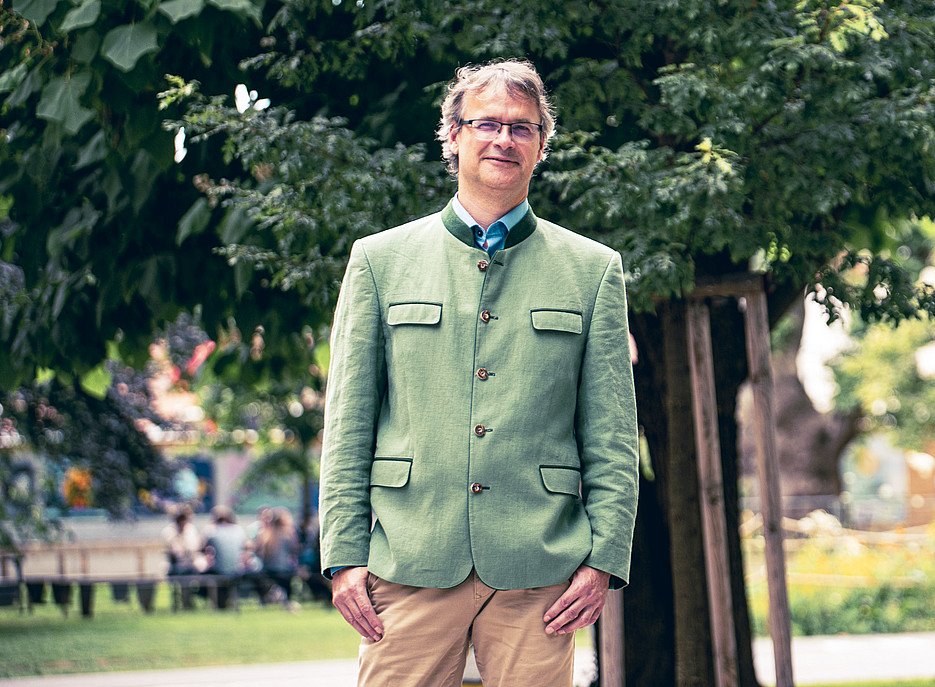
Wolfgang Kroutil standing in front of a deciduous tree ©Uni Graz/Tzivanopoulos
©Uni Graz/Tzivanopoulos
Wolfgang Kroutil, chemist at the University of Graz, coordinates all participating research groups in the Cluster of Excellence "Circular Bioengineering" on the topic of "Biocatalysis and Sustainable Production Methods". Photo: University of Graz/Tzivanopoulos
created by Gudrun Pichler

Related news

Studying at the University of Graz: Registration for admission procedures in March

Ready for a new chapter in your life with the start of your studies at the University of Graz in the winter semester 2026/27? Here you will find information on deadlines, admission procedures, registration, and everything else you need to successfully start your studies in the fall.

Mensa Space: New learning and meeting place for students

The University of Graz and ÖH Uni Graz opened the “Mensa Space” to the public at the end of January 2026: This unique project was designed in collaboration with students and offers study areas, a lounge with snack vending machines and microwaves, as well as a gaming area and kitchen. Since January 28, the 24/7 zone will be open to all members of the University of Graz.

Dual careers: How dual career services strengthen universities

The "Dual Career Styria Carinthia" network creates prospects for academic couples and promotes equal opportunities and the attractiveness of the location. The University of Graz shows how close cooperation with business and research contributes to the successful support of professional reorientation - especially in the course of new infrastructures such as the Koralm railway.

How the University of Graz supports families

Whether it's childcare or caring for family members, the University of Graz supports employees and students with a wide range of services. From vacation programs and playrooms to advice on care work, the university, which is certified as family-friendly, helps students and staff to balance everyday campus life and family responsibilities in a flexible and unbureaucratic way.

Begin of page section:
Additional information:

University of Graz
Universitaetsplatz 3
8010 Graz
Austria
  • Contact
  • Web Editors
  • Moodle
  • UNIGRAZonline
  • Imprint
  • Data Protection Declaration
  • Accessibility Declaration
Weatherstation
Uni Graz

End of this page section. Go to overview of page sections

End of this page section. Go to overview of page sections

Begin of page section:

End of this page section. Go to overview of page sections