Begin of page section:
Page sections:

  • Go to contents (Accesskey 1)
  • Go to position marker (Accesskey 2)
  • Go to main navigation (Accesskey 3)
  • Go to sub navigation (Accesskey 4)
  • Go to additional information (Accesskey 5)
  • Go to page settings (user/language) (Accesskey 8)
  • Go to search (Accesskey 9)

End of this page section. Go to overview of page sections

Begin of page section:
Page settings:

English en
Deutsch de
Search
Login

End of this page section. Go to overview of page sections

Begin of page section:
Search:

Search for details about Uni Graz
Close

End of this page section. Go to overview of page sections


Search

Begin of page section:
Main navigation:

Page navigation:

  • University

    University
    • About the University
    • Organisation
    • Faculties
    • Library
    • Working at University of Graz
    • Campus
    Developing solutions for the world of tomorrow - that is our mission. Our students and our researchers take on the great challenges of society and carry the knowledge out.
  • Research Profile

    Research Profile
    • Our Expertise
    • Research Questions
    • Research Portal
    • Promoting Research
    • Research Transfer
    • Ethics in Research
    Scientific excellence and the courage to break new ground. Research at the University of Graz creates the foundations for making the future worth living.
  • Studies

    Studies
    • Prospective Students
    • Students
  • Community

    Community
    • International
    • Location
    • Research and Business
    • Alumni
    The University of Graz is a hub for international research and brings together scientists and business experts. Moreover, it fosters the exchange and cooperation in study and teaching.
  • Spotlight
Topics
  • Sustainable University
  • Researchers answer
  • Work for us
Close menu

End of this page section. Go to overview of page sections

Begin of page section:
You are here:

University of Graz News Big Data im Sport

End of this page section. Go to overview of page sections

Thursday, 23 November 2017

Big Data im Sport
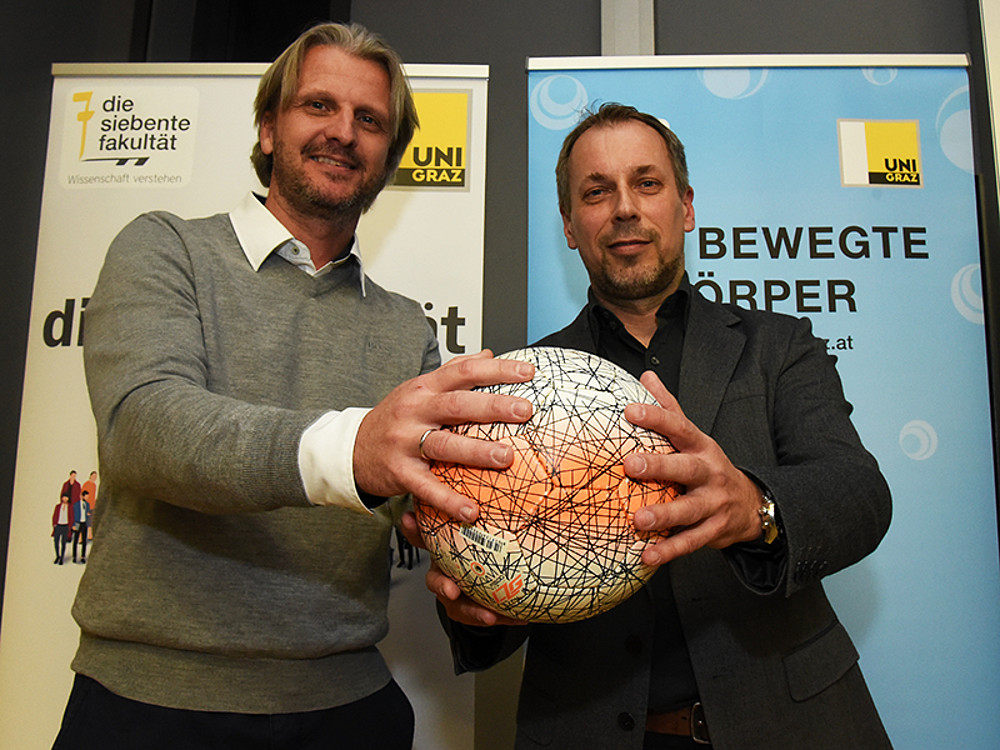
Sturm-Legende Markus Schopp (links) und Sportwissenschafter Gerhard Tschakert diskutierten über Spielanalyse und aktuellen Fußball. Foto: Uni Graz/Schweiger

Sturm-Legende Markus Schopp (links) und Sportwissenschafter Gerhard Tschakert diskutierten über Spielanalyse und aktuellen Fußball. Foto: Uni Graz/Schweiger

Sturm-Legende Markus Schopp begeisterte 200 „Fans“ an der Uni Graz

Er feierte mit dem SK Sturm in den legendären 1990er-Jahren die ganz großen Triumphe und ist nach wie vor eine Fußball-Ikone, wie der randvolle Hörsaal am Zentrum für Molekulare Biowissenschaften der Uni Graz am 22. November 2017 bewies. Markus Schopp war im Rahmen der sportwissenschaftlichen Reihe „der bewegte Körper“ der 7. fakultät zu Gast und stellte die eindrucksvollen Methoden der professionellen Spielanalyse vor. Der ehemalige Fußball-Profi besitzt seit 2012 eine UEFA Pro-Lizenz als Trainer und absolvierte kürzlich in München eine spezielle Ausbildung für Matchanalyse.
Natürlich nahm Gastgeber, Sportwissenschafter Gerhard Tschakert, auch auf aktuelle Ereignisse Bezug. „Wie sieht’s heuer mit Sturm aus“, wollte Tschakert wissen. „Die Mannschaft wurde gut zusammengestellt. In ihr liegt viel Potenzial und sie verfügt über eine gewisse Leichtigkeit“, stellte Schopp dem Team ein gutes Zeugnis aus.
Hohe Chancen räumte Schopp auch der Spielanalyse ein, die außerhalb Österreichs bereits intensiv genutzt wird. Mit Hilfe von Video- oder GPS-Daten können Spielzüge nachgezeichnet und optimiert werden. „Es geht bei einem schlechten Spiel nicht darum, zu sagen, wir haben Pech gehabt, sondern zu fragen, was können wir besser machen“, begründete der Sportler. Big Data im Sport spiele international längst eine große Rolle. „Wir haben die Herausforderung aus der riesigen Menge die richtigen Daten herauszufiltern.“

Die Veranstaltungsreihe „Der bewegte Körper“ ist Teil der 7. fakultät, des Zentrums für Wissen, Gesellschaft und Kommunikation der Uni Graz.


created by Andreas Schweiger

Related news

AI in schools: Maria Bertel drafts legal guidelines for teachers

The legal expert and her team analysed the legal situation regarding the use of artificial intelligence in education as part of an EU project and answered open questions from practice.

Cosmetics in the environment: University of Graz proves danger to ants

Titanium dioxide, which is found in cosmetics, for example, is increasingly entering the environment in the form of nanoparticles. This could also put insects at risk. If ants ingest the substance in combination with the pesticide glyphosate, it disturbs the development of their offspring. Scientists at the University of Graz are drawing attention to the negative consequences of this toxic cocktail.

Varied and healthy: studies move

Exercise is the ideal way to balance out everyday stress, prevent illness and keep fit. Why this is the case, how to do it properly and what role human bodily functions and psychology play can be studied at the University of Graz.

Religious scholar Theresia Heimerl: Fasting as a spiritual boost

Fasting is not just a strategy for losing weight – it is a ritual dating back thousands of years with spiritual and evolutionary roots that has positive effects on the body. At the University of Graz, religious scholar Theresia Heimerl is investigating why fasting is a "spiritual boost".

Begin of page section:
Additional information:

University of Graz
Universitaetsplatz 3
8010 Graz
Austria
  • Contact
  • Web Editors
  • Moodle
  • UNIGRAZonline
  • Imprint
  • Data Protection Declaration
  • Accessibility Declaration
Weatherstation
Uni Graz

End of this page section. Go to overview of page sections

End of this page section. Go to overview of page sections

Begin of page section:

End of this page section. Go to overview of page sections