Begin of page section:
Page sections:

  • Go to contents (Accesskey 1)
  • Go to position marker (Accesskey 2)
  • Go to main navigation (Accesskey 3)
  • Go to sub navigation (Accesskey 4)
  • Go to additional information (Accesskey 5)
  • Go to page settings (user/language) (Accesskey 8)
  • Go to search (Accesskey 9)

End of this page section. Go to overview of page sections

Begin of page section:
Page settings:

English en
Deutsch de
Search
Login

End of this page section. Go to overview of page sections

Begin of page section:
Search:

Search for details about Uni Graz
Close

End of this page section. Go to overview of page sections


Search

Begin of page section:
Main navigation:

Page navigation:

  • University

    University
    • About the University
    • Organisation
    • Faculties
    • Library
    • Working at University of Graz
    • Campus
    Developing solutions for the world of tomorrow - that is our mission. Our students and our researchers take on the great challenges of society and carry the knowledge out.
  • Research Profile

    Research Profile
    • Our Expertise
    • Research Questions
    • Research Portal
    • Promoting Research
    • Research Transfer
    • Ethics in Research
    Scientific excellence and the courage to break new ground. Research at the University of Graz creates the foundations for making the future worth living.
  • Studies

    Studies
    • Prospective Students
    • Students
  • Community

    Community
    • International
    • Location
    • Research and Business
    • Alumni
    The University of Graz is a hub for international research and brings together scientists and business experts. Moreover, it fosters the exchange and cooperation in study and teaching.
  • Spotlight
Topics
  • Our digital Advent calendar
  • Sustainable University
  • Researchers answer
  • Work for us
Close menu

End of this page section. Go to overview of page sections

Begin of page section:
You are here:

University of Graz News Bees under observation: University of Graz provides unprecedented insights into the hive

End of this page section. Go to overview of page sections

Thursday, 17 October 2024

Bees under observation: University of Graz provides unprecedented insights into the hive

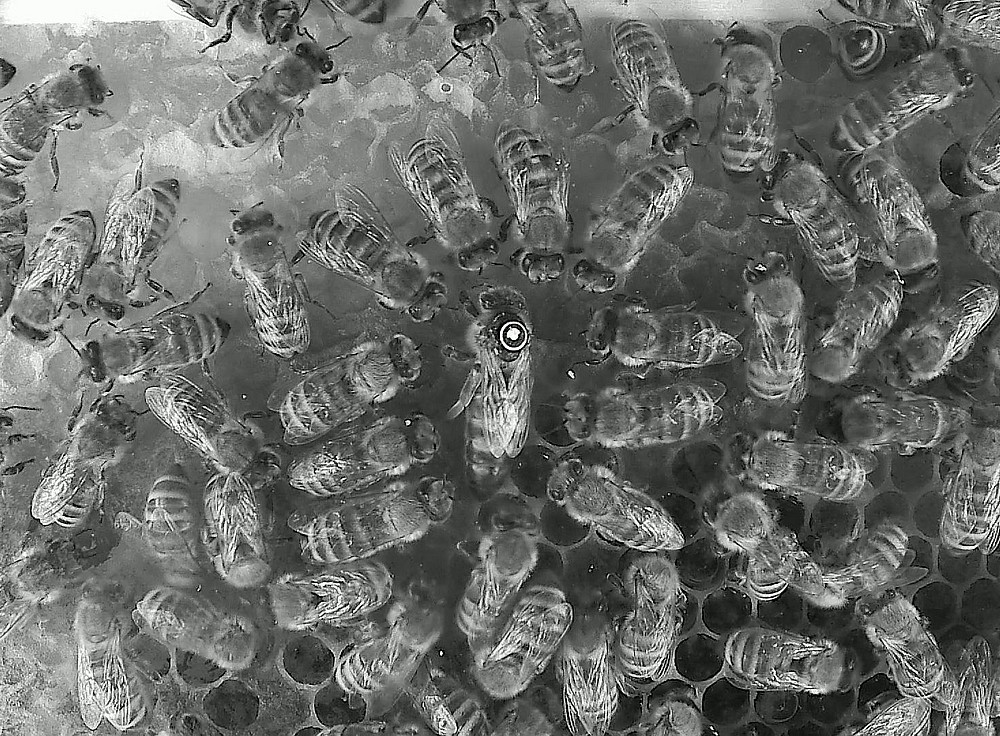
Bees in the hive on a honeycomb around the queen photographed in infrared light

Infrared insights into the beehive: The technology from the University of Graz provides unique insights into the behaviour of the queen and her court. Photo: H2020 FET-Open project ‘RoboRoyale’

What is going on in the combs? How many eggs is the queen laying? How much honey is there? Autonomous robots and AI algorithms provide important data and high-resolution real-time images from inside a beehive. "As part of an international team, we have developed a game-changer technology for a new type of digitalised behavioural research," reports biologist Thomas Schmickl from the Artifical Life Lab at the University of Graz. The publication, which has just appeared as the cover story in the journal "Science Robotics", describes the wealth of information that can be obtained from this unique research facility.

The University of Graz delivers 1.4 terabytes of data, including recordings of the queen bee and her interactions in the hive, to its research partners in the EU-funded "RoboRoyale" project for analysis on a daily basis. The robots observe the queen's movement patterns and egg-laying behaviour, count the population and measure breeding success. At the same time, a permanently updated map of the honeycomb contents is generated. "Due to the high complexity of the bee colony and the development of the honeycomb contents, only these insights enable a fundamental understanding of the social self-regulation of the bee colony," explains Schmickl.

The new system was built around a fully functional bee colony so that the animals can carry out their foraging flights undisturbed. Two movable camera heads work autonomously and take pictures in infrared light so as not to influence the bees' behaviour. AI algorithms analyse and classify the more than 100 million individual images taken to date. This technology makes it possible for the first time to record a large amount of data in parallel with high accuracy and over long periods of time.

Astonishing findings
Initial evaluations of the information obtained show that the queen bee travels 1.5 kilometers per month on the two combs, which are only 33 by 42 cm in size. In the now waning season in October, she still lays an average of 187 eggs per day and rests for up to 1.5 hours in between.

The research is part of the COLIBRI profile area, in which the University of Graz is dedicated to complexity research. Thomas Schmickl and his team want to extend the digital methods to other important animal and plant species in the future in order to collect new data about our ecosystems.

Publication:
Ulrich et al.: "Autonomous tracking of honeybee behaviors over long-term periods with cooperating robots", Science Robotics

created by Dagmar Eklaude

Related news

Chemical Christmas show at the University of Graz: An explosive evening at the Schauspielh

At the beginning of December, the University of Graz transformed the theater into a laboratory: as part of “Chemical Life,” teacher training students staged a chemical Christmas show for Styrian school classes—complete with ethanol rockets, nitrogen snow, and glowing effects. An evening designed to inspire interest in studying chemistry.

Train by train: Koralm railway accelerates exchange between the Universities

Lectures at the University of Klagenfurt in the morning, seminars at the University of Graz in the afternoon: Austria's longest tunnel and a journey time of around 45 minutes make it easy. The Koralm railway increases the speed of networking between the two university locations. The collaboration builds on existing cooperation - for example in the areas of teacher training, Slavic studies and as employers, the universities are well coordinated.

On the trail of the Big Bang: University of Graz receives 1.5 million euros for doctoral programmes

The Austrian Science Fund FWF has selected the Doctoral Programme in Theoretical Particle Physics at the University of Graz for funding from the Doc.funds. Six young scientists will be funded for 3.5 years. They will gain fundamentally new insights into the origins of the world.

From trans women and knee prostheses: sports science prizes awarded

Walking better with a prosthesis, successfully getting rid of excess weight, training more effectively, more fairness for trans people in sport: these were the topics addressed by the students at the University of Graz who were awarded the sports science prizes for their Master's theses on 3 December 2025.

Begin of page section:
Additional information:

University of Graz
Universitaetsplatz 3
8010 Graz
Austria
  • Contact
  • Web Editors
  • Moodle
  • UNIGRAZonline
  • Imprint
  • Data Protection Declaration
  • Accessibility Declaration
Weatherstation
Uni Graz

End of this page section. Go to overview of page sections

End of this page section. Go to overview of page sections

Begin of page section:

End of this page section. Go to overview of page sections