
Begin of page section:
Page sections:

  • Go to contents (Accesskey 1)
  • Go to position marker (Accesskey 2)
  • Go to main navigation (Accesskey 3)
  • Go to sub navigation (Accesskey 4)
  • Go to additional information (Accesskey 5)
  • Go to page settings (user/language) (Accesskey 8)
  • Go to search (Accesskey 9)

End of this page section. Go to overview of page sections

Begin of page section:
Page settings:

English en
Deutsch de
Search
Login

End of this page section. Go to overview of page sections

Begin of page section:
Search:

Search for details about Uni Graz
Close

End of this page section. Go to overview of page sections


Search

Begin of page section:
Main navigation:

Page navigation:

  • University

    University
    • About the University
    • Organisation
    • Faculties
    • Library
    • Working at University of Graz
    • Campus
    Developing solutions for the world of tomorrow - that is our mission. Our students and our researchers take on the great challenges of society and carry the knowledge out.
  • Research Profile

    Research Profile
    • Our Expertise
    • Research Questions
    • Research Portal
    • Promoting Research
    • Research Transfer
    • Ethics in Research
    Scientific excellence and the courage to break new ground. Research at the University of Graz creates the foundations for making the future worth living.
  • Studies

    Studies
    • Prospective Students
    • Students
  • Community

    Community
    • International
    • Location
    • Research and Business
    • Alumni
    The University of Graz is a hub for international research and brings together scientists and business experts. Moreover, it fosters the exchange and cooperation in study and teaching.
  • Spotlight
Topics
  • Our digital Advent calendar
  • Sustainable University
  • Researchers answer
  • Work for us
Close menu

End of this page section. Go to overview of page sections

Begin of page section:
You are here:

University of Graz News Bibliotheks-Eröffnung

End of this page section. Go to overview of page sections

Thursday, 19 September 2019

Bibliotheks-Eröffnung

Die UB Graz ist eine Forschungsbibliothek. Am 26. September wird sie wieder eröffnet. Grafik: Uni Graz

Die UB Graz ist eine Forschungsbibliothek. Am 26. September wird sie wieder eröffnet. Grafik: Uni Graz

Am 26. September wird die modernste Bibliothek Österreichs eröffnet: die Universitätsbibliothek Graz. Sie verbindet auf 10.000 Quadratmetern moderne Architektur mit digitaler Forschung

Jetzt ist es wirklich soweit: Die Bibliothek der Universität Graz (UB Graz) wird eröffnet. Knapp zweieinhalb Jahre nach dem Abriss des 1970er-Jahre-Zubaus übergibt die Bundesimmobiliengesellschaft (BIG) am 26. September 2019 die Schlüssel zur modernsten Bibliothek Österreich an Rektorin Christa Neuper. Die Investition von rund 28 Millionen Euro kann sich wirklich sehen lassen: Die Verbindung von Alt und Neu, von Tradition und Moderne ist gelungen. Die Universität Graz feiert am 26. September ein großes Fest, zu dem jede/jeder eingeladen ist.

Mit dem Abriss hat alles begonnen
UB-Abriss-Video


Forschung am Puls der Zeit
Die UB Graz betreibt topaktuelle, zeitgemäße Forschung. In Zeiten der Digitalisierung und der weltweiten Vernetzung ist das Teilen von Wissen einfacher als je zuvor. Zum Beispiel bieten wissenschaftliche Verlage Journale an, in denen Forschungsliteratur frei zugänglich ist. Für Jedermann und Jederfrau. Und hier unterstützen die ExpertInnen der UB Graz die AutorInnen beim Publizieren in so genannten "Open Access"-Zeitschriften. Die BesucherInnen können am Eröffnungstag in diese neu gestaltete, multimediale Wissenswelt eintauchen.

Der Lesesaal leert sich
Video


Eröffnungsfeier
Zu diesem Fest sind nicht nur alle Freunde der Universitätsbibliothek herzlich eingeladen, sondern alle Menschen, die sich für Bücher, Neue Medien aber auch für Forschung und Wissen interessieren. Sie alle können am 26. September 2019 das neue Gebäude entdecken.  Künstlerische Interventionen, nach einem Konzept von Werner Schrempf, Intendant von La Strada Graz, setzen überraschende Akzente und lenken den Blick auf die Architektur und die Geschichte, die Entwicklungen und die Zukunft der drittgrößten Bibliothek Österreichs.

„Bodies in Urban Spaces“ von Willi Dorner. Das Projekt „bodies in urban spaces“ ist eine temporäre Intervention in den unterschiedlichen architektonischen  Räumen. Körper und Architektur gehen ungewöhnliche Beziehungen ein und eröffnen neue Perspektiven auf die Universitätsbibliothek. Die Spuren der Intervention existieren nur in der Erinnerung der Augenzeugen.

Christian Bakanic & Marie Spaemann. Der österreichischer  Akkordeonist/ Komponist Christian Bakanic und die in Wien geborene Cellistin und Singer-/Songwriterin Marie Spaemann loten mit ihrer Musik zwischen Bach, Piazzolla und eigenen Kompositionen die Raumakustik aus und erkunden auch die unterschiedlichsten Räume.

Bei den inszenierten Führungen in Kooperation mit Karin Gschiel und Thomas Sobotka erfahren die BesucherInnen Hintergründe über die  Architektur, die Universitätsbibliothek und die internen Abläufe. Und ganz nebenbei führen die Guides Sie an Orte, die speziell für die  Neueröffnung zugänglich sind (gutes Schuhwerk wird empfohlen).


Das Programm zur Eröffnung:

  • Do., 26. September, 13 Uhr: Offizielle Eröffnung im Foyer der Universitätsbibliothek. BIG-Geschäftsführer Hans-Peter Weiss übergibt den Schlüssel an Rektorin Christa Neuper. Musik: Christian Bakanic & Marie Spaemann
  • Ab 13.40 Uhr: Künstlerische Entdeckungsreise mit „Bodies in Urban Spaces“ von Willi Dorner.
  • Ab 14 Uhr: Inszenierte Führungen durch das Gebäude mit Karin Gschiel & Thomas Sobotka. Restplätze vor Ort verfügbar
  • Kurzvorträge im neuen Alumni- Hörsaal: ab 15 Uhr: „Wie gesund werden wir mit 120 sein?“ Wolfgang Kroutil über Forschungen im Profilbereich „BioHealth“. „Wie einfach ist Komplexität?“ Christoph Kuzmics über Forschungen im Profilbereich „Colibri“. „Wie viel Fieber hat die Erde und wie stoppen wir es?“ Karl Steininger über Forschungen im Profilbereich „Climate Change Graz“.
    „Wie intelligent können Regeln sein?“ Karl Stöger über Forschungen im Profilbereich „Smart Regulation“.


Alles zur neuen Universitätsbibliothek unter https://www.kleinezeitung.at/service/ubneu/index.do
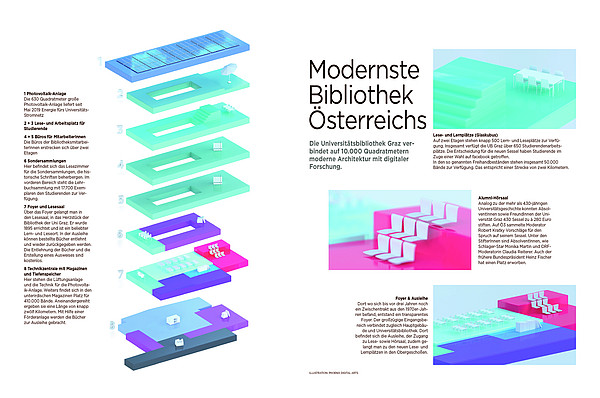
 

Grafik: Phoenix Digital Arts
created by Konstantin Tzivanopoulos

Related news

Fair distribution: Researchers determine just greenhouse gas budgets for all EU regions

Ten years ago, on 12 December 2015, the Paris Climate Agreement was signed at the UN Climate Conference. In order to limit global warming to well below two degrees, only a certain amount of CO2 may be emitted worldwide. While the focus was originally on national emission targets, more than 200 subnational regions and almost 300 cities have now adopted their own targets. But how many emissions are they fairly entitled to? Researchers at the University of Graz have now developed transparent criteria for fair distribution at the subnational level for the first time and determined corresponding greenhouse gas budgets for all European regions. The paper was published today in the scientific journal Nature Communications.

Chemical Christmas show at the University of Graz: An explosive evening at the Schauspielh

At the beginning of December, the University of Graz transformed the theater into a laboratory: as part of “Chemical Life,” teacher training students staged a chemical Christmas show for Styrian school classes—complete with ethanol rockets, nitrogen snow, and glowing effects. An evening designed to inspire interest in studying chemistry.

Train by train: Koralm railway accelerates exchange between the Universities

Lectures at the University of Klagenfurt in the morning, seminars at the University of Graz in the afternoon: Austria's longest tunnel and a journey time of around 45 minutes make it easy. The Koralm railway increases the speed of networking between the two university locations. The collaboration builds on existing cooperation - for example in the areas of teacher training, Slavic studies and as employers, the universities are well coordinated.

On the trail of the Big Bang: University of Graz receives 1.5 million euros for doctoral programmes

The Austrian Science Fund FWF has selected the Doctoral Programme in Theoretical Particle Physics at the University of Graz for funding from the Doc.funds. Six young scientists will be funded for 3.5 years. They will gain fundamentally new insights into the origins of the world.

Begin of page section:
Additional information:

University of Graz
Universitaetsplatz 3
8010 Graz
Austria
  • Contact
  • Web Editors
  • Moodle
  • UNIGRAZonline
  • Imprint
  • Data Protection Declaration
  • Accessibility Declaration
Weatherstation
Uni Graz

End of this page section. Go to overview of page sections

End of this page section. Go to overview of page sections

Begin of page section:

End of this page section. Go to overview of page sections