Begin of page section:
Page sections:

  • Go to contents (Accesskey 1)
  • Go to position marker (Accesskey 2)
  • Go to main navigation (Accesskey 3)
  • Go to sub navigation (Accesskey 4)
  • Go to additional information (Accesskey 5)
  • Go to page settings (user/language) (Accesskey 8)
  • Go to search (Accesskey 9)

End of this page section. Go to overview of page sections

Begin of page section:
Page settings:

English en
Deutsch de
Search
Login

End of this page section. Go to overview of page sections

Begin of page section:
Search:

Search for details about Uni Graz
Close

End of this page section. Go to overview of page sections


Search

Begin of page section:
Main navigation:

Page navigation:

  • University

    University
    • About the University
    • Organisation
    • Faculties
    • Library
    • Working at University of Graz
    • Campus
    Developing solutions for the world of tomorrow - that is our mission. Our students and our researchers take on the great challenges of society and carry the knowledge out.
  • Research Profile

    Research Profile
    • Our Expertise
    • Research Questions
    • Research Portal
    • Promoting Research
    • Research Transfer
    • Ethics in Research
    Scientific excellence and the courage to break new ground. Research at the University of Graz creates the foundations for making the future worth living.
  • Studies

    Studies
    • Prospective Students
    • Students
  • Community

    Community
    • International
    • Location
    • Research and Business
    • Alumni
    The University of Graz is a hub for international research and brings together scientists and business experts. Moreover, it fosters the exchange and cooperation in study and teaching.
  • Spotlight
Topics
  • Our digital Advent calendar
  • Sustainable University
  • Researchers answer
  • Work for us
Close menu

End of this page section. Go to overview of page sections

Begin of page section:
You are here:

University of Graz News Bewegung statt Barrieren

End of this page section. Go to overview of page sections

Wednesday, 21 June 2017

Bewegung statt Barrieren

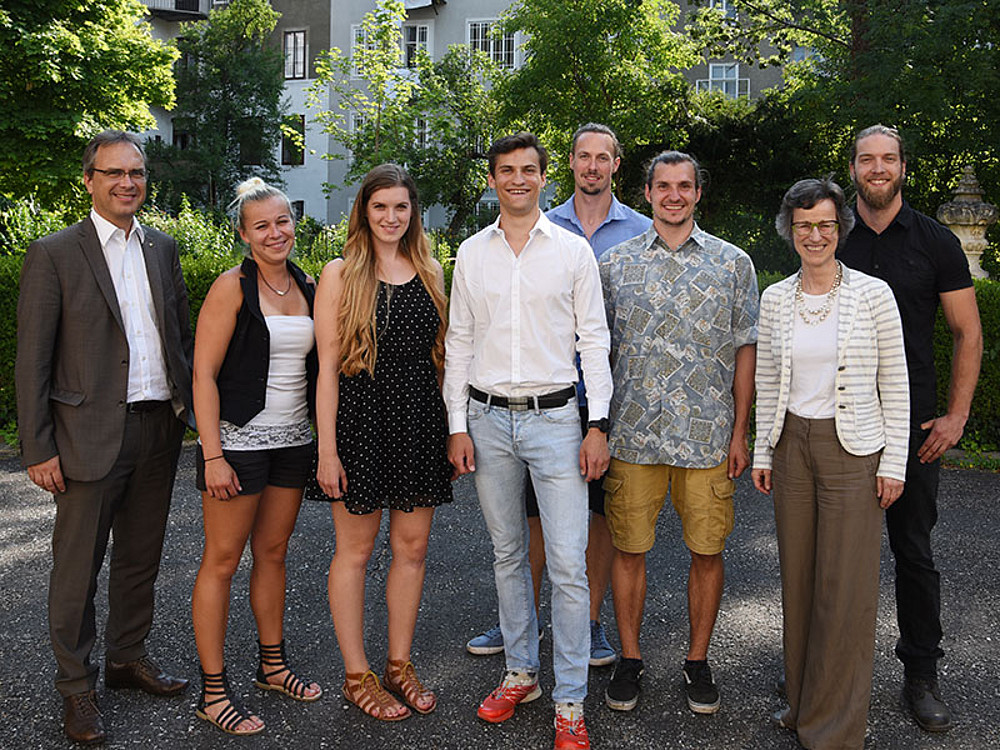
Vizerektor Peter Riedler und Sportwissenschafterin Sylvia Titze mit Studierenden, die sich im Rahmen von "come in" engagierten. Fotos: Uni Graz/Tzivanopoulos ©Uni Graz/Tzivanopoulos

Vizerektor Peter Riedler und Sportwissenschafterin Sylvia Titze mit Studierenden, die sich im Rahmen von "come in" engagierten. Fotos: Uni Graz/Tzivanopoulos

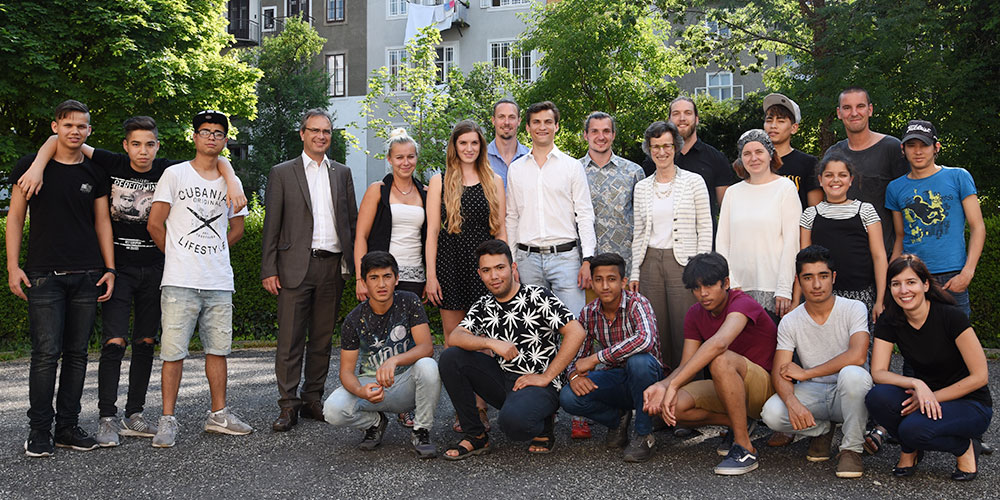
Peter Riedler, Sylvia Titze sowie die Verantwortlichen von "come in" und Anton Paar freuten sich über den Erfolg des Sportprogramms: Sowohl die geflüchteten Jugendlichen als auch die Studierenden profitierten von der Initiative. ©Uni Graz/Tzivanopoulos

Peter Riedler, Sylvia Titze sowie die Verantwortlichen von "come in" und Anton Paar freuten sich über den Erfolg des Sportprogramms: Sowohl die geflüchteten Jugendlichen als auch die Studierenden profitierten von der Initiative.

Studierende boten geflüchteten Jugendlichen ein Sportprogramm an

Sportstudierende der Uni Graz gestalten ein Bewegungsprogramm für geflüchtete Jugendliche: Nachdem diese Idee im Zuge einer Lehrveranstaltung unter der Leitung von Ao.Univ.-Prof. Dr. Sylvia Titze erstmals im Wintersemester 2016/17 erfolgreich umgesetzt worden war, gab es heuer im Frühjahr eine Wiederholung – abermals in Kooperation mit der Einrichtung „come in – Wohnen und Begleitung für geflüchtete Jugendliche“, einer Initiative von alpha nova, unterstützt von der Anton Paar GmbH. Bei der Abschlussveranstaltung am 20. Juni 2017 im Meerscheinschlössl präsentierten die zehn Studierenden eine Foto-Dokumentation ihrer praktischen Arbeit und als gedrucktes, „greifbares“ Produkt eine Zeitschrift. Darin reflektieren sie zum einen eigene Erfahrungen und Erlebnisse, zum anderen stellen sie die Teilnehmer mit deren Herkunftsländern, Sportvorlieben und Berufswünschen vor und geben ihnen damit ein Forum. Neben den Fotos und der Zeitschrift erhielten die Jugendlichen auch Teilnahme-Zertifikate, überreicht von Vizerektor Peter Riedler, Roswitha Al- Hussein, stellvertretende Leiterin von „come in“, und Sylvia Titze.

Viermal pro Woche gestalteten die Studierenden für 24 geflüchtete Jugendliche Lauf-, Krafttraining- und Schwimm-Einheiten. „Sport fördert die psycho-soziale Gesundheit, das Selbstwertgefühl, emotionales Wohlbefinden sowie Kontaktfähigkeit und kann deshalb Menschen in schwierigen Lebenssituationen eine Hilfe sein“, erklärt Ao.Univ.-Prof. Dr. Sylvia Titze vom Institut für Sportwissenschaft der Universität Graz eine zentrale Motivation für ihre Lehrveranstaltungen der besonderen Art. „Außerdem bringt das regelmäßige Programm Struktur und Rhythmus in den Tagesablauf der Jugendlichen“, weiß die Forscherin von „come in“-Leiterin Andrea Prieschl. Aber auch die Studierenden würden profitieren. Sie berichten, so Titze, von viel Motivation, Spaß und Freude auf beiden Seiten, und davon, dass sie selbst wertvolle, bereichernde Erfahrungen sammeln konnten.

„come in“ bietet als eine Einrichtung von alpha nova geflüchteten Jugendlichen einen Platz zum Wohnen, sorgt für Orientierung im Alltag, unterstützt beim Erwerb der deutschen Sprache, begleitet bei Freizeitaktivitäten, vermittelt psychologische Hilfen und fördert Eigenverantwortung und Selbständigkeit. Die Unterkunft samt Einrichtung stellt die Anton Paar GmbH kostenlos zur Verfügung.

created by Gudrun Pichler

Related news

Chemical Christmas show at the University of Graz: An explosive evening at the Schauspielh

At the beginning of December, the University of Graz transformed the theater into a laboratory: as part of “Chemical Life,” teacher training students staged a chemical Christmas show for Styrian school classes—complete with ethanol rockets, nitrogen snow, and glowing effects. An evening designed to inspire interest in studying chemistry.

Train by train: Koralm railway accelerates exchange between the Universities

Lectures at the University of Klagenfurt in the morning, seminars at the University of Graz in the afternoon: Austria's longest tunnel and a journey time of around 45 minutes make it easy. The Koralm railway increases the speed of networking between the two university locations. The collaboration builds on existing cooperation - for example in the areas of teacher training, Slavic studies and as employers, the universities are well coordinated.

On the trail of the Big Bang: University of Graz receives 1.5 million euros for doctoral programmes

The Austrian Science Fund FWF has selected the Doctoral Programme in Theoretical Particle Physics at the University of Graz for funding from the Doc.funds. Six young scientists will be funded for 3.5 years. They will gain fundamentally new insights into the origins of the world.

From trans women and knee prostheses: sports science prizes awarded

Walking better with a prosthesis, successfully getting rid of excess weight, training more effectively, more fairness for trans people in sport: these were the topics addressed by the students at the University of Graz who were awarded the sports science prizes for their Master's theses on 3 December 2025.

Begin of page section:
Additional information:

University of Graz
Universitaetsplatz 3
8010 Graz
Austria
  • Contact
  • Web Editors
  • Moodle
  • UNIGRAZonline
  • Imprint
  • Data Protection Declaration
  • Accessibility Declaration
Weatherstation
Uni Graz

End of this page section. Go to overview of page sections

End of this page section. Go to overview of page sections

Begin of page section:

End of this page section. Go to overview of page sections