



Begin of page section:
Page sections:

  • Go to contents (Accesskey 1)
  • Go to position marker (Accesskey 2)
  • Go to main navigation (Accesskey 3)
  • Go to sub navigation (Accesskey 4)
  • Go to additional information (Accesskey 5)
  • Go to page settings (user/language) (Accesskey 8)
  • Go to search (Accesskey 9)

End of this page section. Go to overview of page sections

Begin of page section:
Page settings:

English en
Deutsch de
Search
Login

End of this page section. Go to overview of page sections

Begin of page section:
Search:

Search for details about Uni Graz
Close

End of this page section. Go to overview of page sections


Search

Begin of page section:
Main navigation:

Page navigation:

  • University

    University
    • About the University
    • Organisation
    • Faculties
    • Library
    • Working at University of Graz
    • Campus
    Developing solutions for the world of tomorrow - that is our mission. Our students and our researchers take on the great challenges of society and carry the knowledge out.
  • Research Profile

    Research Profile
    • Our Expertise
    • Research Questions
    • Research Portal
    • Promoting Research
    • Research Transfer
    • Ethics in Research
    • Commission for Scientific Integrity
    Scientific excellence and the courage to break new ground. Research at the University of Graz creates the foundations for making the future worth living.
  • Studies

    Studies
    • Prospective Students
    • Students
    • Registration for Study Programme (Winter semester 2026/27)
  • Community

    Community
    • International
    • Location
    • Research and Business
    • Alumni
    The University of Graz is a hub for international research and brings together scientists and business experts. Moreover, it fosters the exchange and cooperation in study and teaching.
Topics
  • Sustainable University
  • Researchers answer
  • Work for us
Close menu

End of this page section. Go to overview of page sections

Begin of page section:
You are here:

University of Graz News Besser als das Original?

End of this page section. Go to overview of page sections

Friday, 19 February 2016

Besser als das Original?

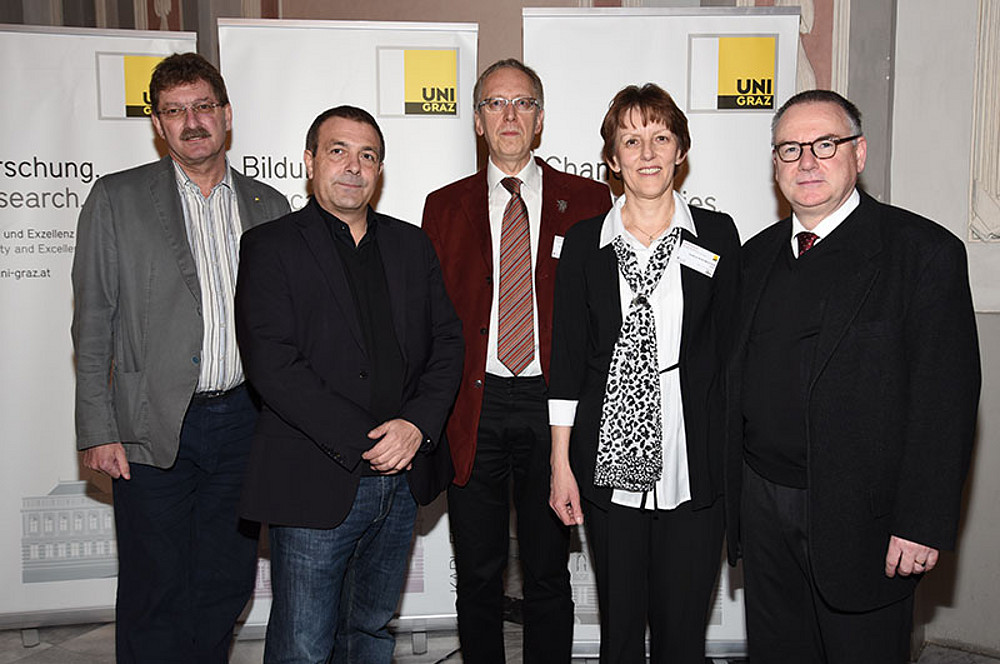
Vizerektor Peter Scherrer, GEWI-Vizedekan Arne Ziegler, Wernfried und Andrea Hofmeister mit Bodo Plachta, Vorsitzender der Arbeitsgemeinschaft für germanistische Edition. Foto: Uni Graz/Kastrun.

Vizerektor Peter Scherrer, GEWI-Vizedekan Arne Ziegler, Wernfried und Andrea Hofmeister mit Bodo Plachta, Vorsitzender der Arbeitsgemeinschaft für germanistische Edition. Foto: Uni Graz/Kastrun.

Internationale Tagung befasst sich mit der Überarbeitung von Texten vom Mittelalter bis zur Gegenwart

"Revision" und "Edition" sind Begriffe, die die Änderung einzelner Passagen bis hin zur kompletten Neugestaltung eines gesamten Textes meinen. Diese komplexen Prozesse schließen oftmals den so genannten "Autorwillen" ein, zum Beispiel wenn der/die VerfasserIn selbst Korrekturen in Auftrag gibt oder diese kontrolliert. Mitunter ist das aber nicht möglich - etwa bei historischen Primärtexten - , weshalb hier besonderes Fingerspitzengefühl gefragt ist.

Mit genau dieser behutsamen Herangehensweise befasst sich aktuell die sechzehnte internationale Tagung der Arbeitsgemeinschaft für germanistische Edition, die seit 17. Februar und noch bis morgen, 20. Februar 2016, an der Karl-Franzens-Universität Graz stattfindet. Durchgeführt wird sie vom Fachbereich Mediävistik des Instituts für Germanistik unter der Federführung von Ao.Univ.-Prof. Dr. Wernfried Hofmeister und Priv.-Doz. Dr. Andrea Hofmeister, gemeinsam mit der Arbeitsgemeinschaft philosophischer Editionen und der Fachgruppe Freie Forschungsinstitute in der Gesellschaft für Musikforschung. Vizerektor Peter Scherrer und Arne Ziegler, Vizedekan der Geisteswissenschaftlichen Fakultät, eröffneten die Tagung und begrüßten die TeilnehmerInnen. 

In fünf Plenen gehen ExpertInnen Revisionen und ihrem Einfluss auf den editorischen Prozess auf den Grund. Dabei werden unter anderem Themen wie die Textgenese des Librettos zu Mozarts "Die Entführung aus dem Serail", die Entstehung zeitgenössischer Lyrik sowie exemplarische Überarbeitungen von Ödön von Horvaths "Geschichten aus dem Wienerwald" behandelt. Natürlich ist auch der mittelalterlichen Literatur ein großer Schwerpunkt gewidmet, doch auch speziellere Themen - etwa die Spieltexte der Wanderbühnen - finden Widerhall in dem umfangreichen Programm.  Und auch die Frage nach dem Umgang mit Nach- und Raubdrucken wird nicht ausgespart.

Die Tagung wurde von der Reihe "Lange Nacht der Textrevisionen" begleitet, in deren Rahmen die Erfolgsautorin Barbara Frischmuth aus "Die Schrift des Freundes" im Grazer Literaturhaus las und  im Anschluss mit Anna Babka, Universität Wien, über die Praxis des Schreibens diskutierte.

created by Gerhild Kastrun

Related news

"Mathematics explains the world"

How can life be quantified? And what can science reveal that remains hidden from the naked eye? The 14th European Conference on Mathematical and Theoretical Biology at the University of Graz is dedicated to these questions. From 13 to 17 July, around 1,300 researchers from all over the world will gather on campus to discuss models, biological processes and the future of data-driven medicine. Klemens Fellner, Dean of the Faculty of Natural Sciences and Mathematics and a mathematician, talks about the language that explains the world

Internationally up-to-date: University of Graz offers new degree programmes in art studies

From the Old Masters to AI art – three newly designed degree programmes offer students at the University of Graz fresh perspectives on artistic production. In addition to historical art, the programmes place a greater emphasis on contemporary and global developments. The registration period is open.

The Nazi elite school Napola: Historian seeks memories and personal documents

They were to be brought up to become the future elite of National Socialism: boys and girls aged ten and over who, following the ‘Anschluss’ of Austria to the German Reich, attended a so-called Napola (short for Nationalpolitische Lehranstalt; also known as NPEA, Nationalpolitische Erziehungsanstalt). There were nine such institutions in what is now Austria between 1939 and 1945.

Heat-resistant: Eva Preinfalk explains how cities can protect their residents

Certain demographic and some occupational groups are particularly vulnerable to high temperatures. A range of measures is needed to provide relief for everyone, explains climate economist Eva Preinfalk.

Begin of page section:
Additional information:

University of Graz
Universitaetsplatz 3
8010 Graz
Austria
  • Contact
  • Web Editors
  • Moodle
  • UNIGRAZonline
  • Imprint
  • Data Protection Declaration
  • Accessibility Declaration
Weatherstation
Uni Graz

End of this page section. Go to overview of page sections

End of this page section. Go to overview of page sections

Begin of page section:

End of this page section. Go to overview of page sections