Begin of page section:
Page sections:

  • Go to contents (Accesskey 1)
  • Go to position marker (Accesskey 2)
  • Go to main navigation (Accesskey 3)
  • Go to sub navigation (Accesskey 4)
  • Go to additional information (Accesskey 5)
  • Go to page settings (user/language) (Accesskey 8)
  • Go to search (Accesskey 9)

End of this page section. Go to overview of page sections

Begin of page section:
Page settings:

English en
Deutsch de
Search
Login

End of this page section. Go to overview of page sections

Begin of page section:
Search:

Search for details about Uni Graz
Close

End of this page section. Go to overview of page sections


Search

Begin of page section:
Main navigation:

Page navigation:

  • University

    University
    • About the University
    • Organisation
    • Faculties
    • Library
    • Working at University of Graz
    • Campus
    Developing solutions for the world of tomorrow - that is our mission. Our students and our researchers take on the great challenges of society and carry the knowledge out.
  • Research Profile

    Research Profile
    • Our Expertise
    • Research Questions
    • Research Portal
    • Promoting Research
    • Research Transfer
    • Ethics in Research
    Scientific excellence and the courage to break new ground. Research at the University of Graz creates the foundations for making the future worth living.
  • Studies

    Studies
    • Prospective Students
    • Students
  • Community

    Community
    • International
    • Location
    • Research and Business
    • Alumni
    The University of Graz is a hub for international research and brings together scientists and business experts. Moreover, it fosters the exchange and cooperation in study and teaching.
  • Spotlight
Topics
  • Sustainable University
  • Researchers answer
  • Work for us
Close menu

End of this page section. Go to overview of page sections

Begin of page section:
You are here:

University of Graz News Bacteria in chain mail: Lactobacilli protect themselves with a lattice of proteins

End of this page section. Go to overview of page sections

Friday, 14 June 2024

Bacteria in chain mail: Lactobacilli protect themselves with a lattice of proteins

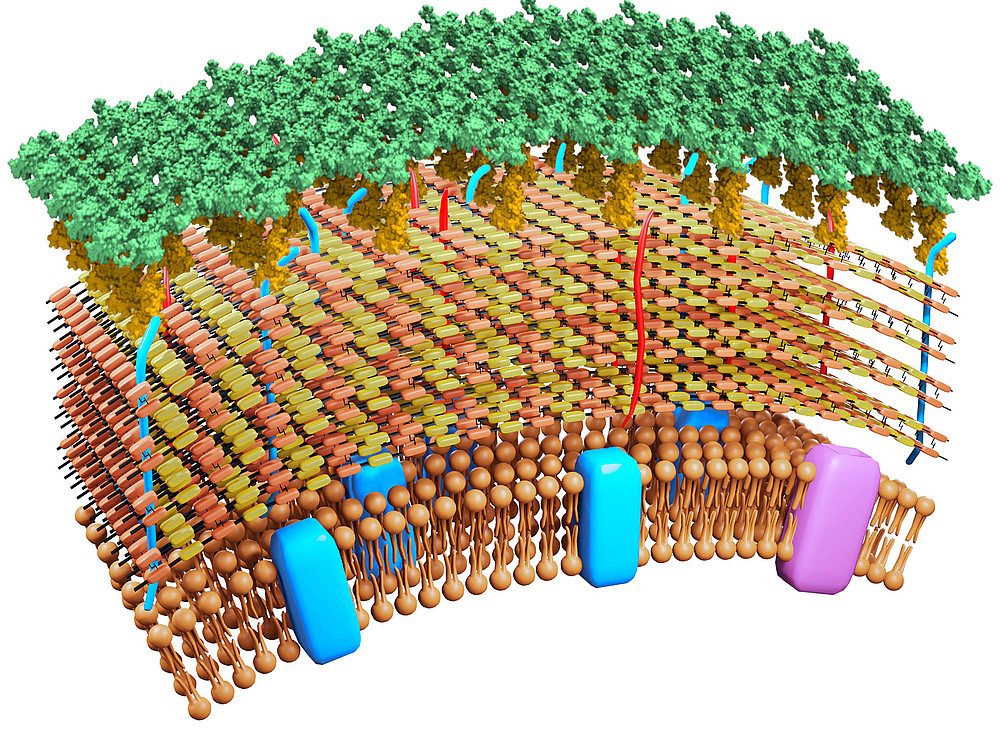
Schematic overview of the cell wall composition of Lactobacillus ©Rehan - stock.adobe.com

Schematic overview of the cell wall composition of Lactobacillus: The S-layer (green and yellow) is the outermost layer that covers the entire bacterium like a chain mail. Image: Rehan – stock.adobe.com

We know them from the advertising for yoghurts or other probiotic foods: lactobacilli. They play an important role in the gut, but also in the microbiome of mucous membranes in other regions of our body. Researchers at the University of Graz have now succeeded for the first time in elucidating the three-dimensional structure of the protein layer on the surface of lactobacilli. It protects the bacteria like chain mail against external attacks. This knowledge is valuable. It opens up new possibilities for the treatment of intestinal diseases and for better drug delivery systems. The new findings were published in the scientific journal PNAS.

Lactobacilli are clearly among the good guys. They regulate the immune response, have an anti-inflammatory effect and displace pathogenic germs by docking onto human cells so that dangerous bacteria no longer find a place there. The surface layer, or S-layer for short, of the lactobacilli plays a key role in this interaction, for example with the intestinal wall. "As the outermost layer, lactobacilli form a lattice of proteins that surrounds them like chain mail," explain Theo Sagmeister and Nina Gubensäk, first authors of the latest publication and researchers in Tea Pavkov-Keller's working group at the Institute of Molecular Biosciences at the University of Graz. The team has now elucidated the detailed three-dimensional structure of the protein lattice for the first time.

"On the one hand, the S-layers of lactobacilli fulfil a protective function, on the other hand they interact intensively with human cells in the intestine. Both are very useful for drug delivery systems," says Tea Pavkov-Keller, emphasising the further significance of the new findings. "With the help of such structures, drugs could be transported safely and in a controlled manner to their destination in the body on a nanoscale, where they can then unfold their therapeutic effect in the right quantity," says the researcher.

Publication
The molecular architecture of Lactobacillus S-Layer: Assembly and attachment to teichoic acids
Sagmeister et al.
PNAS, 5 June 2024
https://doi.org/10.1073/pnas.2401686121

Nina Gubensäk, Christoph Grininger, Theo Sagmeister, Tea Pavkov-Keller, Lukas Petrowitsch and Christoph Buhlheller ©University of Graz/Tzivanopoulos
©University of Graz/Tzivanopoulos
The team of researchers: Nina Gubensäk, Christoph Grininger, Theo Sagmeister, Tea Pavkov-Keller, Lukas Petrowitsch and Christoph Buhlheller (f.l.t.r.). Photo: University of Graz/Tzivanopoulos
created by Gudrun Pichler

Related news

AI in schools: Maria Bertel drafts legal guidelines for teachers

The legal expert and her team analysed the legal situation regarding the use of artificial intelligence in education as part of an EU project and answered open questions from practice.

Cosmetics in the environment: University of Graz proves danger to ants

Titanium dioxide, which is found in cosmetics, for example, is increasingly entering the environment in the form of nanoparticles. This could also put insects at risk. If ants ingest the substance in combination with the pesticide glyphosate, it disturbs the development of their offspring. Scientists at the University of Graz are drawing attention to the negative consequences of this toxic cocktail.

Varied and healthy: studies move

Exercise is the ideal way to balance out everyday stress, prevent illness and keep fit. Why this is the case, how to do it properly and what role human bodily functions and psychology play can be studied at the University of Graz.

Religious scholar Theresia Heimerl: Fasting as a spiritual boost

Fasting is not just a strategy for losing weight – it is a ritual dating back thousands of years with spiritual and evolutionary roots that has positive effects on the body. At the University of Graz, religious scholar Theresia Heimerl is investigating why fasting is a "spiritual boost".

Begin of page section:
Additional information:

University of Graz
Universitaetsplatz 3
8010 Graz
Austria
  • Contact
  • Web Editors
  • Moodle
  • UNIGRAZonline
  • Imprint
  • Data Protection Declaration
  • Accessibility Declaration
Weatherstation
Uni Graz

End of this page section. Go to overview of page sections

End of this page section. Go to overview of page sections

Begin of page section:

End of this page section. Go to overview of page sections