Begin of page section:
Page sections:

  • Go to contents (Accesskey 1)
  • Go to position marker (Accesskey 2)
  • Go to main navigation (Accesskey 3)
  • Go to sub navigation (Accesskey 4)
  • Go to additional information (Accesskey 5)
  • Go to page settings (user/language) (Accesskey 8)
  • Go to search (Accesskey 9)

End of this page section. Go to overview of page sections

Begin of page section:
Page settings:

English en
Deutsch de
Search
Login

End of this page section. Go to overview of page sections

Begin of page section:
Search:

Search for details about Uni Graz
Close

End of this page section. Go to overview of page sections


Search

Begin of page section:
Main navigation:

Page navigation:

  • University

    University
    • About the University
    • Organisation
    • Faculties
    • Library
    • Working at University of Graz
    • Campus
    Developing solutions for the world of tomorrow - that is our mission. Our students and our researchers take on the great challenges of society and carry the knowledge out.
  • Research Profile

    Research Profile
    • Our Expertise
    • Research Questions
    • Research Portal
    • Promoting Research
    • Research Transfer
    • Ethics in Research
    Scientific excellence and the courage to break new ground. Research at the University of Graz creates the foundations for making the future worth living.
  • Studies

    Studies
    • Prospective Students
    • Students
  • Community

    Community
    • International
    • Location
    • Research and Business
    • Alumni
    The University of Graz is a hub for international research and brings together scientists and business experts. Moreover, it fosters the exchange and cooperation in study and teaching.
  • Spotlight
Topics
  • Our digital Advent calendar
  • Sustainable University
  • Researchers answer
  • Work for us
Close menu

End of this page section. Go to overview of page sections

Begin of page section:
You are here:

University of Graz News Aus Abfall wird Arznei

End of this page section. Go to overview of page sections

Monday, 18 December 2017

Aus Abfall wird Arznei
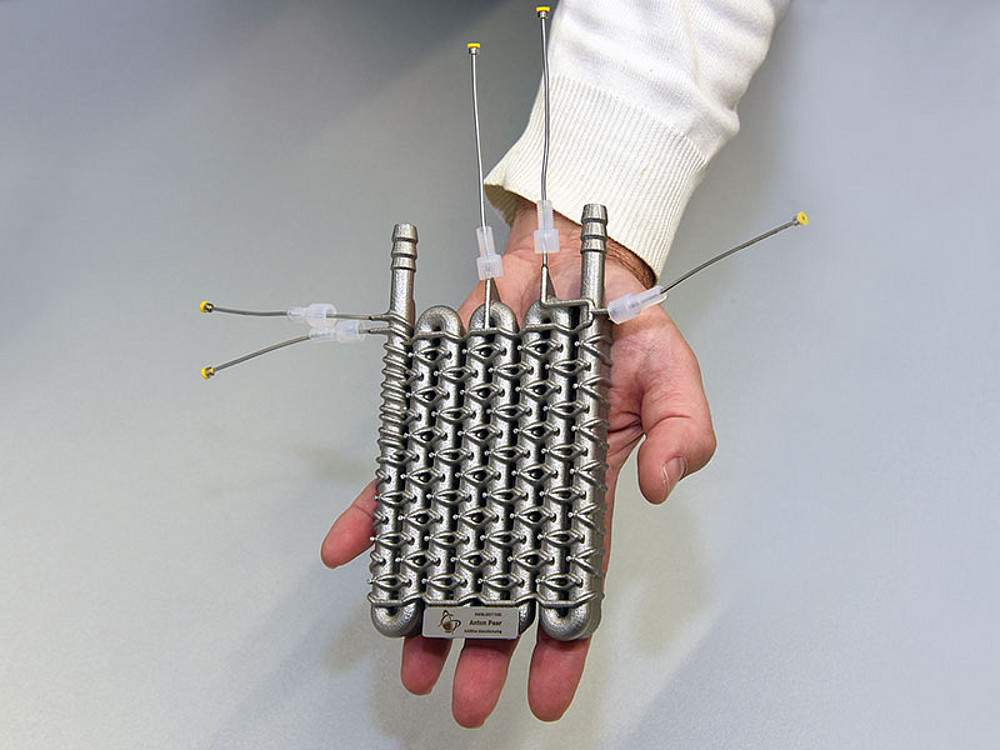
Die Grazer ForscherInnen testeten den von der Firma Anton Paar gedruckten Flow-Reaktor. Foto: Uni Graz/Pichler ©Uni Graz/Pichler

Die Grazer ForscherInnen testeten den von der Firma Anton Paar gedruckten Flow-Reaktor. Durch den 3D-Druck lassen sich Flow-Reaktoren beliebiger Komplexität herstellen, was eine große Kostenersparnis bedeutet. Foto: Uni Graz/Pichler

ChemikerInnen der Uni Graz nutzen Treibhausgas zur Herstellung eines Wirkstoffs gegen Schlafkrankheit

Wie aus einem schädlichen Abfallprodukt ein wertvoller Stoff zur Herstellung wichtiger Medikamente werden kann, zeigen ChemikerInnen der Karl-Franzens-Universität Graz. Univ.-Prof. Dr. C. Oliver Kappe hat mit seinem Team einen Weg gefunden, das starke Treibhausgas Fluoroform, das bei der Teflon-Erzeugung anfällt, mittels Flow-Chemie für die Synthese des Arzneistoffs Eflornithin zu nutzen. Die Arbeit wurde kürzlich im Fachjournal „Green Chemistry“ publiziert.

Damit Fluoroform nicht in die Atmosphäre gelangt, wird es üblicherweise verbrannt. Das kostet zum einen Energie, zum anderen entsteht dabei CO2, was wiederum für unerwünschte Emissionen sorgt. „In dem gemeinsam mit einem Industriepartner entwickelten Flow-Verfahren ist es uns gelungen, Fluoroform einer sinnvollen Nutzung zuzuführen. Wir verwenden es zur Herstellung von Eflornithin, einem bedeutenden Arzneistoff gegen die Schlafkrankheit, der von der Weltgesundheitsorganisation WHO auf die Liste der ,Essential Medicines‘ gesetzt wurde“, erklärt C. Oliver Kappe.
Bei der Flow-Chemie werden die für eine Synthese benötigten Substanzen in einem kontinuierlichen Verfahren durch Reaktionskammern im Milliliterbereich gepumpt, in denen die einzelnen Prozesse nacheinander ablaufen. Extreme Temperatur- und Druckbedingungen können Reaktionen um ein Vielfaches beschleunigen. „Die Flow-Chemie spart im Vergleich zu herkömmlichen Verfahren Zeit und Kosten und ist darüber hinaus oft umweltfreundlicher, weil zwischen den einzelnen Reaktionsschritten keine Abfallprodukte anfallen“, unterstreicht Kappe.

Revolution in 3D
Ihre „grüne“ Synthese verknüpften die WissenschafterInnen mit einer revolutionären Technik: einem Flow-Reaktor, der in einem 3D-Druckverfahren erzeugt wurde. Das Design des Reaktors haben die ChemikerInnen mit ForscherInnen der TU Graz und der Research Center Pharmaceutical Engineering GmbH (RCPE) – einem Kompetenzzentrum im Eigentum von TU Graz (65 %), Universität Graz (20 %) und Joanneum Research (15 %) – entwickelt und getestet. Die Firma Anton Paar druckte den Reaktor mittels Metall-Laser-Sintern aus Stahlpulver. Die neue Technik überzeugt durch ihre Vorteile: „Durch den 3D-Druck lassen sich Flow-Reaktoren beliebiger Komplexität herstellen, während man mit herkömmlichen Fertigungsmethoden diesbezüglich stark limitiert ist. Das bedeutet zusätzlich eine enorme Kostenersparnis“, zeigt sich Kappe begeistert von den Ergebnissen des Kooperationsprojekts, die jüngst im Fachjournal „Reaction Chemistry & Engineering“ veröffentlicht wurden.

Publikationen:
Utilization of fluoroform for difluoromethylation in continuous flow: a concise synthesis of α-difluoromethyl-amino acids
Manuel Köckinger, Tanja Ciaglia, Michael Bersier, Paul Hanselmann, Bernhard Gutmann, and C. Oliver Kappe
Green Chemistry, November 2017. DOI: 10.1039/c7gc02913f

Design and 3D printing of a stainless steel reactor for continuous difluoromethylations using fluoroform
Bernhard Gutmann, Manuel Köckinger, Gabriel Glotz, Tania Ciaglia, Eyke Slama, Matej Zadravec, Stefan Pfanner, Manuel C. Maier, Heidrun Gruber-Wölfler, and C. Oliver Kappe
Reaction Chemistry & Engineering, November 2017. DOI: 10.1039/c7re00176b

created by Gudrun Pichler

Related news

Chemical Christmas show at the University of Graz: An explosive evening at the Schauspielh

At the beginning of December, the University of Graz transformed the theater into a laboratory: as part of “Chemical Life,” teacher training students staged a chemical Christmas show for Styrian school classes—complete with ethanol rockets, nitrogen snow, and glowing effects. An evening designed to inspire interest in studying chemistry.

Train by train: Koralm railway accelerates exchange between the Universities

Lectures at the University of Klagenfurt in the morning, seminars at the University of Graz in the afternoon: Austria's longest tunnel and a journey time of around 45 minutes make it easy. The Koralm railway increases the speed of networking between the two university locations. The collaboration builds on existing cooperation - for example in the areas of teacher training, Slavic studies and as employers, the universities are well coordinated.

On the trail of the Big Bang: University of Graz receives 1.5 million euros for doctoral programmes

The Austrian Science Fund FWF has selected the Doctoral Programme in Theoretical Particle Physics at the University of Graz for funding from the Doc.funds. Six young scientists will be funded for 3.5 years. They will gain fundamentally new insights into the origins of the world.

From trans women and knee prostheses: sports science prizes awarded

Walking better with a prosthesis, successfully getting rid of excess weight, training more effectively, more fairness for trans people in sport: these were the topics addressed by the students at the University of Graz who were awarded the sports science prizes for their Master's theses on 3 December 2025.

Begin of page section:
Additional information:

University of Graz
Universitaetsplatz 3
8010 Graz
Austria
  • Contact
  • Web Editors
  • Moodle
  • UNIGRAZonline
  • Imprint
  • Data Protection Declaration
  • Accessibility Declaration
Weatherstation
Uni Graz

End of this page section. Go to overview of page sections

End of this page section. Go to overview of page sections

Begin of page section:

End of this page section. Go to overview of page sections