Begin of page section:
Page sections:

  • Go to contents (Accesskey 1)
  • Go to position marker (Accesskey 2)
  • Go to main navigation (Accesskey 3)
  • Go to sub navigation (Accesskey 4)
  • Go to additional information (Accesskey 5)
  • Go to page settings (user/language) (Accesskey 8)
  • Go to search (Accesskey 9)

End of this page section. Go to overview of page sections

Begin of page section:
Page settings:

English en
Deutsch de
Search
Login

End of this page section. Go to overview of page sections

Begin of page section:
Search:

Search for details about Uni Graz
Close

End of this page section. Go to overview of page sections


Search

Begin of page section:
Main navigation:

Page navigation:

  • University

    University
    • About the University
    • Organisation
    • Faculties
    • Library
    • Working at University of Graz
    • Campus
    Developing solutions for the world of tomorrow - that is our mission. Our students and our researchers take on the great challenges of society and carry the knowledge out.
  • Research Profile

    Research Profile
    • Our Expertise
    • Research Questions
    • Research Portal
    • Promoting Research
    • Research Transfer
    • Ethics in Research
    • Commission for Scientific Integrity
    Scientific excellence and the courage to break new ground. Research at the University of Graz creates the foundations for making the future worth living.
  • Studies

    Studies
    • Prospective Students
    • Students
  • Community

    Community
    • International
    • Location
    • Research and Business
    • Alumni
    The University of Graz is a hub for international research and brings together scientists and business experts. Moreover, it fosters the exchange and cooperation in study and teaching.
  • Spotlight
Topics
  • Sustainable University
  • Researchers answer
  • Work for us
Close menu

End of this page section. Go to overview of page sections

Begin of page section:
You are here:

University of Graz News Auftakt

End of this page section. Go to overview of page sections

Tuesday, 13 December 2016

Auftakt

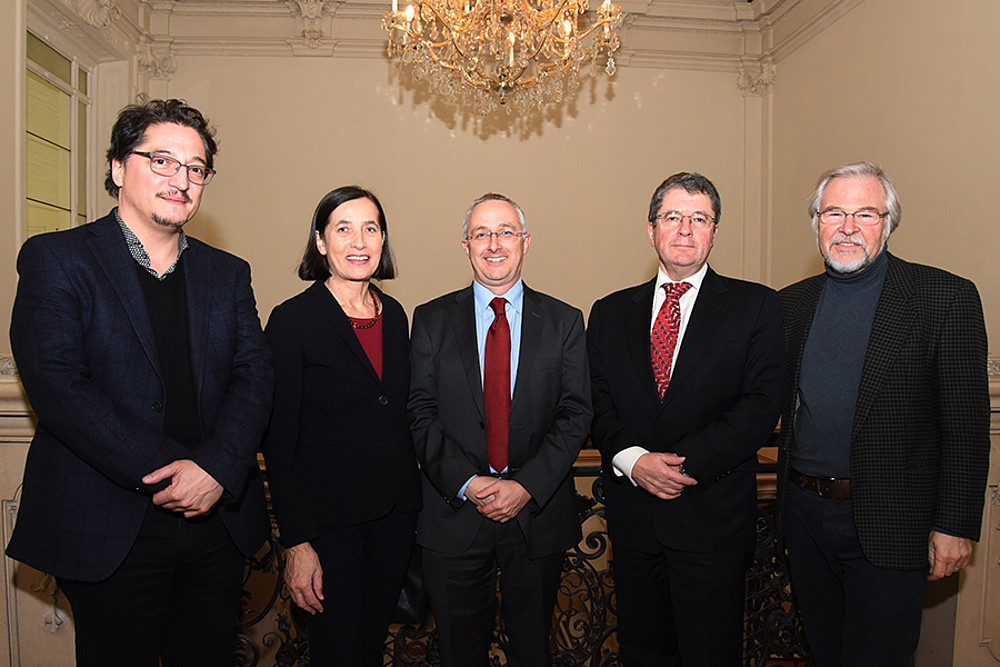
Südosteuropa-Professor Kerem Öktem, UNESCO-Österreich-Generalsekretärin Gabriele Eschig, UNESCO-Professor Gerd Oberleitner, CARA-Direktor Stephen Wordsworth und Uni ETC-Vizedirektor Wolfgang Benedek (v.l.). Foto: Uni Graz/Schweiger. ©Uni Graz/Schweiger

Südosteuropa-Professor Kerem Öktem, UNESCO-Österreich-Generalsekretärin Gabriele Eschig, UNESCO-Professor Gerd Oberleitner, CARA-Direktor Stephen Wordsworth und Uni ETC-Vizedirektor Wolfgang Benedek (v.l.). Foto: Uni Graz/Schweiger.

Erste Veranstaltung des UNESCO-Chairs für Menschenrechte zum Thema akademische Freiheit

Im Frühjahr 2016 erhielt die Uni Graz als erste Universität weltweit einen UNESCO Lehrstuhl für Menschenrechte und menschliche Sicherheit. Lehrstuhlinhaber Ao.Univ-Prof.Dr. Gerd Oberleitner lud gestern, 12. Dezember 2016, zur Auftaktveranstaltung zum Thema akademische Freiheit in Europa ins Palais Kottulinsky in Graz ein.


2016 war eines der herausforderndsten Jahre für die akademische Freiheit seit Langem – seit Jahren tobt der Bürgerkrieg in Syrien und Irak, der die akademische Infrastruktur der Länder nachhaltig zerstört hat. Zusätzlich sind auch WissenschafterInnen in der Türkei seit dem vergangenen Jahr zunehmend von Masseninhaftierungen, Zensur und Reisebeschränkungen betroffen. Diese aktuellen Entwicklungen nahm Oberleitner zum Anlass, das Thema akademische Freiheit gemeinsam mit einem international besetzten Podium zu diskutieren.


Stephen Wordsworth von CARA (Council for At-Risk Academics), eine Organisation, die sich für verfolgte und flüchtende WissenschafterInnen einsetzt, berichtete von den höchsten Zahlen an Anfragen von betroffenen AkademikerInnen im Jahr 2016 seit den 1930er-Jahren. Gabriele Eschig von der österreichischen UNESCO-Vertretung betonte, wie wichtig die Arbeit der Zivilgesellschaft und Nichtregierungsorganisationen für den Schutz von bedrohten AkademikerInnen ist. Univ.-Prof. Dr. Kerem Öktem vom Zentrum für Südosteuropa-Studien der Uni Graz ging auf die Ereignisse in der Türkei im vergangenen Jahr ein und Univ.-Prof. Dr. Wolfgang Benedek vom Uni ETC berichtete schließlich von der Arbeit des World University Service (WUS).


Von allen Vortragenden wurde betont, wie wichtig der Schutz der WissenschafterInnen ist, um zu gewährleisten, dass Länder nach Jahren der Krise wieder aufgebaut werden können, dass das Wissen nicht verloren geht und vor allem, dass es noch LehrerInnen gibt, die das Wissen auch an die nächste Generation weitergeben können. Dies trägt nachhaltig zur Etablierung von Demokratien und zur Sicherung von Frieden bei.


Eröffnet wurde die Auftaktveranstaltung durch Forschungs-Vizerektor Peter Scherrer und dem Dekan der rechtswissenschaftlichen Fakultät, Univ.-Prof. Dr. Stefan Storr. Scherrer mahnte in seiner Begrüßung das unabdingbare Festhalten der Freiheit von Wissenschaft ein. Dekan Stefan Storr betonte Auftrag und Pflicht einer Universität, Menschenrechte umzusetzen. Und Gerd Oberleitner, hob schließlich neben der Relevanz für Kooperationen und der gesellschaftlichen Bedeutung in der Stadt der Menschenrechte den Stellenwert der Professur für die Bildung hervor: „Wir wollen unsere Studierenden ermutigen, aktive und verantwortungsvolle WeltbürgerInnen zu sein.“

created by Lisa Sonnleitner & Andreas Schweiger

Related news

Studying at the University of Graz: How to enrol

Ready for a new chapter in your life with the start of your studies at the University of Graz in the winter semester 2026/27? Here you will find information on deadlines, admission procedures, registration, and everything else you need to successfully start your studies in the fall.

Interpreting data: Why studies sometimes get it wrong

Hilmar Brohmer and Ziva Korda from the Institute of Psychology, together with 500 international colleagues, have re-evaluated a hundred scientific publications and have often come to different conclusions.

Crystal-clear: AI method revolutionises solar observation

The Sun makes life on Earth possible. However, its magnetic fields can also cause massive disruption. This makes it all the more important to gain a better understanding of the processes taking place on our nearest star. A research team from the University of Graz and the High Altitude Observatory in Boulder (USA) has succeeded in doing just that. The astrophysicists have developed an AI-supported method that makes even the smallest structures on the Sun visible. The scientists are convinced that this will bring about a lasting change in solar observation and that the new method can be used for the planned European Solar Telescope.

Long Night of Research: How many languages are there in the world?

From a linguistic perspective, there are worlds of difference between Bern, Berlin and Vienna. A dialect impersonator will demonstrate live just how varied German can sound. How many languages are there in the world? What are their distinctive features? Which of these are spoken in Austria? These and other questions will be answered during the Long Night of Research at the University of Graz: on Friday, 24 April 2025, from 5 pm to 11 pm, in the University Library. Visitors can immerse themselves in the diversity of languages without travelling far by taking part in a quiz at the station.

Begin of page section:
Additional information:

University of Graz
Universitaetsplatz 3
8010 Graz
Austria
  • Contact
  • Web Editors
  • Moodle
  • UNIGRAZonline
  • Imprint
  • Data Protection Declaration
  • Accessibility Declaration
Weatherstation
Uni Graz

End of this page section. Go to overview of page sections

End of this page section. Go to overview of page sections

Begin of page section:

End of this page section. Go to overview of page sections