Begin of page section:
Page sections:

  • Go to contents (Accesskey 1)
  • Go to position marker (Accesskey 2)
  • Go to main navigation (Accesskey 3)
  • Go to sub navigation (Accesskey 4)
  • Go to additional information (Accesskey 5)
  • Go to page settings (user/language) (Accesskey 8)
  • Go to search (Accesskey 9)

End of this page section. Go to overview of page sections

Begin of page section:
Page settings:

English en
Deutsch de
Search
Login

End of this page section. Go to overview of page sections

Begin of page section:
Search:

Search for details about Uni Graz
Close

End of this page section. Go to overview of page sections


Search

Begin of page section:
Main navigation:

Page navigation:

  • University

    University
    • About the University
    • Organisation
    • Faculties
    • Library
    • Working at University of Graz
    • Campus
    Developing solutions for the world of tomorrow - that is our mission. Our students and our researchers take on the great challenges of society and carry the knowledge out.
  • Research Profile

    Research Profile
    • Our Expertise
    • Research Questions
    • Research Portal
    • Promoting Research
    • Research Transfer
    • Ethics in Research
    • Commission for Scientific Integrity
    Scientific excellence and the courage to break new ground. Research at the University of Graz creates the foundations for making the future worth living.
  • Studies

    Studies
    • Prospective Students
    • Students
    • Welcome Weeks for First Year Students
  • Community

    Community
    • International
    • Location
    • Research and Business
    • Alumni
    The University of Graz is a hub for international research and brings together scientists and business experts. Moreover, it fosters the exchange and cooperation in study and teaching.
Topics
  • Sustainable University
  • Researchers answer
  • Work for us
Close menu

End of this page section. Go to overview of page sections

Begin of page section:
You are here:

University of Graz News Hotspot in Albania: a researcher from the University of Graz on an Italian experiment

End of this page section. Go to overview of page sections

Friday, 21 February 2025

Hotspot in Albania: a researcher from the University of Graz on an Italian experiment

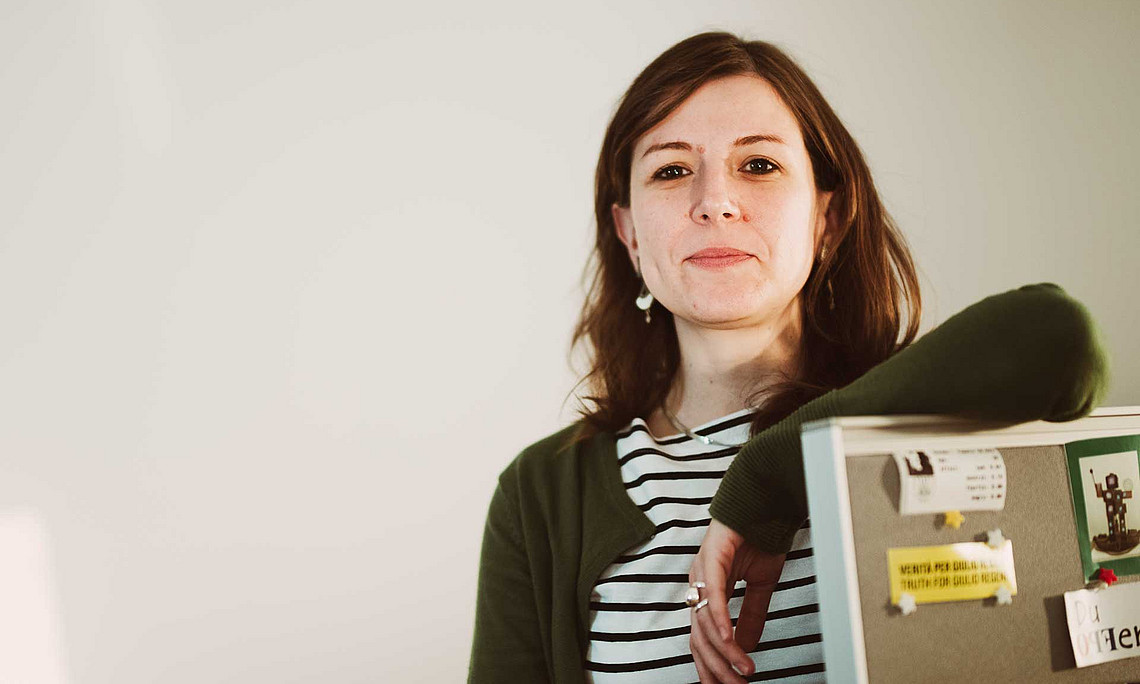
Chiara Pagano ©Uni Graz/Tzivanopoulos
©Uni Graz/Tzivanopoulos

Chiara Pagano's research focuses on migration policy at the EU's external borders. Photo: Uni Graz/Tzivanopoulos

It's an experiment. With high costs. With people. Italy has already sent migrants picked up in international waters to the Gjader hotspot in Albania, which was set up the previous year, three times. There they were to undergo the so-called accelerated border procedure for asylum. And three times, the Italian authorities had to take the asylum seekers, who were all men, back. Chiara Pagano, a researcher in the Graz-based university project "Elastic Borders”, gives insights into a legally complex situation.

In fact, the Italian court of appeal too, which was recently entrusted these decisions by governmental decree of 23 October 2024, eventually did not validate the administrative detention orders. Instead, it decided to wait for the European Court of Justice’s assessment on the “safe country of origin”. Only then National courts will be provided with clearer guidelines on the determination of which migrants may be subject to an accelerated border procedure in Europe, if any. Such a procedure, which is currently being experimented with in a few countries at the EU external borders, will be key to the functioning of the New EU's asylum and migration pact, which will enter into force in March 2026. Chiara Pagano, a researcher in the Graz University project “Elastic Borders”, is working on the development of the EU's external borders and summarises the current state of the dispute:

“That Italian judges are against Italy operating Hotspots and Repatriation centers in Albania is a very widespread yet inaccurate opinion. The Italian courts that have been so far involved in the issue do not fundamentally question the operation of the Albanian camps. What they refuse to validate is asylum seekers’ administrative detention beyond the 48 hours provided by the Italian legislation on immigration. Such a validation is instrumental to the implementation of accelerated border procedures to which migrants transferred to Albania are to be subjected. However, it is at present advocated by Italian public security authorities operating the centers in Albania according to the very much disputed criteria of the 'Safe third country of origin'. Now, referring to a decision by the European Court of Justice (ECJ), Rome ordinary court first, and the Court of Appeal more recently, have repeatedly stated that it is not possible to determine that countries such as Bangladesh or Egypt are safe and, therefore, that is not possible to detain asylum seekers originating from these countries so as to subject them to accelerated border procedures. Decisions as such have not only impacted the implementation of accelerated border procedures in Albania, but in Italy too. In fact, the ordinary courts of Catania and Palermo have also refrained from validating detention orders of migrants originating from these countries who were transferred to the hotspot of Pozzallo-Modica and Porto Empedocle, in Sicily, to be subjected to accelerated border procedures. What makes the case of asylum seekers transferred to the hotspot in Albania peculiar is that, according to the Italy-Albania protocol, once freed from administrative detention these persons cannot be legally released in Albania, as this would be tantamount to smuggling. This is why Italian authorities must immediately transfer them to Italy upon their release. 
Giorgia Meloni’s government initially tried to react to the limitations arising from the ECJ ruling by drawing up a new list of safe countries of origin. However, this did not change Rome court’s decision. The executive then tried to bypass this Court by forwarding directly to the Court of Appeal all decisions on the validation of detention orders for people transferred to Albania, which also means that no further legal remedies could be applied. As we have recently seen, this attempt also revealed a failure, after the Court of Appeal suspended any decision on the detention of migrants brought to Albania until the European Court of Justice will express its advice on the determination of third safe countries of origin on February 25. 
One fact is that the so-far unsuccessful experience of offshoring Italian hotspot procedures to Albania has already been extremely expensive for Italian taxpayers. Building and operating these camps will cost at least 800 million euros for five years. And yet, if they ever become operative, the Albanian camps will host a maximum of 3,000 people at a time, and a maximum of 36,000 people per year by the Government’s own admission. This is an already unrealistic number, considering the expected length of procedures and the limitation to 3,000 contemporary presences. Moreover, these modest figures contrasts with the 66,317 arrivals registered in Italy in 2024 alone – an extremely low number compared to 2023, when the number of arrivals was 58% higher, as well as to the years before. 
With the so-called 'Albania model' Italy is already testing procedures that are to be implemented throughout the EU next year, as a result of the entering into force of the new pact on asylum and migration. Among other things, this provides for fast-track assessments of asylum requests at the EU's external borders, which will lead to the proliferation of administrative detention measures to the detriment of people on the move from a new EU list of supposedly safe third countries. It can be anticipated that such developments will also dramatically worsen the situation for asylum seekers in Italy.”

⇒ Learn more about the research of Chiara Pagano

 

created by Protokolliert von Andreas Schweiger

Related news

ERC Starting Grants: three million euros for two researchers at the University of Graz

Two researchers from the University of Graz have secured prestigious and generously funded grants from the EU. Starting Grants from the European Research Council (ERC), each worth 1.5 million euros, have been awarded to the human geographer Heide Bruckner and the social scientist Silvana Weiss.

Austria’s emissions rose in 2025: University of Graz researchers analyse the causes

The Environment Agency Austria has today published the figures for the country’s greenhouse gas emissions in 2025. While emissions fell sharply year on year from 2022 to 2024, they rose again by just under 0.7 per cent in 2025. Researchers at the University of Graz have analysed how much of this increase was due to structural changes in the economy and how much was attributable to external factors over which there is little control. “In 2025, the colder winter compared with 2024 increased emissions by 0.81 per cent, while the weak economy reduced them by 0.38 per cent. If we factor out these influences, we find an underlying increase of 0.26 per cent compared with the previous year,” reports economist Karl Steininger. “This clearly means that Austria is not on track to meet its climate targets, which require a substantial reduction in emissions by 2030.”

Electrifying: Researchers film the first moments on the way from light to electricity

Physicists at the University of Graz (Austria), in collaboration with colleagues from Marburg University and Forschungszentrum Jülich (Germany), have achieved a scientific breakthrough. For the first time, the generation of electrical energy from light has been filmed and described theoretically. This work is of far-reaching significance, not least for optimising sustainable energy production from photovoltaics. This is because it provides fundamental building blocks for understanding the physical processes that take place, for example, in organic solar cells. The paper was published in the journal Physical Review X, one of the world’s most prestigious physics journals.

Deported and given up: the fate of migrants in Tunisia

We don't like to look at the situation of migrants in Tunisia. Chiara Pagano does. The scientist is concerned with the developments there and the situation of refugees who dream of Europe but live a nightmare in North Africa. Deportation, arrest and violence are part of their everyday lives, which the researcher is making visible as part of the ‘Elastic Borders’ project.

Begin of page section:
Additional information:

University of Graz
Universitaetsplatz 3
8010 Graz
Austria
  • Contact
  • Web Editors
  • Moodle
  • UNIGRAZonline
  • Imprint
  • Data Protection Declaration
  • Accessibility Declaration
Weatherstation
Uni Graz

End of this page section. Go to overview of page sections

End of this page section. Go to overview of page sections

Begin of page section:

End of this page section. Go to overview of page sections