Begin of page section:
Page sections:

  • Go to contents (Accesskey 1)
  • Go to position marker (Accesskey 2)
  • Go to main navigation (Accesskey 3)
  • Go to sub navigation (Accesskey 4)
  • Go to additional information (Accesskey 5)
  • Go to page settings (user/language) (Accesskey 8)
  • Go to search (Accesskey 9)

End of this page section. Go to overview of page sections

Begin of page section:
Page settings:

English en
Deutsch de
Search
Login

End of this page section. Go to overview of page sections

Begin of page section:
Search:

Search for details about Uni Graz
Close

End of this page section. Go to overview of page sections


Search

Begin of page section:
Main navigation:

Page navigation:

  • University

    University
    • About the University
    • Organisation
    • Faculties
    • Library
    • Working at University of Graz
    • Campus
    Developing solutions for the world of tomorrow - that is our mission. Our students and our researchers take on the great challenges of society and carry the knowledge out.
  • Research Profile

    Research Profile
    • Our Expertise
    • Research Questions
    • Research Portal
    • Promoting Research
    • Research Transfer
    • Ethics in Research
    • Commission for Scientific Integrity
    Scientific excellence and the courage to break new ground. Research at the University of Graz creates the foundations for making the future worth living.
  • Studies

    Studies
    • Prospective Students
    • Students
    • Welcome Weeks for First Year Students
  • Community

    Community
    • International
    • Location
    • Research and Business
    • Alumni
    The University of Graz is a hub for international research and brings together scientists and business experts. Moreover, it fosters the exchange and cooperation in study and teaching.
Topics
  • Sustainable University
  • Researchers answer
  • Work for us
Close menu

End of this page section. Go to overview of page sections

Begin of page section:
You are here:

University of Graz News Asiatische Metropolen

End of this page section. Go to overview of page sections

Tuesday, 19 March 2013

Asiatische Metropolen
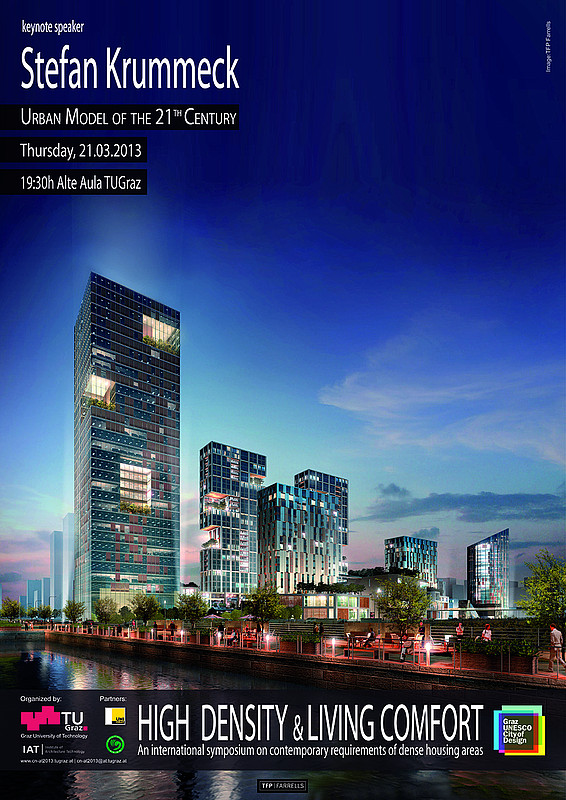
Plakat zum Kongress

Bevölkerungsexplosion verlangt zukunftsfähige Baukonzepte: Internationale Konferenz von TU Graz und Konfuzius-Institut der Uni Graz

In China leben bereits in 86 Städten über fünf Millionen Menschen: Die rasant steigenden Einwohnerzahlen in asiatischen Metropolen stellen Stadtentwicklung und Wohnbau vor große Herausforderungen. Im Rahmen der internationalen Konferenz „High Density & Living Comfort“ thematisieren Wissenschafterinnen und Wissenschafter, wie sich Klimaschutz und Wohnkomfort in asiatischen Städten auf engstem Raum in Einklang bringen lassen. Die Konferenz des Instituts für Architekturtechnologie der TU Graz in Partnerschaft mit dem Konfuzius-Institut der Uni Graz ist öffentlich zugänglich und findet von 21. bis 22. März 2013 statt – Medienvertreterinnen und -vertreter sind herzlich willkommen.

In Wolkenkratzern integrierte Gärten, Balkone in 150 Metern Höhe und winddurchlässige Fassadensysteme: Das rasante Wachstum dicht besiedelter Städte in Asien erfordert zukunftsfähige Architektur- und Stadtplanungskonzepte. Mit dem Boom asiatischer Metropolen gehen zahlreiche Probleme einher, beispielsweise ein steigender Energieverbrauch und ein erhöhter CO2-Ausstoß. In den südostchinesischen Ballungsgebieten herrscht ein feuchtes subtropisches Klima mit fast 100 Prozent Luftfeuchte und Temperaturen um die 40 Grad Celsius. Im Gebäudeinneren ist ein Wohnklima mit 50 Prozent Luftfeuchte und 22 Grad Celsius angenehm – der immense Energiebedarf für Klimaanlagen wird hier zur unvorstellbaren Umweltbelastung.

Ressourcenschonende Architekturkonzepte


Wo Grünflächen und öffentlicher Raum immer mehr Wolkenkratzern weichen müssen und der private Wohnbereich sehr beengt ist, ist auch das reibungslose Zusammenleben von Millionen von Menschen eine große Herausforderung. Architektonische Zukunftsstrategien für asiatische Metropolen zum Thema zu machen, ist daher das Ziel der gemeinsamen Konferenz „High Density & Living Comfort“ der TU Graz und der Uni Graz:
„Wir müssen jetzt beginnen, uns konkrete Zukunftsstrategien für diese boomenden Metropolen zu überlegen. Der Wissensaustausch mit asiatischen Expertinnen und Experten steht bei unserer Konferenz im Mittelpunkt mit der Intention, gemeinsam ressourcenschonende Architekturkonzepte voranzutreiben“, erklärt Ferdinand Oswald vom Institut für Architekturtechnologie der TU Graz, das unter der Leitung von Roger Riewe auch für die inhaltliche Koordination der Konferenz verantwortlich ist. Das Konfuzius-Institut unterstützt die Vernetzung sowohl nach China als auch am Standort Graz. „Neben dem kulturellen Angebot wollen wir verstärkt wissenschaftliche Akzente setzen“, unterstreicht Institutsleiterin Daniela Unger-Ullmann.

Drei Ebenen der Zukunft

Internationale Expertinnen und Experten – aus China, Deutschland, Großbritannien, Kanada, Schweiz, Singapur, Südkorea und Österreich – bündeln bei der Grazer Tagung ihr Fachwissen und wollen gemeinsam neue Lösungen zum Thema Bauen auf engem Raum entwickeln. Die Konferenz nähert sich auf drei Ebenen den verdichteten Stadt- und Siedlungsstrukturen:
Stadtplanung, Wohntypologien und Gebäude- und Fassadentechnologien. Das Programm der Tagung umfasst zehn öffentlich zugängliche Vorträge und anschließende interne Workshops, in denen internationale Doktoratsstudierende mit den Expertinnen und Experten an konkreten Forschungsfragen arbeiten.

Neue Wege der Architektur

Im Rahmen der Tagung findet auch die Ausstellung „Structure & Facade“ statt, die innovative Architekturkonzepte und Fassadensysteme des TU-Instituts für Architekturtechnologie in den Mittelpunkt rückt. „Mit der Konferenz ist die Arbeit an zukunftsfähigen Bautechnologien für asiatische Großstädte natürlich noch nicht getan: Die Erkenntnisse der Tagung fließen in unsere Forschungsprojekte ‚Sustainable facade and construction design strategies‘ und „Sustainable Living in High Density Structures“ mit der Chinesischen Universität Hongkong ein“, so Oswald.


„High Density & Living Comfort“
Termin: 21. - 22. März 2013
Orte: Aula der TU Graz, Rechbauerstraße 12

created by Susanne Eigner (TU Graz) & Andreas Schweiger

Related news

A fresh start, a calling, holidays: what draws people from other career paths to teaching

They used to develop software; now they teach maths in the classroom. Career changers are expected to help address the shortage of qualified teachers in Austria’s schools. In their doctoral theses at the Institute for Educational Research and Teacher Training at the University of Graz, Melanie Gürentz and Claudia Mair examined how these new teachers perceive their new professional roles.

Talent Talks bridge the gap in career guidance

The Styrian Chamber of Commerce (WKO Steiermark), the Styrian Chamber of Labour (AK Steiermark) and the AMS are joining forces when it comes to training young people and, through the “Talent Talks”, are creating a seamless pathway to career guidance. This takes preparation and follow-up support – just in time for the start of the term and the scheme’s tenth anniversary – to a whole new level. A new survey conducted by the Talent Centre among 2,687 former participants to mark the anniversary shows just how important this development is. Of the young people who received follow-up support from the Talent Report, 74.6 per cent stated that they had a good understanding of their own strengths and talents following the Talent Check. Without follow-up support, the figure was 66.5 per cent – a significant difference of 8.1 percentage points.

ERC Starting Grants: three million euros for two researchers at the University of Graz

Two researchers from the University of Graz have secured prestigious and generously funded grants from the EU. Starting Grants from the European Research Council (ERC), each worth 1.5 million euros, have been awarded to the human geographer Heide Bruckner and the social scientist Silvana Weiss.

Austria’s emissions rose in 2025: University of Graz researchers analyse the causes

The Environment Agency Austria has today published the figures for the country’s greenhouse gas emissions in 2025. While emissions fell sharply year on year from 2022 to 2024, they rose again by just under 0.7 per cent in 2025. Researchers at the University of Graz have analysed how much of this increase was due to structural changes in the economy and how much was attributable to external factors over which there is little control. “In 2025, the colder winter compared with 2024 increased emissions by 0.81 per cent, while the weak economy reduced them by 0.38 per cent. If we factor out these influences, we find an underlying increase of 0.26 per cent compared with the previous year,” reports economist Karl Steininger. “This clearly means that Austria is not on track to meet its climate targets, which require a substantial reduction in emissions by 2030.”

Begin of page section:
Additional information:

University of Graz
Universitaetsplatz 3
8010 Graz
Austria
  • Contact
  • Web Editors
  • Moodle
  • UNIGRAZonline
  • Imprint
  • Data Protection Declaration
  • Accessibility Declaration
Weatherstation
Uni Graz

End of this page section. Go to overview of page sections

End of this page section. Go to overview of page sections

Begin of page section:

End of this page section. Go to overview of page sections