Begin of page section:
Page sections:

  • Go to contents (Accesskey 1)
  • Go to position marker (Accesskey 2)
  • Go to main navigation (Accesskey 3)
  • Go to sub navigation (Accesskey 4)
  • Go to additional information (Accesskey 5)
  • Go to page settings (user/language) (Accesskey 8)
  • Go to search (Accesskey 9)

End of this page section. Go to overview of page sections

Begin of page section:
Page settings:

English en
Deutsch de
Search
Login

End of this page section. Go to overview of page sections

Begin of page section:
Search:

Search for details about Uni Graz
Close

End of this page section. Go to overview of page sections


Search

Begin of page section:
Main navigation:

Page navigation:

  • University

    University
    • About the University
    • Organisation
    • Faculties
    • Library
    • Working at University of Graz
    • Campus
    Developing solutions for the world of tomorrow - that is our mission. Our students and our researchers take on the great challenges of society and carry the knowledge out.
  • Research Profile

    Research Profile
    • Our Expertise
    • Research Questions
    • Research Portal
    • Promoting Research
    • Research Transfer
    • Ethics in Research
    • Commission for Scientific Integrity
    Scientific excellence and the courage to break new ground. Research at the University of Graz creates the foundations for making the future worth living.
  • Studies

    Studies
    • Prospective Students
    • Students
  • Community

    Community
    • International
    • Location
    • Research and Business
    • Alumni
    The University of Graz is a hub for international research and brings together scientists and business experts. Moreover, it fosters the exchange and cooperation in study and teaching.
Topics
  • Sustainable University
  • Researchers answer
  • Work for us
Close menu

End of this page section. Go to overview of page sections

Begin of page section:
You are here:

University of Graz News Arctic adventure: Florina Schalamon on the challenges facing female polar explorers

End of this page section. Go to overview of page sections

Wednesday, 17 July 2024

Arctic adventure: Florina Schalamon on the challenges facing female polar explorers

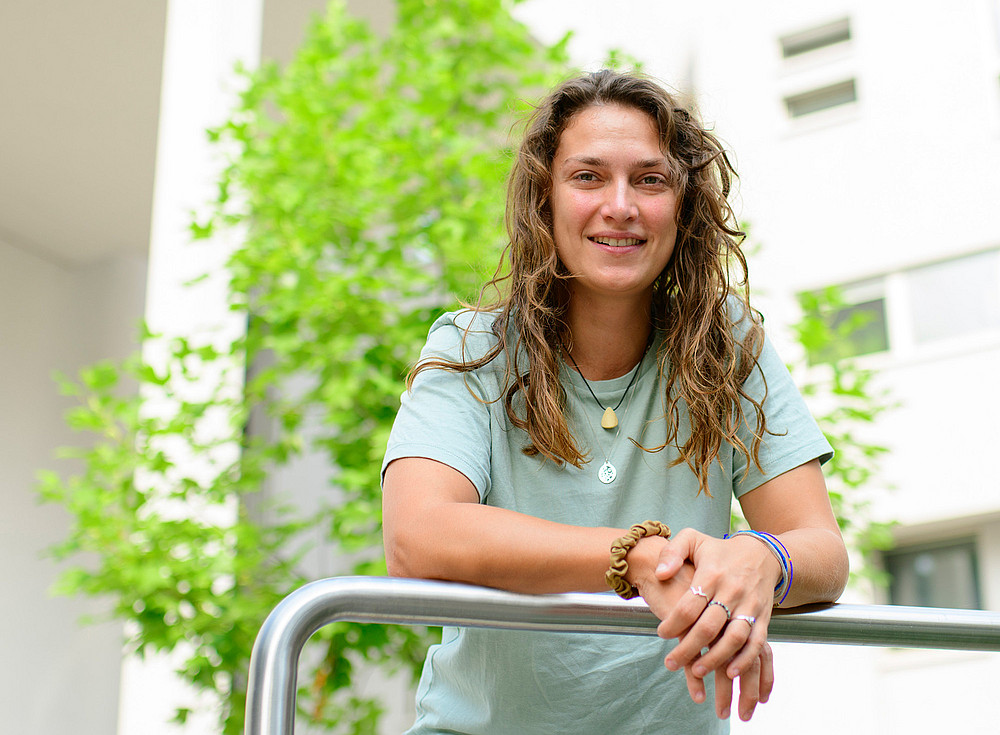
Florina Schalamon, leaning on a railing with her forearms, in front of a white building and green tree ©University of Graz/Tzivanopoulos

Polar researcher Florina Schalamon is a doctoral student at the Department of Geography and Regional Science at the University of Graz. Photo: Uni Graz/Tzivanopoulos

Field research at the end of the world. On a ship in the Arctic Ocean, in a remote station or in a tent in the far north, at minus 40 degrees. A real adventure. Florina Schalamon, a doctoral student at the University of Graz, has already had some of such experiences. She is currently investigating changes in Greenland's glaciers as a result of climate change. And she has another topic in her sights: the challenges that women in particular face during research stays in polar regions. In a recently published international study, Schalamon and her colleagues show why the adventure often holds extra hurdles for female scientists and how these can be overcome.

Florina Schalamon had already become interested in the Arctic during her bachelor's degree in physics in Mainz/Germany. The first time she went on a polar expedition was during her Master's degree in Meteorology. A stay abroad at the Svalbard University Center in Spitsbergen/Norway gave her ample opportunity for field research. "It was fascinating and exciting," says the scientist, who loves going on expeditions. She is now part of the team led by Jakob Abermann, Professor at the Institute of Geography and Spatial Research at the University of Graz.

Looking to the future with historical data

For her dissertation, Schalamon is investigating how various climate factors affect the Greenland ice and how these relationships have changed over the last century. "The ice on the world's largest island has a significant influence on the global sea level, which is why it is so important to closely monitor what is happening," explains Schalamon. In her research, she can draw on unique historical data from the world-famous meteorologist and geophysicist Alfred Wegener. The professor at the University of Graz collected this data on his last expedition to Greenland, during which he died in 1930. The two years of the expedition coincided with an exceptionally warm period. The records are therefore well suited for comparison with current measurements. "We want to find out exactly how climate developments influence the glaciers and whether the mutual interactions are stable over time. I am currently comparing which weather systems prevail during the two warm periods and how often, and how this influences the air temperature. Of course, this always has an impact on the ice masses. If we understand this interaction better, we can also better predict future developments," says the researcher.

Bad climate for female polar researchers

Polar research is dependent on scientific work in the field. Compared to Wegener's time, expeditions today involve fewer hardships and dangers due to technical progress. However, they are still challenging, and not just because of the harsh nature. For women in particular, hierarchical, patriarchal structures and a lack of privacy can lead to additional stress. And thus to negative experiences, as Florina Schalamon knows. "Unconscious stereotypical role behavior and a lack of appreciation often make the work of female scientists more difficult. For example, there are cases where women are automatically assigned to prepare meals while the men sift through the collected data. Or that colleagues do not include them in scientific discussions," reports Schalamon. After all, everyday sexism is also present at the end of the world, and some topics relevant to women, such as menstruation, are still taboo. "Four out of five female colleagues have bad experiences in the field," says Schalamon, referring to the international survey she conducted together with researchers from Switzerland, Denmark, Canada, Australia, Ireland and England. The authors collected around 320 responses from female polar explorers from all over the world - most of them under the age of 40.

There is another way

The publication also presents concrete proposals for solutions. These range from the development of a code of conduct and corresponding training to a reporting system with consequences in the event of misconduct. "When selecting expedition participants, it would be important to pay attention to diversity as much as possible and to give people the opportunity to get to know each other in advance so that they can grow together as a team," adds Schalamon. In addition to the scientific objectives, important social and practical questions should also be clarified: Who will take on which tasks and at what intervals will they rotate? How do we treat each other respectfully? How do we address problems? What feedback options are available? Who takes on the role of a confidant? What do we eat? Where do we pee? Where do I have privacy? How do I deal with my menstruation? Where do we sleep? In short: What do we need to feel comfortable? If misconduct does occur in the field, it is important to talk about it with others instead of remaining silent and to support affected colleagues instead of looking the other way.

The study Coming in from the cold: Addressing the challenges experienced by women conducting remote polar fieldwork has been published in a special collection organised by the Association of Polar Early Career Scientists (APECS) and PLOS Climate.
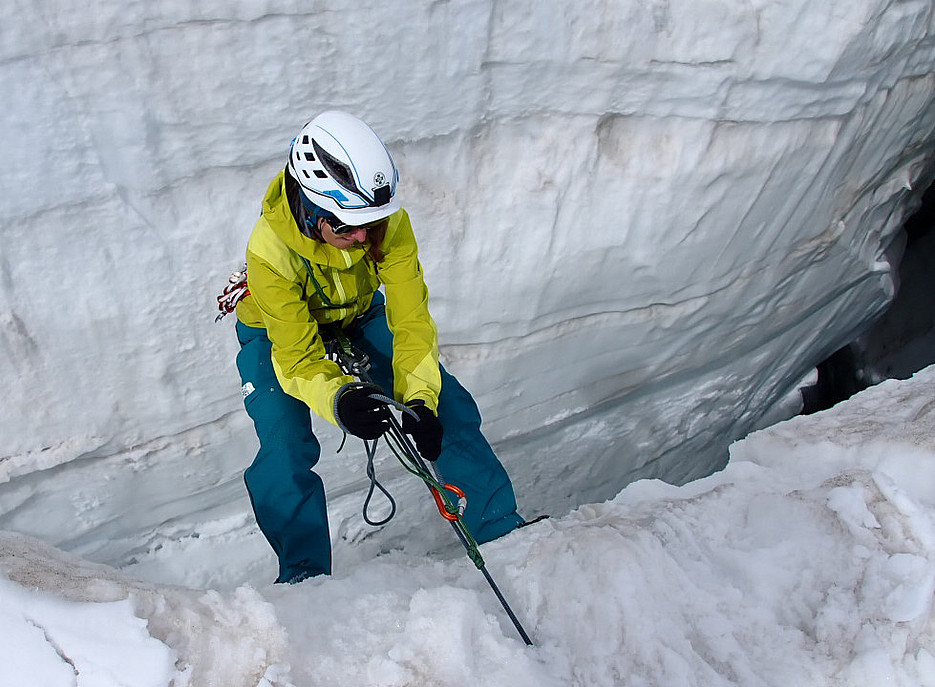
Woman with helmet and alpine clothing abseils into a crevasse ©Thomas Zölss
©Thomas Zölss
Florina Schalamon during glacier training. Photo: Thomas Zölss
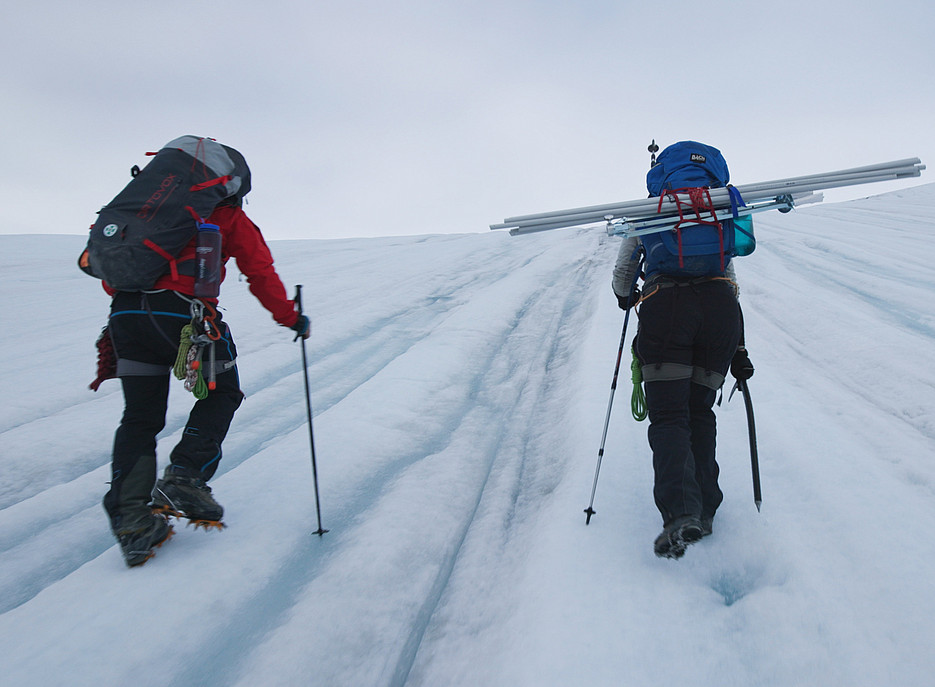
Two people with rucksacks and alpine equipment walk up a glacier ©Wally and Fauland
©Wally and Fauland
Expeditions into the eternal ice require fitness and expertise. Photo: Wally and Fauland
created by Gudrun Pichler

Related news

Superti-Furga will becomefounding director of the CORI Institute in Graz

The Austrian Academy of Sciences (ÖAW) is establishing a new flagship centre for research into metabolic diseases in collaboration with the three universities in Graz. This innovative research approach combines mathematics and experimental biology with artificial intelligence

A match for life

Stem cell donations save lives. However, the only way to determine who is ultimately compatible with whom is through a testing process. Pharmacist Marion Mußbacher explains the mechanisms behind this. On 6 May 2026, the ÖH and the charity “Geben für Leben” are calling for people to come forward for typing at the University of Graz.

Mild Research Night: Around 750 visitors travelled around the world at the university

Lovely weather and a wide range of research topics drew visitors to the University of Graz last Friday. Highlights included a journey around the globe in eight stops, a ‘speed-dating’ session with books, insights into Alfred Wegener’s Greenland expedition, and guided tours of the democracy exhibition at the UniGraz@Museum.

Career Booster: How the Research Careers Campus supports researchers

They are innovative, creative and productive – researchers who have not yet been appointed to a professorship make a massive contribution to a university’s research output. To provide them with even better support on their career path, the University of Graz has established the Research Careers Campus. The official launch took place on 22 April 2026 with a ‘festival’.

Begin of page section:
Additional information:

University of Graz
Universitaetsplatz 3
8010 Graz
Austria
  • Contact
  • Web Editors
  • Moodle
  • UNIGRAZonline
  • Imprint
  • Data Protection Declaration
  • Accessibility Declaration
Weatherstation
Uni Graz

End of this page section. Go to overview of page sections

End of this page section. Go to overview of page sections

Begin of page section:

End of this page section. Go to overview of page sections