Begin of page section:
Page sections:

  • Go to contents (Accesskey 1)
  • Go to position marker (Accesskey 2)
  • Go to main navigation (Accesskey 3)
  • Go to sub navigation (Accesskey 4)
  • Go to additional information (Accesskey 5)
  • Go to page settings (user/language) (Accesskey 8)
  • Go to search (Accesskey 9)

End of this page section. Go to overview of page sections

Begin of page section:
Page settings:

English en
Deutsch de
Search
Login

End of this page section. Go to overview of page sections

Begin of page section:
Search:

Search for details about Uni Graz
Close

End of this page section. Go to overview of page sections


Search

Begin of page section:
Main navigation:

Page navigation:

  • University

    University
    • About the University
    • Organisation
    • Faculties
    • Library
    • Working at University of Graz
    • Campus
    Developing solutions for the world of tomorrow - that is our mission. Our students and our researchers take on the great challenges of society and carry the knowledge out.
  • Research Profile

    Research Profile
    • Our Expertise
    • Research Questions
    • Research Portal
    • Promoting Research
    • Research Transfer
    • Ethics in Research
    Scientific excellence and the courage to break new ground. Research at the University of Graz creates the foundations for making the future worth living.
  • Studies

    Studies
    • Prospective Students
    • Students
  • Community

    Community
    • International
    • Location
    • Research and Business
    • Alumni
    The University of Graz is a hub for international research and brings together scientists and business experts. Moreover, it fosters the exchange and cooperation in study and teaching.
  • Spotlight
Topics
  • Our digital Advent calendar
  • Sustainable University
  • Researchers answer
  • Work for us
Close menu

End of this page section. Go to overview of page sections

Begin of page section:
You are here:

University of Graz News Arbeitsplätze für Menschen mit Behinderung
End of this page section. Go to overview of page sections

Monday, 27 November 2017

Arbeitsplätze für Menschen mit Behinderung

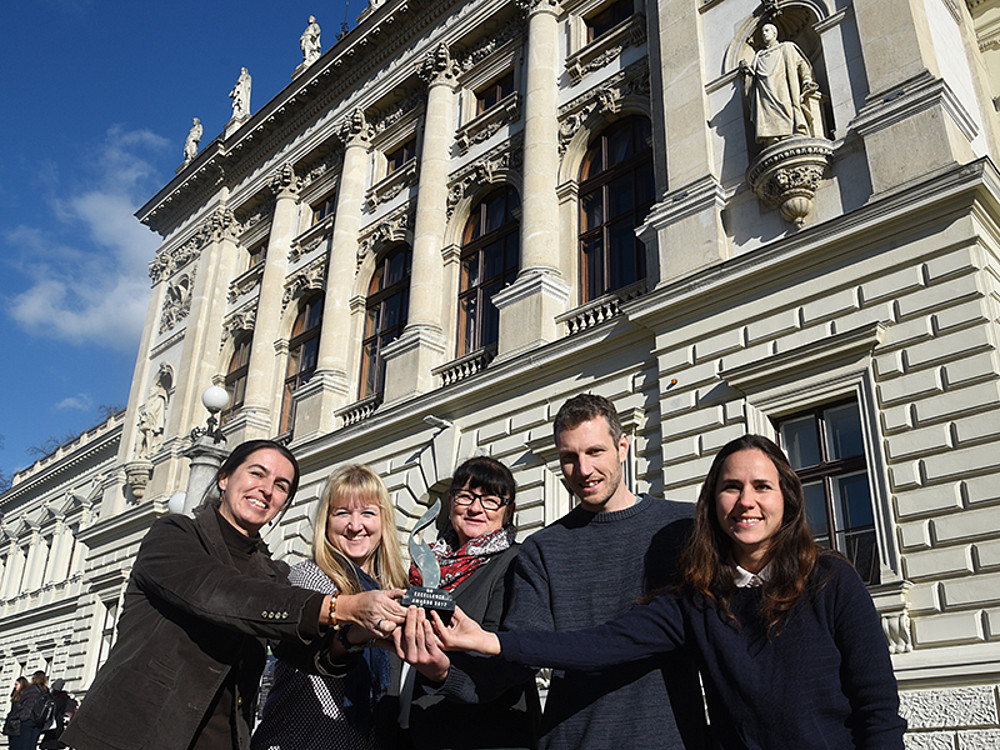
Human Resources Excellence Award für Initiative des Personalressorts der Uni Graz: Kerstin Käfer, Lydia Kurz, Eva Regle, Philippe Streit und Julia Goldgruber (v.l.) Foto: Uni Graz/Schweiger

Human Resources Excellence Award für Initiative des Personalressorts der Uni Graz: Kerstin Käfer, Lydia Kurz, Eva Regle, Philippe Streit und Julia Goldgruber (v.l.) Foto: Uni Graz/Schweiger

Uni Graz mit HR-Excellence-Award in Berlin ausgezeichnet

Menschen mit Behinderungen und/oder chronischen Erkrankungen Chancengleichheit in der Arbeitswelt einräumen: Diesem gesellschaftlichen Auftrag hat sich die Karl-Franzens-Universität Graz verpflichtet und dazu im Oktober 2016 das Projekt „Uniqability meets University – Nachhaltige Inklusion von Menschen mit Beeinträchtigung“ ins Leben gerufen. Ziel ist es, neue Arbeitsplätze, die ausschließlich behinderten Menschen zur Verfügung stehen, zu schaffen.
Knapp ein Jahr nach dem Start kann die Initiative eine erfolgreiche Bilanz vorweisen: Zusätzliche 56 Personen haben mittlerweile an der Uni Graz einen Arbeitsplatz gefunden. „Entscheidend für den Erfolg ist das spezielle Recruitingverfahren. Interessierte mit einer Behinderung bewerben sich nicht auf eine konkret ausgeschriebene Stelle, sondern von sich aus initiativ. Im Gespräch werden Fähigkeiten und Fertigkeiten der BewerberInnen identifiziert und unter Berücksichtigung der jeweiligen Beeinträchtigung ein entsprechender Arbeitsplatz eingerichtet“, schildert Projektleiterin Eva Regele vom Personalressort der Uni Graz.

Für die verstärkten Maßnahmen erhielt die Uni Graz am 24. November 2017 in Berlin den Human Resources Excellence Award 2017 in der in der Kategorie „Diversity Management“ für KMU.
Die Human Resources Excellence Awards (HREA) zeichnet herausragende Personalarbeit in Unternehmen und öffentlichen Einrichtungen in Deutschland, Österreich und der Schweiz aus. Das Magazin „Human Resources Manager“ und die Quadriga würdigten heuer bereits zum sechsten Mal die innovativsten Strategien im Bereich des Personalmanagements.

created by Andreas Schweiger

Related news

Fair distribution: Researchers determine just greenhouse gas budgets for all EU regions

Ten years ago, on 12 December 2015, the Paris Climate Agreement was signed at the UN Climate Conference. In order to limit global warming to well below two degrees, only a certain amount of CO2 may be emitted worldwide. While the focus was originally on national emission targets, more than 200 subnational regions and almost 300 cities have now adopted their own targets. But how many emissions are they fairly entitled to? Researchers at the University of Graz have now developed transparent criteria for fair distribution at the subnational level for the first time and determined corresponding greenhouse gas budgets for all European regions. The paper was published today in the scientific journal Nature Communications.

Chemical Christmas show at the University of Graz: An explosive evening at the Schauspielh

At the beginning of December, the University of Graz transformed the theater into a laboratory: as part of “Chemical Life,” teacher training students staged a chemical Christmas show for Styrian school classes—complete with ethanol rockets, nitrogen snow, and glowing effects. An evening designed to inspire interest in studying chemistry.

Train by train: Koralm railway accelerates exchange between the Universities

Lectures at the University of Klagenfurt in the morning, seminars at the University of Graz in the afternoon: Austria's longest tunnel and a journey time of around 45 minutes make it easy. The Koralm railway increases the speed of networking between the two university locations. The collaboration builds on existing cooperation - for example in the areas of teacher training, Slavic studies and as employers, the universities are well coordinated.

On the trail of the Big Bang: University of Graz receives 1.5 million euros for doctoral programmes

The Austrian Science Fund FWF has selected the Doctoral Programme in Theoretical Particle Physics at the University of Graz for funding from the Doc.funds. Six young scientists will be funded for 3.5 years. They will gain fundamentally new insights into the origins of the world.

Begin of page section:
Additional information:

University of Graz
Universitaetsplatz 3
8010 Graz
Austria
  • Contact
  • Web Editors
  • Moodle
  • UNIGRAZonline
  • Imprint
  • Data Protection Declaration
  • Accessibility Declaration
Weatherstation
Uni Graz

End of this page section. Go to overview of page sections

End of this page section. Go to overview of page sections

Begin of page section:

End of this page section. Go to overview of page sections