Begin of page section:
Page sections:

  • Go to contents (Accesskey 1)
  • Go to position marker (Accesskey 2)
  • Go to main navigation (Accesskey 3)
  • Go to sub navigation (Accesskey 4)
  • Go to additional information (Accesskey 5)
  • Go to page settings (user/language) (Accesskey 8)
  • Go to search (Accesskey 9)

End of this page section. Go to overview of page sections

Begin of page section:
Page settings:

English en
Deutsch de
Search
Login

End of this page section. Go to overview of page sections

Begin of page section:
Search:

Search for details about Uni Graz
Close

End of this page section. Go to overview of page sections


Search

Begin of page section:
Main navigation:

Page navigation:

  • University

    University
    • About the University
    • Organisation
    • Faculties
    • Library
    • Working at University of Graz
    • Campus
    Developing solutions for the world of tomorrow - that is our mission. Our students and our researchers take on the great challenges of society and carry the knowledge out.
  • Research Profile

    Research Profile
    • Our Expertise
    • Research Questions
    • Research Portal
    • Promoting Research
    • Research Transfer
    • Ethics in Research
    • Commission for Scientific Integrity
    Scientific excellence and the courage to break new ground. Research at the University of Graz creates the foundations for making the future worth living.
  • Studies

    Studies
    • Prospective Students
    • Students
    • Registration for Study Programme (Winter semester 2026/27)
    • Welcome Weeks for First Year Students
  • Community

    Community
    • International
    • Location
    • Research and Business
    • Alumni
    The University of Graz is a hub for international research and brings together scientists and business experts. Moreover, it fosters the exchange and cooperation in study and teaching.
Topics
  • Sustainable University
  • Researchers answer
  • Work for us
Close menu

End of this page section. Go to overview of page sections

Begin of page section:
You are here:

University of Graz News Anita Ziegerhofer und Helmut Eberhart erhielten den Josef Krainer-Heimatpreis

End of this page section. Go to overview of page sections

Monday, 09 December 2024

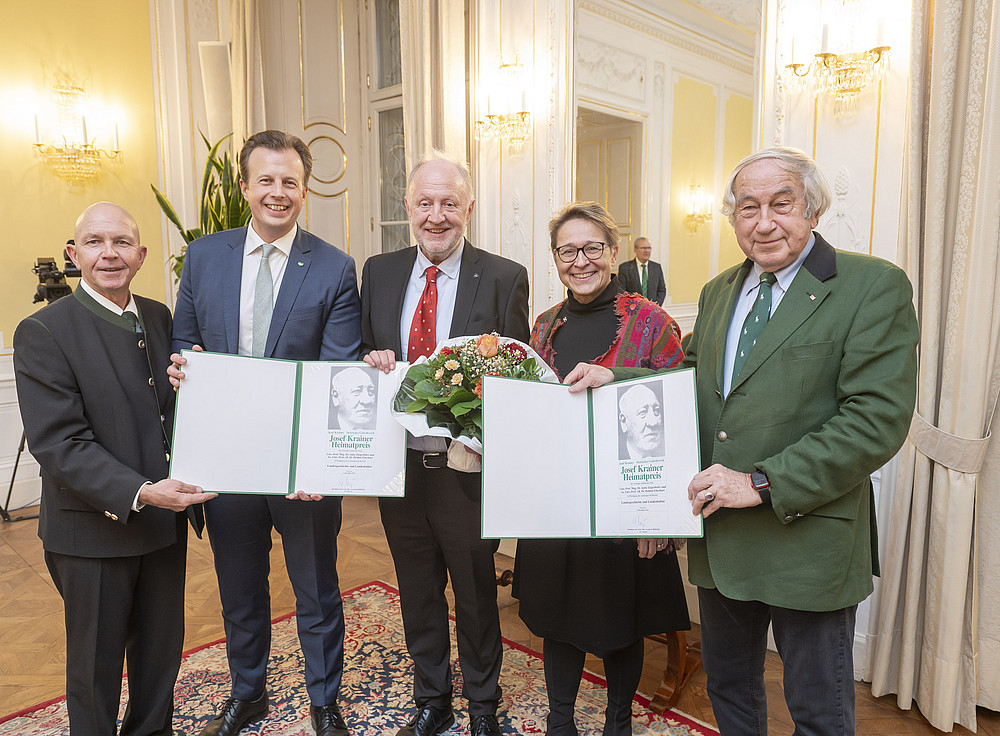
Anita Ziegerhofer und Helmut Eberhart erhielten den Josef Krainer-Heimatpreis

Josef Krainer-Heimatpreis: Michael Krainer, LR Karlheinz Kornhäusl, Helmut Eberhart, Anita Ziegerhofer und Gerald Schöpfer (v.l.) ©Foto Fischer
©Foto Fischer

Josef Krainer-Heimatpreis: Michael Krainer, LR Karlheinz Kornhäusl, Helmut Eberhart, Anita Ziegerhofer und Gerald Schöpfer (v.l.). Foto: Foto Fischer.

Vergangene Woche war es wieder soweit: Im Weißen Saal der Grazer Burg stand die feierliche Überreichung der Josef Krainer-Preise auf dem Programm. Landesrat Karlheinz Kornhäusl – in Vertretung von Landeshauptmann Christopher Drexler –, Gerald Schöpfer, Obmann des Josef Krainer-Steirischen Gedenkwerkes, und Michael Krainer als Familienvertreter zeichneten dabei verdiente Persönlichkeiten der Steiermark aus.

Seitens der Universität Graz erhielten die Wissenschaftler:innen Anita Ziegerhofer und Helmut Eberhart den Josef Krainer-Heimatpreis in den Bereichen Landesgeschichte und Landeskultur. Weitere Preisträger waren Franz Cserni (Unternehmer und Kunst), die Familie Grossauer (Gastronomie), Annemarie Schlack (Kinder- und Menschenrechte), Spafudla (Musik) sowie Hans Stolz (Kultur). Den Großen Josef Krainer-Preis 2024 erhielten Wolfdieter Dreibholz und Karla Kowalski (beide Architektur). 


Von der Geschichte der Steiermark bis zum „Mythos Tankstelle“

Mit der Professur für Rechtsgeschichte im Jahr 2021 schrieb Anita Ziegerhofer selbst Geschichte: Sie ist die erste Frau in diesem Fach an der Universität Graz seit der Gründung der Rechtswissenschaftlichen Fakultät im Jahr 1778. Ihre Forschung reicht von der europäischen Integrationsrechtsgeschichte ab dem 14. Jahrhundert bis hin zur Verfassungsrechtsentwicklung des 20. Jahrhunderts. Besonders die Gender-Dimensionen des Rechts sowie ihre regionalgeschichtlichen Arbeiten, wie etwa die „Geschichte der Steiermark ab 1918 - Vom Rand ins Zentrum”, prägen ihr wissenschaftliches Profil.

Die Forschungsschwerpunkte von Helmut Eberhart umfassen Fachgeschichte, Wallfahrtsforschung, den Strukturwandel im ländlichen Raum sowie kulturelle Aspekte Südosteuropas. Helmut Eberhart lehrte an renommierten Universitäten weltweit, von Jerusalem über Wuhan bis Zürich. Für sein Engagement und seine wissenschaftlichen Verdienste wurde er mit zahlreichen Auszeichnungen geehrt, darunter das Große Ehrenzeichen des Landes Steiermark. Mit seinem jüngsten Werk, „Mythos Tankstelle” zeigt Helmut Eberhart erneut, wie alltägliche Orte zu spannenden Kulturgeschichten werden können.
 

>> Mehr zu allen Preisträger:innen 

created by Gerhild Leljak

Related news

Commissioned by NATO: University of Graz tests high-tech textiles

As part of an international project, antimicrobial and fire-resistant fabrics with UV protection are being developed in Zagreb. Pharmacists from the University of Graz are ensuring that these fabrics are skin-friendly.

The Arctic up close: ORF special feature on the University of Graz’s research station in S

Students from the University of Graz are spending two weeks conducting research at the Univerisity of Graz research station at the Sermilik Fjord in Greenland, which has been operational for three years. They are measuring glacial runoff, tracking ice melt in real time and installing weather stations. ORF is following the expedition and will be reporting on the special feature ‘Arctic Adventure’ across its various channels from 20 July.

Medicine for ants: Caffeine prolongs the life of infected insects

Black coffee stimulates us and acts against bacteria. So, can caffeine also be good for insects? Yes, confirm biologists of the University of Graz. When ants suffer from a fungal disease, they consume more caffeine and remain active for longer.

How formulas are making medicine more personalised

When Federica Caforio talks about the heart, it doesn’t sound like an operating theatre, but rather like equations, parameters and simulations. Yet this is precisely where the medical promise of her research lies: one day, clinical data will be used to create a digital twin of the heart – a virtual model that will enable a better understanding of diseases and allow for more personalised treatment plans. She will be presenting her research at the ‘ECMTB 2026’ mathematics conference.

Begin of page section:
Additional information:

University of Graz
Universitaetsplatz 3
8010 Graz
Austria
  • Contact
  • Web Editors
  • Moodle
  • UNIGRAZonline
  • Imprint
  • Data Protection Declaration
  • Accessibility Declaration
Weatherstation
Uni Graz

End of this page section. Go to overview of page sections

End of this page section. Go to overview of page sections

Begin of page section:

End of this page section. Go to overview of page sections