Begin of page section:
Page sections:

  • Go to contents (Accesskey 1)
  • Go to position marker (Accesskey 2)
  • Go to main navigation (Accesskey 3)
  • Go to sub navigation (Accesskey 4)
  • Go to additional information (Accesskey 5)
  • Go to page settings (user/language) (Accesskey 8)
  • Go to search (Accesskey 9)

End of this page section. Go to overview of page sections

Begin of page section:
Page settings:

English en
Deutsch de
Search
Login

End of this page section. Go to overview of page sections

Begin of page section:
Search:

Search for details about Uni Graz
Close

End of this page section. Go to overview of page sections


Search

Begin of page section:
Main navigation:

Page navigation:

  • University

    University
    • About the University
    • Organisation
    • Faculties
    • Library
    • Working at University of Graz
    • Campus
    Developing solutions for the world of tomorrow - that is our mission. Our students and our researchers take on the great challenges of society and carry the knowledge out.
  • Research Profile

    Research Profile
    • Our Expertise
    • Research Questions
    • Research Portal
    • Promoting Research
    • Research Transfer
    • Ethics in Research
    Scientific excellence and the courage to break new ground. Research at the University of Graz creates the foundations for making the future worth living.
  • Studies

    Studies
    • Prospective Students
    • Students
  • Community

    Community
    • International
    • Location
    • Research and Business
    • Alumni
    The University of Graz is a hub for international research and brings together scientists and business experts. Moreover, it fosters the exchange and cooperation in study and teaching.
  • Spotlight
Topics
  • Our digital Advent calendar
  • Sustainable University
  • Researchers answer
  • Work for us
Close menu

End of this page section. Go to overview of page sections

Begin of page section:
You are here:

University of Graz News Andere Seiten

End of this page section. Go to overview of page sections

Thursday, 20 April 2023

Andere Seiten

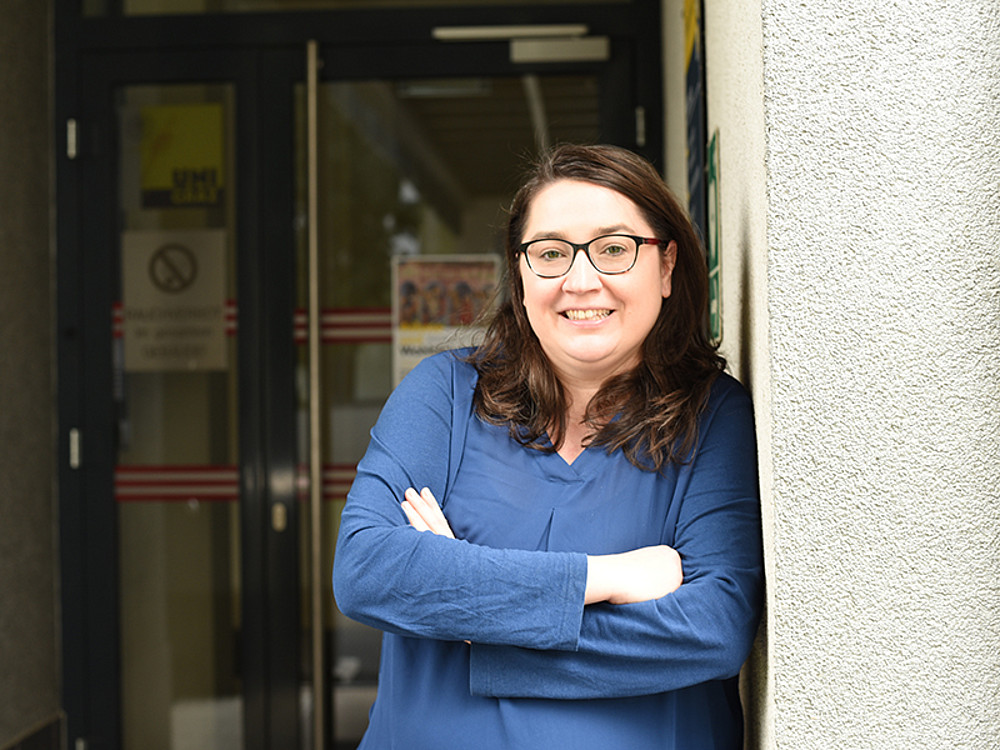
Wie funktioniert Leadership im Alten Testament? Das erforscht die Bibelwissenschaftlerin Katharina Pyschny. Foto: Uni Graz/Leljak.

Wie funktioniert Leadership im Alten Testament? Das erforscht die Bibelwissenschaftlerin Katharina Pyschny. Foto: Uni Graz/Leljak.

Wie funktioniert Leadership im Alten Testament? Das erforscht die Bibelwissenschaftlerin Katharina Pyschny

Man kann das Alte Testament als den Inbegriff von überholten Machtstrukturen lesen. Befehlsgewalt von Männern, strenge Hierarchien, Dominanz der Institutionen – all das zeigt uns die antike Traditionsliteratur zweifellos. Aber wer genauer hinsieht, entdeckt auch andere Seiten der Heiligen Schrift. „Es gibt Passagen, die für eine Verteilung von Herrschaft und Verantwortung plädieren. Sie stellen die Frage, was gute Leadership eigentlich ist“, umreißt Katharina Pyschny eines ihrer zentralen Forschungsthemen. Sie ist seit Oktober 2022 Professorin am Institut für Alttestamentliche Bibelwissenschaft der Uni Graz.

Anleitung zum Delegieren

Wer den Handlungsspielraum auf sich alleine konzentriert, keine Aufgaben abgeben kann und anderen nichts zutraut, läuft nicht nur selbst Gefahr, in ein Burn-out zu schlittern. Er oder sie riskiert auch Unzufriedenheit unter jenen, die er oder sie führen soll. Dieses Thema wird zum Beispiel im Buch Exodus angesprochen, erklärt Pyschny. In Ex18,18 führt Jitro seinem Schwiegersohn Moses – der als Richter sichtlich überfordert ist – vor Augen, was passiert, wenn dieser nicht lernt, loszulassen: „So richtest du dich selbst zugrunde und auch das Volk, das bei dir ist.“ In Ex18,22 wird Jitro noch konkreter: „Entlaste dich und lass auch andere Verantwortung tragen!“

Moses folgt dem Rat seines Schwiegervaters und ernennt Männer aus dem Volk, mit denen er sich künftig die richterlichen Aufgaben teilt. Katharina Pyschny unterstreicht auch die wichtige Rolle Jitros in einem Prozess, den wir heute als Mentoring bezeichnen würden. „Wie und warum Führungsansprüche im Alten Testament verhandelt bzw. als rechtens anerkannt werden, lässt sich auch an alttestamentlichen Figurinen von Prophet:innen oder Stammesältesten ablesen“, erzählt die Forscherin.

Der Mensch ist Körper, Geist und Seele

Ein zweiter Schwerpunkt der Bibelwissenschaftlerin, die von der Humboldt-Universität zu Berlin nach Graz gekommen ist, ist die Frage, wie Menschsein im Alten Testament dargestellt wird. Dieses Bild ist erstaunlich anschlussfähig an heutige Perspektiven, erklärt sie: „Der Mensch wird ganzheitlich, also als Einheit, gedacht. Wir sehen dieses Konzept sehr gut in der hebräischen Sprache. Es gibt darin Begriffe, die zugleich ein Körperorgan und die damit assoziierten Gefühle beschreiben“, erklärt Pyschny.

So bedeutet ʾaf gleichzeitig „Nase“ und „Zorn“, næfæš meint den Halsbereich, aber auch Vitalität, Lebenskraft oder Personalität. Und lēb, das Herz, hat im hebräischen Denken nicht unbedingt etwas mit Liebe oder Romantik zu tun, sondern ist das Entscheidungsorgan schlechthin. So lassen sich physische, kognitive und emotionale Aspekte nicht voneinander trennen. Das ist für die Forscherin auch die Brücke zum Heute: „Wir haben in der Covid-19-Pandemie erfahren, dass der Mensch nur in Verbindung mit anderen gut lebt und dass physischer Abstand nicht zur sozialen Isolation führen darf.“

created by Gerhild Leljak

Related news

Chemical Christmas show at the University of Graz: An explosive evening at the Schauspielh

At the beginning of December, the University of Graz transformed the theater into a laboratory: as part of “Chemical Life,” teacher training students staged a chemical Christmas show for Styrian school classes—complete with ethanol rockets, nitrogen snow, and glowing effects. An evening designed to inspire interest in studying chemistry.

Train by train: Koralm railway accelerates exchange between the Universities

Lectures at the University of Klagenfurt in the morning, seminars at the University of Graz in the afternoon: Austria's longest tunnel and a journey time of around 45 minutes make it easy. The Koralm railway increases the speed of networking between the two university locations. The collaboration builds on existing cooperation - for example in the areas of teacher training, Slavic studies and as employers, the universities are well coordinated.

On the trail of the Big Bang: University of Graz receives 1.5 million euros for doctoral programmes

The Austrian Science Fund FWF has selected the Doctoral Programme in Theoretical Particle Physics at the University of Graz for funding from the Doc.funds. Six young scientists will be funded for 3.5 years. They will gain fundamentally new insights into the origins of the world.

From trans women and knee prostheses: sports science prizes awarded

Walking better with a prosthesis, successfully getting rid of excess weight, training more effectively, more fairness for trans people in sport: these were the topics addressed by the students at the University of Graz who were awarded the sports science prizes for their Master's theses on 3 December 2025.

Begin of page section:
Additional information:

University of Graz
Universitaetsplatz 3
8010 Graz
Austria
  • Contact
  • Web Editors
  • Moodle
  • UNIGRAZonline
  • Imprint
  • Data Protection Declaration
  • Accessibility Declaration
Weatherstation
Uni Graz

End of this page section. Go to overview of page sections

End of this page section. Go to overview of page sections

Begin of page section:

End of this page section. Go to overview of page sections