Begin of page section:
Page sections:

  • Go to contents (Accesskey 1)
  • Go to position marker (Accesskey 2)
  • Go to main navigation (Accesskey 3)
  • Go to sub navigation (Accesskey 4)
  • Go to additional information (Accesskey 5)
  • Go to page settings (user/language) (Accesskey 8)
  • Go to search (Accesskey 9)

End of this page section. Go to overview of page sections

Begin of page section:
Page settings:

English en
Deutsch de
Search
Login

End of this page section. Go to overview of page sections

Begin of page section:
Search:

Search for details about Uni Graz
Close

End of this page section. Go to overview of page sections


Search

Begin of page section:
Main navigation:

Page navigation:

  • University

    University
    • About the University
    • Organisation
    • Faculties
    • Library
    • Working at University of Graz
    • Campus
    Developing solutions for the world of tomorrow - that is our mission. Our students and our researchers take on the great challenges of society and carry the knowledge out.
  • Research Profile

    Research Profile
    • Our Expertise
    • Research Questions
    • Research Portal
    • Promoting Research
    • Research Transfer
    • Ethics in Research
    Scientific excellence and the courage to break new ground. Research at the University of Graz creates the foundations for making the future worth living.
  • Studies

    Studies
    • Prospective Students
    • Students
  • Community

    Community
    • International
    • Location
    • Research and Business
    • Alumni
    The University of Graz is a hub for international research and brings together scientists and business experts. Moreover, it fosters the exchange and cooperation in study and teaching.
  • Spotlight
Topics
  • Our digital Advent calendar
  • Sustainable University
  • Researchers answer
  • Work for us
Close menu

End of this page section. Go to overview of page sections

Begin of page section:
You are here:

University of Graz News Amino acids stimulate protein partnership

End of this page section. Go to overview of page sections

Thursday, 25 January 2024

Amino acids stimulate protein partnership

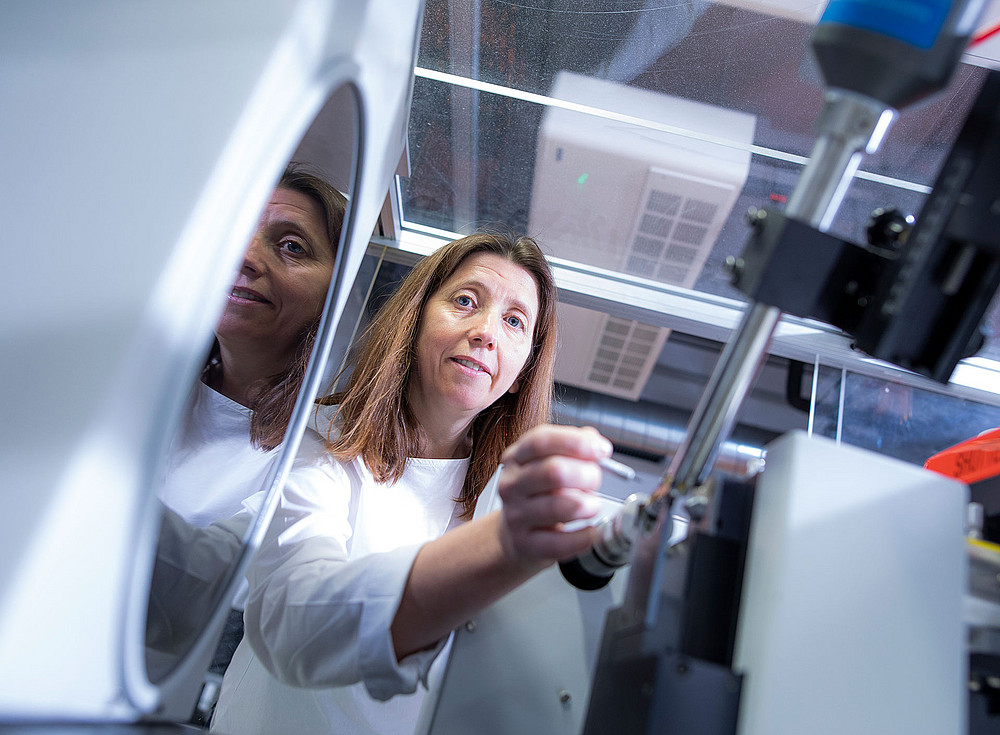
Monika Oberer at a research device ©Uni Graz / Kanizaj

Monika Oberer researches how proteins work in the cell, for a better understanding of the molecular mechanisms of lipid metabolism. Photo: Uni Graz / Kanizaj

It is one of the key enzymes for the lipid catabolism in the body: ATGL (adipose triglyceride lipase). It was discovered at the University of Graz in 2004. Stimulated by its partner protein CGI-58, it ensures the release of fatty acids into the bloodstream. This process is crucial for metabolic balance. Chronically elevated fatty acid levels are the cause of heart disease, fatty liver or diabetes, among other things. Inhibiting ATGL can alleviate these disorders. For new therapeutic approaches, it is therefore crucial to know the molecular mechanisms of action in detail. Scientists at the University of Graz have now discovered amino acids that are required in ATGL to be stimulated by CGI-58. The study was published in the Journal of Lipid Research.

ATGL massively increases its enzymatic activity by binding to CGI-58. This regulates and optimises the performance of this essential cellular machinery for lipid catabolism. The molecular mechanisms that regulate this interaction have so far remained largely unexplained. "We have now identified specific amino acids on a surface region of ATGL that are essential for the efficient stimulation of its activity by the partner protein," explains Monika Oberer, research group leader at the Department of Molecular Biosciences at the University of Graz.

On the way to this finding, the scientists combined biochemical and molecular biological methods with modern AI-based modeling techniques. "When analysing ATGL-like proteins in various organisms, we found amino acids that are always present in mammals, not so in plants and fungi," reports Oberer. From these, the team then identified those involved in the stimulation of ATGL by CGI-58 by using experimental laboratory technologies and complex 3D modeling. "Our study provides a comprehensive functional model for the interaction of partner proteins in lipid metabolism. This significantly improves our understanding of these central cellular processes," says the researcher, emphasising the significance of the publication.

Monika Oberer's research group is part of BioHealth, a Field of Excellence at the University of Graz.

Publication
Unmasking Crucial Residues in Adipose Triglyceride Lipase for Co-Activation with Comparative Gene Identification-58
Natalia Kulminskaya, Carlos Francisco Rodriguez Gamez, Peter Hofer, Ines Kathrin Cerk, Noopur Dubey, Roland Viertlmayr, Theo Sagmeister, Tea Pavkov-Keller, Rudolf Zechner, Monika Oberer
Journal of Lipid Research, DOI: 10.1016/j.jlr.2023.100491

created by Gudrun Pichler

Related news

Chemical Christmas show at the University of Graz: An explosive evening at the Schauspielh

At the beginning of December, the University of Graz transformed the theater into a laboratory: as part of “Chemical Life,” teacher training students staged a chemical Christmas show for Styrian school classes—complete with ethanol rockets, nitrogen snow, and glowing effects. An evening designed to inspire interest in studying chemistry.

Train by train: Koralm railway accelerates exchange between the Universities

Lectures at the University of Klagenfurt in the morning, seminars at the University of Graz in the afternoon: Austria's longest tunnel and a journey time of around 45 minutes make it easy. The Koralm railway increases the speed of networking between the two university locations. The collaboration builds on existing cooperation - for example in the areas of teacher training, Slavic studies and as employers, the universities are well coordinated.

On the trail of the Big Bang: University of Graz receives 1.5 million euros for doctoral programmes

The Austrian Science Fund FWF has selected the Doctoral Programme in Theoretical Particle Physics at the University of Graz for funding from the Doc.funds. Six young scientists will be funded for 3.5 years. They will gain fundamentally new insights into the origins of the world.

From trans women and knee prostheses: sports science prizes awarded

Walking better with a prosthesis, successfully getting rid of excess weight, training more effectively, more fairness for trans people in sport: these were the topics addressed by the students at the University of Graz who were awarded the sports science prizes for their Master's theses on 3 December 2025.

Begin of page section:
Additional information:

University of Graz
Universitaetsplatz 3
8010 Graz
Austria
  • Contact
  • Web Editors
  • Moodle
  • UNIGRAZonline
  • Imprint
  • Data Protection Declaration
  • Accessibility Declaration
Weatherstation
Uni Graz

End of this page section. Go to overview of page sections

End of this page section. Go to overview of page sections

Begin of page section:

End of this page section. Go to overview of page sections