Begin of page section:
Page sections:

  • Go to contents (Accesskey 1)
  • Go to position marker (Accesskey 2)
  • Go to main navigation (Accesskey 3)
  • Go to sub navigation (Accesskey 4)
  • Go to additional information (Accesskey 5)
  • Go to page settings (user/language) (Accesskey 8)
  • Go to search (Accesskey 9)

End of this page section. Go to overview of page sections

Begin of page section:
Page settings:

English en
Deutsch de
Search
Login

End of this page section. Go to overview of page sections

Begin of page section:
Search:

Search for details about Uni Graz
Close

End of this page section. Go to overview of page sections


Search

Begin of page section:
Main navigation:

Page navigation:

  • University

    University
    • About the University
    • Organisation
    • Faculties
    • Library
    • Working at University of Graz
    • Campus
    Developing solutions for the world of tomorrow - that is our mission. Our students and our researchers take on the great challenges of society and carry the knowledge out.
  • Research Profile

    Research Profile
    • Our Expertise
    • Research Questions
    • Research Portal
    • Promoting Research
    • Research Transfer
    • Ethics in Research
    Scientific excellence and the courage to break new ground. Research at the University of Graz creates the foundations for making the future worth living.
  • Studies

    Studies
    • Prospective Students
    • Students
  • Community

    Community
    • International
    • Location
    • Research and Business
    • Alumni
    The University of Graz is a hub for international research and brings together scientists and business experts. Moreover, it fosters the exchange and cooperation in study and teaching.
  • Spotlight
Topics
  • Our digital Advent calendar
  • Sustainable University
  • Researchers answer
  • Work for us
Close menu

End of this page section. Go to overview of page sections

Begin of page section:
You are here:

University of Graz News Extreme weather: Researchers at University of Graz study causes of heavy rain

End of this page section. Go to overview of page sections

Friday, 13 September 2024

Extreme weather: Researchers at University of Graz study causes of heavy rain

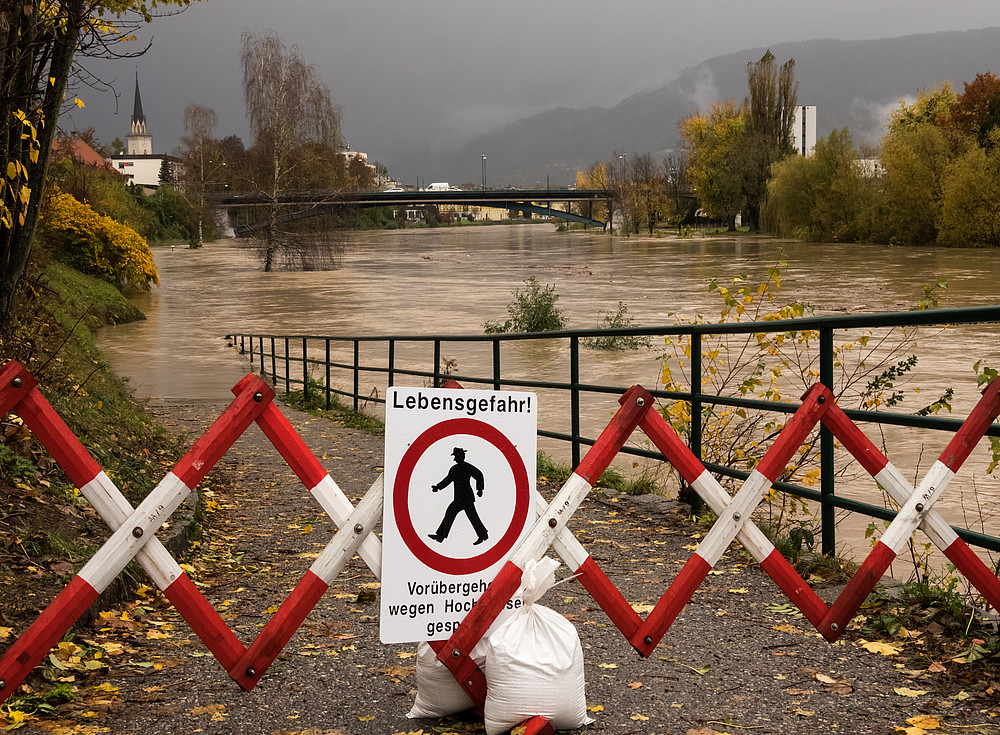
A "Lebensgefahr" sign is placed on the ground in front of an iron fence with red and white stripes, next to the flooded River Drau at Villach, Austria, during the autumn flood.

Heavy rainfall events associated with vB low pressure areas are becoming more intense. Photo: Adobe Stock/Rhombur

Researchers at the University of Graz are investigating how warm Mediterranean temperatures influence the intensity of heavy rain in Austria. Their research helps to better understand the dynamics of extreme Mediterranean weather conditions.

Suddenly, temperatures drop by 20 degrees and it rains for days. Meteorologists call such extreme weather conditions, which are currently occurring in mid-September, Vb weather conditions (five-b). They are not uncommon in Austria, Slovenia, Hungary and Slovakia, but they always pose a real challenge for the emergency services. At the University of Graz, scientists from Douglas Maraun's team are investigating how climate change affects these weather conditions and their effects.

“These low-pressure systems develop over the Mediterranean and move anticlockwise south of the Alps towards Austria,” explains the climate researcher. ‘The air is blocked by the mountains of the eastern Alps and it starts to rain.’ In August, the temperature of the Mediterranean reached 27 degrees, which has a major influence on the intensity of the precipitation. ”The air above it warms up and can then absorb a lot of moisture. This results in very heavy rain.”

More evaporation

As early as 2016, Maraun's research group at the Wegener Center for Climate and Global Change was already investigating how high temperatures in the Mediterranean influence precipitation levels in Austria. Using elaborate computer simulations, the researchers compared how warming of the Mediterranean Sea since the 1980s has changed precipitation along the path of Vb cyclones. “The number of Vb cyclones remained roughly the same in the simulations, but at higher temperatures, evaporation over the Mediterranean increased sharply,” says the climate expert. ‘This means that more moisture was transported along the storm tracks, which led to more intense extreme precipitation in the simulations.’ This situation is now also emerging in reality.

“The cause of the currently high sea temperatures is not 100 percent clear at present,” says Maraun. ”Although the long-term trend is largely due to climate change, there are other factors involved.” For example, new emissions standards for ships have been issued to protect the environment. “This is actually a paradox: we now have much cleaner air over the Mediterranean Sea. But as a result, less sunlight is reflected, which further intensifies warming.” Due to climate change, an intensification of heavy precipitation must also be expected in the future, the climate researcher concludes.

created by Roman Vilgut

Related news

On the trail of the Big Bang: University of Graz receives 1.5 million euros for doctoral programmes

The Austrian Science Fund FWF has selected the Doctoral Programme in Theoretical Particle Physics at the University of Graz for funding from the Doc.funds. Six young scientists will be funded for 3.5 years. They will gain fundamentally new insights into the origins of the world.

From trans women and knee prostheses: sports science prizes awarded

Walking better with a prosthesis, successfully getting rid of excess weight, training more effectively, more fairness for trans people in sport: these were the topics addressed by the students at the University of Graz who were awarded the sports science prizes for their Master's theses on 3 December 2025.

Influential: Rupert Baumgartner and Holger Hoff among the highly cited researchers

The number of publications in scientific journals is considered to be a measure of a researcher's scientific achievement. How often these works are cited by colleagues provides information about the relevance of the publications. Sustainability researcher Rupert Baumgartner and transdisciplinarity expert Holger Hoff from the University of Graz are among the top 1 per cent of the most cited scientists in their fields of research.

Nobel Lecture 2025: How evolution enters chemistry

During the Nobel Lecture at BioTechMed-Graz, Nobel Prize winner in Chemistry Frances H. Arnold provided insight into her research on the directed evolution of enzymes.

Begin of page section:
Additional information:

University of Graz
Universitaetsplatz 3
8010 Graz
Austria
  • Contact
  • Web Editors
  • Moodle
  • UNIGRAZonline
  • Imprint
  • Data Protection Declaration
  • Accessibility Declaration
Weatherstation
Uni Graz

End of this page section. Go to overview of page sections

End of this page section. Go to overview of page sections

Begin of page section:

End of this page section. Go to overview of page sections