Begin of page section:
Page sections:

  • Go to contents (Accesskey 1)
  • Go to position marker (Accesskey 2)
  • Go to main navigation (Accesskey 3)
  • Go to sub navigation (Accesskey 4)
  • Go to additional information (Accesskey 5)
  • Go to page settings (user/language) (Accesskey 8)
  • Go to search (Accesskey 9)

End of this page section. Go to overview of page sections

Begin of page section:
Page settings:

English en
Deutsch de
Search
Login

End of this page section. Go to overview of page sections

Begin of page section:
Search:

Search for details about Uni Graz
Close

End of this page section. Go to overview of page sections


Search

Begin of page section:
Main navigation:

Page navigation:

  • University

    University
    • About the University
    • Organisation
    • Faculties
    • Library
    • Working at University of Graz
    • Campus
    Developing solutions for the world of tomorrow - that is our mission. Our students and our researchers take on the great challenges of society and carry the knowledge out.
  • Research Profile

    Research Profile
    • Our Expertise
    • Research Questions
    • Research Portal
    • Promoting Research
    • Research Transfer
    • Ethics in Research
    • Commission for Scientific Integrity
    Scientific excellence and the courage to break new ground. Research at the University of Graz creates the foundations for making the future worth living.
  • Studies

    Studies
    • Prospective Students
    • Students
  • Community

    Community
    • International
    • Location
    • Research and Business
    • Alumni
    The University of Graz is a hub for international research and brings together scientists and business experts. Moreover, it fosters the exchange and cooperation in study and teaching.
  • Spotlight
Topics
  • Sustainable University
  • Researchers answer
  • Work for us
Close menu

End of this page section. Go to overview of page sections

Begin of page section:
You are here:

University of Graz News 164 gegen 70.000

End of this page section. Go to overview of page sections

Thursday, 16 March 2017

164 gegen 70.000

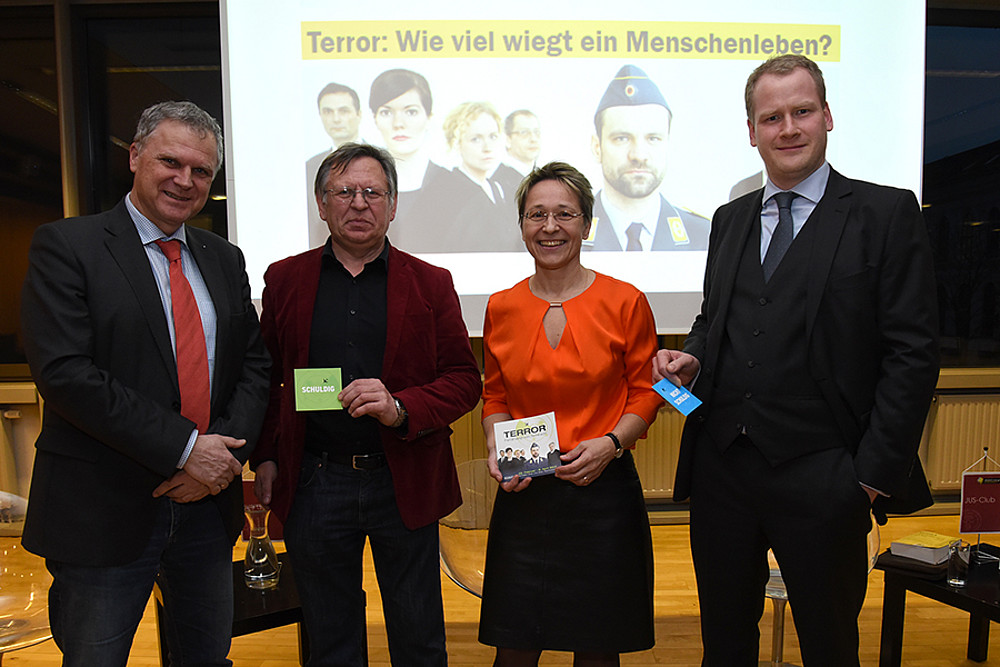
Fesselndes Thema, spannende Diskussion: Leitender Staatsanwalt Thomas Mühlbacher, Ethiker Leopold Neuhold, Rechtswissenschafterin Anita Ziegerhofer und Verfassungsrechtler Christoph Bezemek (v.l.) Foto: Uni Graz/Schweiger

Fesselndes Thema, spannende Diskussion: Leitender Staatsanwalt Thomas Mühlbacher, Ethiker Leopold Neuhold, Rechtswissenschafterin Anita Ziegerhofer und Verfassungsrechtler Christoph Bezemek (v.l.) Foto: Uni Graz/Schweiger

Dürfen Menschen geopfert werden? Justizdrama "Terror" im wissenschaftlichen Rampenlicht

Terroristen entführen ein Flugzeug mit 164 Personen an Bord. Es steuert auf ein vollbesetztes Fußballstadion zu. Soll das Flugzeug abgeschossen und dabei 164 Passagiere getötet werden, um 70.000 Menschen im Stadion zu retten? Das Theaterstück „Terror“ von Ferdinand von Schirach rollt dieses Thema in Form einer Gerichtsverhandlung auf und lässt das Publikum über Schuld entscheiden. Und dieses spricht den angeklagten Kampfjetpiloten in den weltweiten Aufführungen - so auch beim aktuellen Gastspiel von „Terror“ am Landesgericht für Strafsachen Graz – meistens frei. Wo beginnt die Ethik, wo endet das Recht? Darauf versuchte eine ExpertInnnenrunde von WissenschafterInnnen der Uni Graz die Antworten zu finden: Verfassungsrechtler Univ.-Prof. Dr. Christoph Bezemek, der Leitende Staatsanwalt Univ.-Prof. Dr. Thomas Mühlbacher und Ethiker Univ.-Prof. Dr. Leopold Neuhold diskutierten unter der Moderation von Rechtswissenschafterin Ao.Univ.-Prof. Dr. Anita Ziegerhofer, mehr als 150 BesucherInnen verfolgten die spannende Debatte am 15. März 2017.

Dürfen bzw. sollen 164 Menschen für 70.000 „geopfert“ werden?, lautete eine zentrale Frage. „Eine Quantifizierung ist nicht zulässig. Das Recht auf Leben ist umfassend“, hielt Verfassungsjurist Bezemek fest. „Gewisse Dinge sind nicht machbar. Da ist das Ziehen eines Loses gerechter“, stieß Ethiker Neuhold ins selbe Horn. Mühlbacher, Praxisprofessor für Strafrecht, unterstrich: „Unbeteiligte Dritte in Sinne der Notwehr zu töten, ist nicht erlaubt.“ Wenngleich Bezemek konterte, dass es rechtlich gesehen in dieser Thematik keine Absolutheit gäbe. Im Sinne des entschuldigten Notstandes sei es grundrechtlich nicht eindeutig geregelt, ob unschuldige Opfer nicht doch in Kauf genommen werden könnten.

Die Podiumsdiskussion war eine Kooperationsveranstaltung von Rechtswissenschaftlicher Fakultät, 7. fakultät, theater@work und JUS-Club.

created by Andreas Schweiger

Related news

Studying at the University of Graz: How to enrol

Ready for a new chapter in your life with the start of your studies at the University of Graz in the winter semester 2026/27? Here you will find information on deadlines, admission procedures, registration, and everything else you need to successfully start your studies in the fall.

Interpreting data: Why studies sometimes get it wrong

Hilmar Brohmer and Ziva Korda from the Institute of Psychology, together with 500 international colleagues, have re-evaluated a hundred scientific publications and have often come to different conclusions.

Crystal-clear: AI method revolutionises solar observation

The Sun makes life on Earth possible. However, its magnetic fields can also cause massive disruption. This makes it all the more important to gain a better understanding of the processes taking place on our nearest star. A research team from the University of Graz and the High Altitude Observatory in Boulder (USA) has succeeded in doing just that. The astrophysicists have developed an AI-supported method that makes even the smallest structures on the Sun visible. The scientists are convinced that this will bring about a lasting change in solar observation and that the new method can be used for the planned European Solar Telescope.

Long Night of Research: How many languages are there in the world?

From a linguistic perspective, there are worlds of difference between Bern, Berlin and Vienna. A dialect impersonator will demonstrate live just how varied German can sound. How many languages are there in the world? What are their distinctive features? Which of these are spoken in Austria? These and other questions will be answered during the Long Night of Research at the University of Graz: on Friday, 24 April 2025, from 5 pm to 11 pm, in the University Library. Visitors can immerse themselves in the diversity of languages without travelling far by taking part in a quiz at the station.

Begin of page section:
Additional information:

University of Graz
Universitaetsplatz 3
8010 Graz
Austria
  • Contact
  • Web Editors
  • Moodle
  • UNIGRAZonline
  • Imprint
  • Data Protection Declaration
  • Accessibility Declaration
Weatherstation
Uni Graz

End of this page section. Go to overview of page sections

End of this page section. Go to overview of page sections

Begin of page section:

End of this page section. Go to overview of page sections