Begin of page section:
Page sections:

  • Go to contents (Accesskey 1)
  • Go to position marker (Accesskey 2)
  • Go to main navigation (Accesskey 3)
  • Go to sub navigation (Accesskey 4)
  • Go to additional information (Accesskey 5)
  • Go to page settings (user/language) (Accesskey 8)
  • Go to search (Accesskey 9)

End of this page section. Go to overview of page sections

Begin of page section:
Page settings:

English en
Deutsch de
Search
Login

End of this page section. Go to overview of page sections

Begin of page section:
Search:

Search for details about Uni Graz
Close

End of this page section. Go to overview of page sections


Search

Begin of page section:
Main navigation:

Page navigation:

  • University

    University
    • About the University
    • Organisation
    • Faculties
    • Library
    • Working at University of Graz
    • Campus
    Developing solutions for the world of tomorrow - that is our mission. Our students and our researchers take on the great challenges of society and carry the knowledge out.
  • Research Profile

    Research Profile
    • Our Expertise
    • Research Questions
    • Research Portal
    • Promoting Research
    • Research Transfer
    • Ethics in Research
    Scientific excellence and the courage to break new ground. Research at the University of Graz creates the foundations for making the future worth living.
  • Studies

    Studies
    • Prospective Students
    • Students
  • Community

    Community
    • International
    • Location
    • Research and Business
    • Alumni
    The University of Graz is a hub for international research and brings together scientists and business experts. Moreover, it fosters the exchange and cooperation in study and teaching.
  • Spotlight
Topics
  • Our digital Advent calendar
  • Sustainable University
  • Researchers answer
  • Work for us
Close menu

End of this page section. Go to overview of page sections

Begin of page section:
You are here:

University of Graz News 12 auf einen Streich

End of this page section. Go to overview of page sections

Thursday, 05 July 2018

12 auf einen Streich

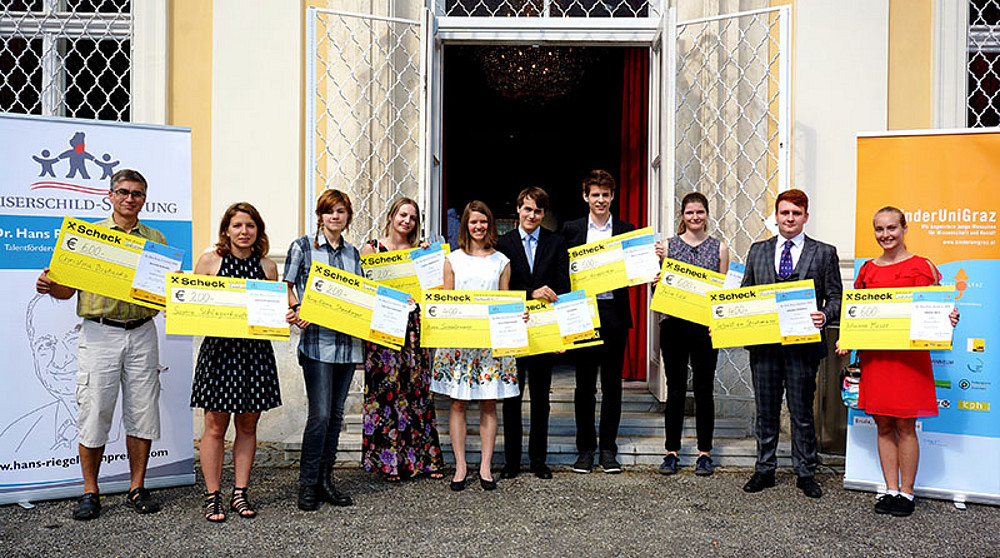
Junge NaturwissenschafterInnen in spe im Fokus: Die PreisträgerInnen der Dr. Hans Riegel-Fachpreise 2018. Foto: cp-pictures. ©CP-PICTURES

Junge NaturwissenschafterInnen in spe im Fokus: Die PreisträgerInnen der Dr. Hans Riegel-Fachpreise 2018. Foto: cp-pictures.

Dr. Hans Riegel Fachpreise an den besten naturwissenschaftlichen Nachwuchs der Steiermark vergeben

Wann ist Hühnerhaltung artgerecht? Ist die Wasserstoffgewinnung aus Urin eine energieeffiziente Form der Elektrolyse? Welche mathematischen Strukturen verbirgt sich hinter der Musik? Und kann man Dinge tatsächlich unsichtbar machen, wie mit einem Tarnanzug aus "Harry Potter"? Das sind nur einige jener Fragen, mit denen sich steirische SchülerInnen heuer in ihren vorwissenschaftlichen Arbeiten beschäftigt haben.

Die zwölf besten Werke in den vier Kategorien Biologie, Chemie, Mathematik und Physik wurden auch heuer wieder mit den Dr.-Hans-Riegel-Fachpreisen ausgezeichnet. Vergeben wird der Preis von der Kaiserschild-Stiftung, dessen Gründer, Hans Riegel, das Unternehmen HARIBO zum Erfolg führte. Für die jungen ForscherInnen von morgen gab es bei der Preisverleihung aber keine Gummibärchen, sondern insgesamt 4.800 Euro an Preisgeld.  Die Schulen der vier Erstplatzierten erhielten außerdem jeweils einen Gutschein im Wert von 250 Euro zur Förderung des naturwissenschaftlichen Unterrichts. 2018 wurden die Dr.-Hans-Riegel-Fachpreise zum neunten Mal in Graz vergeben, die Organisation des Wettbewerbs in der Steiermark übernimmt dabei stets die KinderUniGraz.


Die PreisträgerInnen 2018 sind:


Biologie:

  • 1. Platz: Julia Lex: "Über Theorie und Praxis der Hühnerhaltung"
  • 2. Platz: Johanna Kristl:"Invasive Neophyten im Raum Graz"
  • 3. Platz: Franziska Winkelmaier: "Atropa belladonna – die tödliche Giftpflanze"


Chemie:

  • 1. Platz: Christina Dsubanko: "Wasserstoffgewinnung aus Urin. Eine energieeffizientere Form der Elektrolyse?"
  • 2. Platz: Felix Rainer: "Acetylsalicylsäure, Ibuprofen und Paracetamol im pharmakologischgen und chemischen Vergleich"
  • 3. Platz: Sophia Schlagenhaufen: "Auswirkungen des Standorts auf den Spurenelementgehalt in heimischen Speisepilzen"


Mathematik:

  • 1. Platz: Manuel Hasenbichler:"Üer die "Riemannsche Hypothese" - Die Bedeutung der Riemannschen Vermutung"
  • 2. Platz: Anna Siebenbrunner: "√2 - Historisches, Darstellungen und Bedeutung für die heutige Zeit"
  • 3. Platz: Sabrina Unterreiner: "Die mathematischen Hintergründe der Musik"


Physik:

  • 1. Platz: Johanna Moser: "Wie man Dinge unsichtbar macht - Metamaterialien mit Nanostruktur"
  • 2. Platz: Sebastian Strohmaier: "Entwicklung und Spezifikation bei Flugzeugen anhand
  • ihrer aerodynamischen Komponenten"
  • 3. Platz: Nina-Elena: "Bogensport - Der Weg des Pfeils"
created by Gerhild Leljak

Related news

Chemical Christmas show at the University of Graz: An explosive evening at the Schauspielh

At the beginning of December, the University of Graz transformed the theater into a laboratory: as part of “Chemical Life,” teacher training students staged a chemical Christmas show for Styrian school classes—complete with ethanol rockets, nitrogen snow, and glowing effects. An evening designed to inspire interest in studying chemistry.

Train by train: Koralm railway accelerates exchange between the Universities

Lectures at the University of Klagenfurt in the morning, seminars at the University of Graz in the afternoon: Austria's longest tunnel and a journey time of around 45 minutes make it easy. The Koralm railway increases the speed of networking between the two university locations. The collaboration builds on existing cooperation - for example in the areas of teacher training, Slavic studies and as employers, the universities are well coordinated.

On the trail of the Big Bang: University of Graz receives 1.5 million euros for doctoral programmes

The Austrian Science Fund FWF has selected the Doctoral Programme in Theoretical Particle Physics at the University of Graz for funding from the Doc.funds. Six young scientists will be funded for 3.5 years. They will gain fundamentally new insights into the origins of the world.

From trans women and knee prostheses: sports science prizes awarded

Walking better with a prosthesis, successfully getting rid of excess weight, training more effectively, more fairness for trans people in sport: these were the topics addressed by the students at the University of Graz who were awarded the sports science prizes for their Master's theses on 3 December 2025.

Begin of page section:
Additional information:

University of Graz
Universitaetsplatz 3
8010 Graz
Austria
  • Contact
  • Web Editors
  • Moodle
  • UNIGRAZonline
  • Imprint
  • Data Protection Declaration
  • Accessibility Declaration
Weatherstation
Uni Graz

End of this page section. Go to overview of page sections

End of this page section. Go to overview of page sections

Begin of page section:

End of this page section. Go to overview of page sections