Begin of page section:
Page sections:

  • Go to contents (Accesskey 1)
  • Go to position marker (Accesskey 2)
  • Go to main navigation (Accesskey 3)
  • Go to sub navigation (Accesskey 4)
  • Go to additional information (Accesskey 5)
  • Go to page settings (user/language) (Accesskey 8)
  • Go to search (Accesskey 9)

End of this page section. Go to overview of page sections

Begin of page section:
Page settings:

English en
Deutsch de
Search
Login

End of this page section. Go to overview of page sections

Begin of page section:
Search:

Search for details about Uni Graz
Close

End of this page section. Go to overview of page sections


Search

Begin of page section:
Main navigation:

Page navigation:

  • University

    University
    • About the University
    • Organisation
    • Faculties
    • Library
    • Working at University of Graz
    • Campus
    Developing solutions for the world of tomorrow - that is our mission. Our students and our researchers take on the great challenges of society and carry the knowledge out.
  • Research Profile

    Research Profile
    • Our Expertise
    • Research Questions
    • Research Portal
    • Promoting Research
    • Research Transfer
    • Ethics in Research
    • Commission for Scientific Integrity
    Scientific excellence and the courage to break new ground. Research at the University of Graz creates the foundations for making the future worth living.
  • Studies

    Studies
    • Prospective Students
    • Students
    • Welcome Weeks for First Year Students
  • Community

    Community
    • International
    • Location
    • Research and Business
    • Alumni
    The University of Graz is a hub for international research and brings together scientists and business experts. Moreover, it fosters the exchange and cooperation in study and teaching.
Topics
  • Sustainable University
  • Researchers answer
  • Work for us
Close menu

End of this page section. Go to overview of page sections

Begin of page section:
You are here:

University of Graz News Staying in science? The new ‘Research Careers Campus’ knows how

End of this page section. Go to overview of page sections

Wednesday, 21 May 2025

Staying in science? The new ‘Research Careers Campus’ knows how

Johanna Stadlbauer und Gerald Lind ©www.lunghammer.at
©www.lunghammer.at

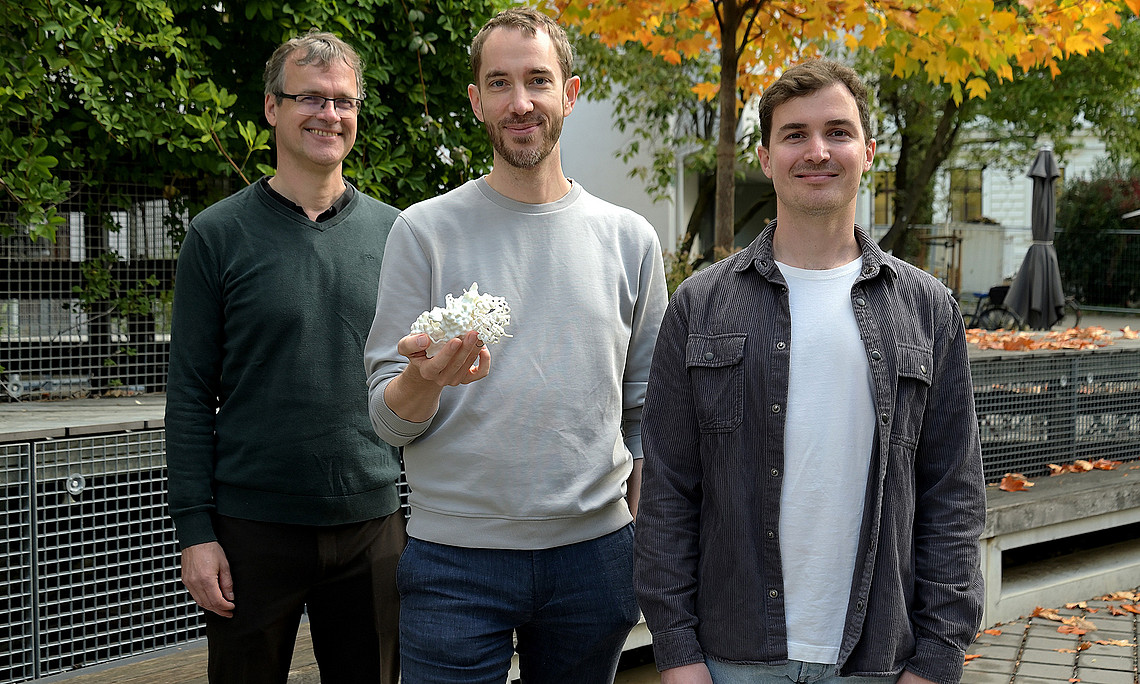
Johanna Stadlbauer and Gerald Lind provide support for scientific careers. Photo: Uni Graz/Lunghammer

Some get a taste for it during their studies. They want to stay in science after graduation and earn their living from research. The University of Graz is paving the way for them with the “Research Careers Campus". To this end, existing successful initiatives for doctoral students (through the Doctoral Academy) and postdocs (through the PostDoc Office) have been combined.

What funding and financing options do I have? How do I communicate about myself and my research within and outside of my scientific communities? How do I deal with setbacks? How do I reconcile an academic career with family life? The “Research Careers Campus” answers these and many other questions in the form of workshops, coaching and counselling sessions. This includes support for supervisors who want to ensure good support for young researchers. Vice-Rector Mireille van Poppel, in whose portfolio the new institution is based, explains: ‘We want to align ourselves with international developments and implement the latest approaches in the funding and development of researchers.’

Single point of contact

Deputy Gerald Lind estimates that all target groups of the “Research Careers Campus” will comprise a total of around 1,750 people. And for these people, there is now a single point of contact where, as far as possible, all offers of scientific career support come together.
In addition to building networks with research-related non-university employers, internal networking plays a role. 
The support is now also open to mid-career researchers. ‘These are generally understood to be people who, after completing their doctorates, have already completed one or two longer research phases, closely supervise the research work of younger colleagues, and have achieved a degree of scientific independence,’ explains the interim director Johanna Stadlbauer.

Friendly University

The package of measures is to be tailored to the specific needs of the target groups. To this end, the ‘Research Career Campus’ is planning to engage in intensive dialogue with mid-career researchers in particular. In the near future, the further development of the unit established on 1 April 2025 is on the agenda.
“We want to establish a positive research culture in all career phases," Stadlbauer and Lind describe the goal. “This involves good working conditions for researchers, exchange between researchers at different career levels, promoting a peer culture and continuing to work on our ”friendly university’,’ Stadlbauer describes. Overall, a great deal is already happening here that should be made even more visible and presented as best practice.

⇒ Research Careers Campus

created by Andreas Schweiger

Related news

Jurassic Sounds: Biologist reconstructs insect songs from 165 million years ago

It was apparently not just the roars of the dinosaurs that made up the soundscape of the animal world during the Jurassic period. Crickets and grasshoppers communicated through a variety of songs and high-pitched sounds, as Thorin Jonsson from the Institute of Biology at the University of Graz discovered together with colleagues from the universities of Lincoln, Bristol (UK), Beijing (China) and Tempe (USA). The findings on what are so far the oldest traces of sound on Earth have just been published in the journal PNAS.

EU funding boosts international exchange between universities

The University of Graz is further expanding its international study opportunities through the European university alliance Arqus and is taking the lead in two key projects. In future, students will benefit from even more joint degree programmes and from simplified recognition of academic achievements through the Joint European Degree Label.

Rescue and risks: Researchers have surveyed public perceptions of AI

The use of artificial intelligence has had to be made transparent since 2 August 2026. The EU’s AI Act, which has been in force since then, also sets out how risky an application is and which security measures apply as a result. However, the assessment of risks by the legislation differs in some cases significantly from the perceptions of the Austrian public. This is the finding of a representative study carried out by data scientist Stefan Thalmann from the University of Graz and his team.

The Healing Sea: Researchers discover new approaches to treating chronic inflammation in sponges

Chronic inflammation plays a key role in many diseases, ranging from metabolic disorders and cardiovascular diseases to tissue damage following injuries or infections. “Normally, the body is able to resolve inflammation on its own. If this process becomes unbalanced, immune cells remain permanently active and continue to drive negative changes in the tissue,” explains Andreas Koeberle, a pharmacist at the University of Graz.

Begin of page section:
Additional information:

University of Graz
Universitaetsplatz 3
8010 Graz
Austria
  • Contact
  • Web Editors
  • Moodle
  • UNIGRAZonline
  • Imprint
  • Data Protection Declaration
  • Accessibility Declaration
Weatherstation
Uni Graz

End of this page section. Go to overview of page sections

End of this page section. Go to overview of page sections

Begin of page section:

End of this page section. Go to overview of page sections