Begin of page section:
Page sections:

  • Go to contents (Accesskey 1)
  • Go to position marker (Accesskey 2)
  • Go to main navigation (Accesskey 3)
  • Go to sub navigation (Accesskey 4)
  • Go to additional information (Accesskey 5)
  • Go to page settings (user/language) (Accesskey 8)
  • Go to search (Accesskey 9)

End of this page section. Go to overview of page sections

Begin of page section:
Page settings:

English en
Deutsch de
Search
Login

End of this page section. Go to overview of page sections

Begin of page section:
Search:

Search for details about Uni Graz
Close

End of this page section. Go to overview of page sections


Search

Begin of page section:
Main navigation:

Page navigation:

  • University

    University
    • About the University
    • Organisation
    • Faculties
    • Library
    • Working at University of Graz
    • Campus
    Developing solutions for the world of tomorrow - that is our mission. Our students and our researchers take on the great challenges of society and carry the knowledge out.
  • Research Profile

    Research Profile
    • Our Expertise
    • Research Questions
    • Research Portal
    • Promoting Research
    • Research Transfer
    • Ethics in Research
    Scientific excellence and the courage to break new ground. Research at the University of Graz creates the foundations for making the future worth living.
  • Studies

    Studies
    • Prospective Students
    • Students
  • Community

    Community
    • International
    • Location
    • Research and Business
    • Alumni
    The University of Graz is a hub for international research and brings together scientists and business experts. Moreover, it fosters the exchange and cooperation in study and teaching.
  • Spotlight
Topics
  • Our digital Advent calendar
  • Sustainable University
  • Researchers answer
  • Work for us
Close menu

End of this page section. Go to overview of page sections

Begin of page section:
You are here:

University of Graz News Why Trump plays no central role in the lives of Americans

End of this page section. Go to overview of page sections

Monday, 20 January 2025

Why Trump plays no central role in the lives of Americans

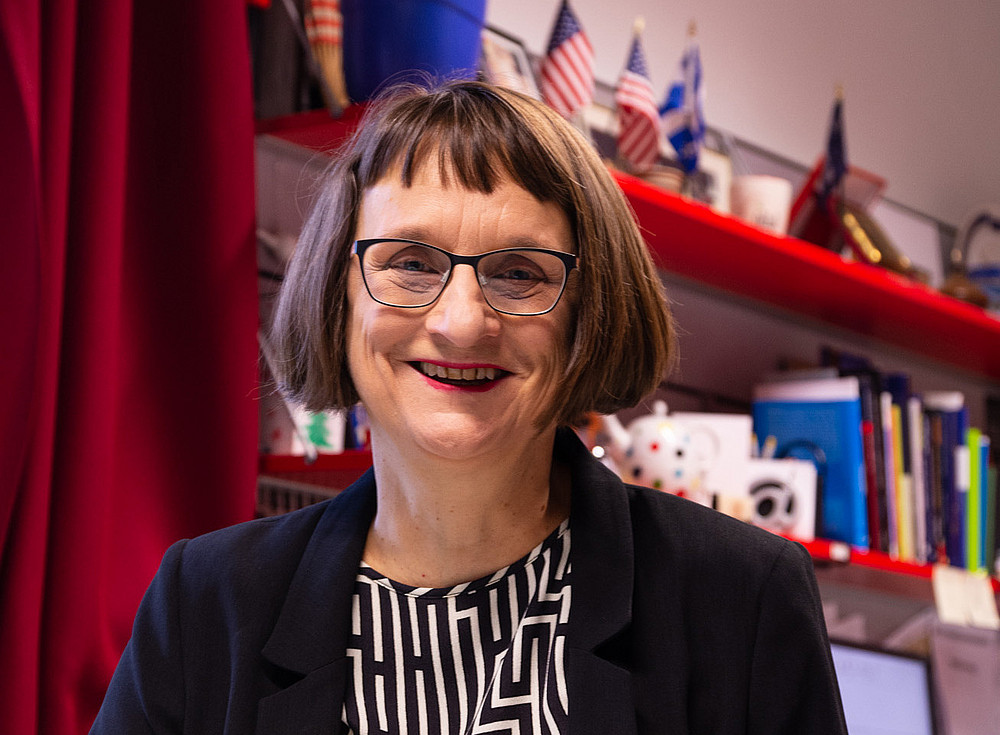
Roberta Maierhofer in front of a board with books and a few small US flags ©University of Graz/Cathrin Wolff

Roberta Maierhofer is an American studies scholar and heads the Center for Inter-American Studies at the University of Graz. Photo: University of Graz/Cathrin Wolff

Today, January 20, 2025, marks the day of Donald Trump’s second inauguration as the president of the United States. In Europe, he recently caused confusion with territorial claims on Greenland. In addition, his announcement concerning tariffs bears bad news for transatlantic relations. But what do US citizens actually think about a president such as him? Roberta Maierhofer, an expert in American studies, explains why the businessman was once again able to make it to the top of the US and why the majority of his fellow citizens do not care about the details of his policies.

What is happening in America? A question on the minds of many people in Europe as they watch with amazement the audacity with which the new US President Donald Trump is exercising his power, while enjoying high-profile support from loyal figures in business and the media. "From our European perspective, as citizens of centrally organized states, we think quite differently from people in the US when it comes to politics," says Roberta Maierhofer, head of the Center for Inter-American Studies at the University of Graz. "Due to the vastness of the country, the lives of individuals are much more strongly influenced by regional communities and state politics. These play a far more important role for people than the government in Washington, which should not interfere too much at all," the scholar explains. According to Maierhofer, what Americans expect of their president is, first and foremost, to represent the USA as a strong, independent nation. And that is precisely what Donald Trump is doing in the eyes of many: he does what he wants, dares to say what many are thinking, negotiates with the world's powerful from a position of strength, and promises to solve all problems.

America first
The living standards in the US has been declining over the last decade. "The middle class has been severely weakened. There is less social spending than under Reagan and real financial losses," says Maierhofer, describing a situation which causes dissatisfaction within large sections of the population. Trump promises a remedy and knows what to do: above all, he says, the country must look after itself again instead of taking care of others. Tariffs are planned to strengthen the domestic economy. The territorial claims on Greenland, Panama and Canada as strategically important areas for the USA also correspond with this way of thinking. "From today's perspective, the idea of buying countries sounds absurd, but it is not new. In 1946, US President Truman offered the Danish government 100 million dollars for Greenland. In 2019, Trump raised the issue again," recalls Maierhofer. In 1917, the United States had purchased the Caribbean island group of the West Indies – since then known as the US Virgin Islands – from Denmark, Alaska from the Russian Empire in 1867, and Louisiana from the French in 1803.

"Trump follows various cultural narratives that have shaped the image of the United States," says the American studies scholar. They also include their independence: "’We don't take orders from anyone!’ The USA regards any interference in the shaping of its foreign policy as unacceptable. That is why they do not  recognize the International Court of Justice," explains Maierhofer. With regard to Trump's actions, she speaks of the “Pippi Langstrumpf principle: we make the world the way we like it. In doing so, we are fearless and do not care about the norms and rules of political action, we are anti-establishment.”

Democratic forces
"We in Europe will probably feel Trump's presidency more than people in the US," Maierhofer suspects, pointing to, among other things, the announced tariffs, the demand for payment of agreed NATO contributions, the suspension of agreed climate targets or the withdrawal of the US as a protective power in Europe. "Foreign policy is the stage for Trump and his confidants." He gets a lot less attention from most US citizens for his plans, especially for his actual foreign policy. "The majority of the population is not interested in it at all and is not informed about it, but simply expects a demonstration of strength at all levels," Maierhofer points out.

Regardless of this, Trump's actions are worrying in any case with regard to democracy, according to the American studies scholar. Domestically, he can exert far-reaching influence by filling posts, such as judges, even beyond the time of his presidency. At the same time, however, Maierhofer is confident: "I have faith in the forces of democracy in the USA. They went back to work immediately after the election, even if they are not always visible." The Republicans were desperate to return to power, but the scholar is sure that the majority of the party and its voters do not agree with Trump. "Critics are currently keeping a very, very low profile so as not to be excluded from important positions. But they exist."

And then there are the far-reaching freedoms and powers on the individual state levels. Each has its own constitution, legislature and judiciary. This results in many opportunities for democratic influence, which clearly limit the power of a US president, however dominant he may appear.

created by Gudrun Pichler

Related news

Chemical Christmas show at the University of Graz: An explosive evening at the Schauspielh

At the beginning of December, the University of Graz transformed the theater into a laboratory: as part of “Chemical Life,” teacher training students staged a chemical Christmas show for Styrian school classes—complete with ethanol rockets, nitrogen snow, and glowing effects. An evening designed to inspire interest in studying chemistry.

Train by train: Koralm railway accelerates exchange between the Universities

Lectures at the University of Klagenfurt in the morning, seminars at the University of Graz in the afternoon: Austria's longest tunnel and a journey time of around 45 minutes make it easy. The Koralm railway increases the speed of networking between the two university locations. The collaboration builds on existing cooperation - for example in the areas of teacher training, Slavic studies and as employers, the universities are well coordinated.

On the trail of the Big Bang: University of Graz receives 1.5 million euros for doctoral programmes

The Austrian Science Fund FWF has selected the Doctoral Programme in Theoretical Particle Physics at the University of Graz for funding from the Doc.funds. Six young scientists will be funded for 3.5 years. They will gain fundamentally new insights into the origins of the world.

From trans women and knee prostheses: sports science prizes awarded

Walking better with a prosthesis, successfully getting rid of excess weight, training more effectively, more fairness for trans people in sport: these were the topics addressed by the students at the University of Graz who were awarded the sports science prizes for their Master's theses on 3 December 2025.

Begin of page section:
Additional information:

University of Graz
Universitaetsplatz 3
8010 Graz
Austria
  • Contact
  • Web Editors
  • Moodle
  • UNIGRAZonline
  • Imprint
  • Data Protection Declaration
  • Accessibility Declaration
Weatherstation
Uni Graz

End of this page section. Go to overview of page sections

End of this page section. Go to overview of page sections

Begin of page section:

End of this page section. Go to overview of page sections