



Begin of page section:
Page sections:

  • Go to contents (Accesskey 1)
  • Go to position marker (Accesskey 2)
  • Go to main navigation (Accesskey 3)
  • Go to sub navigation (Accesskey 4)
  • Go to additional information (Accesskey 5)
  • Go to page settings (user/language) (Accesskey 8)
  • Go to search (Accesskey 9)

End of this page section. Go to overview of page sections

Begin of page section:
Page settings:

English en
Deutsch de
Search
Login

End of this page section. Go to overview of page sections

Begin of page section:
Search:

Search for details about Uni Graz
Close

End of this page section. Go to overview of page sections


Search

Begin of page section:
Main navigation:

Page navigation:

  • University

    University
    • About the University
    • Organisation
    • Faculties
    • Library
    • Working at University of Graz
    • Campus
    Developing solutions for the world of tomorrow - that is our mission. Our students and our researchers take on the great challenges of society and carry the knowledge out.
  • Research Profile

    Research Profile
    • Our Expertise
    • Research Questions
    • Research Portal
    • Promoting Research
    • Research Transfer
    • Ethics in Research
    • Commission for Scientific Integrity
    Scientific excellence and the courage to break new ground. Research at the University of Graz creates the foundations for making the future worth living.
  • Studies

    Studies
    • Prospective Students
    • Students
    • Registration for Study Programme (Winter semester 2026/27)
  • Community

    Community
    • International
    • Location
    • Research and Business
    • Alumni
    The University of Graz is a hub for international research and brings together scientists and business experts. Moreover, it fosters the exchange and cooperation in study and teaching.
Topics
  • Sustainable University
  • Researchers answer
  • Work for us
Close menu

End of this page section. Go to overview of page sections

Begin of page section:
You are here:

University of Graz News Werbung, Wirtschaft und Ware

End of this page section. Go to overview of page sections

Wednesday, 13 January 2016

Werbung, Wirtschaft und Ware
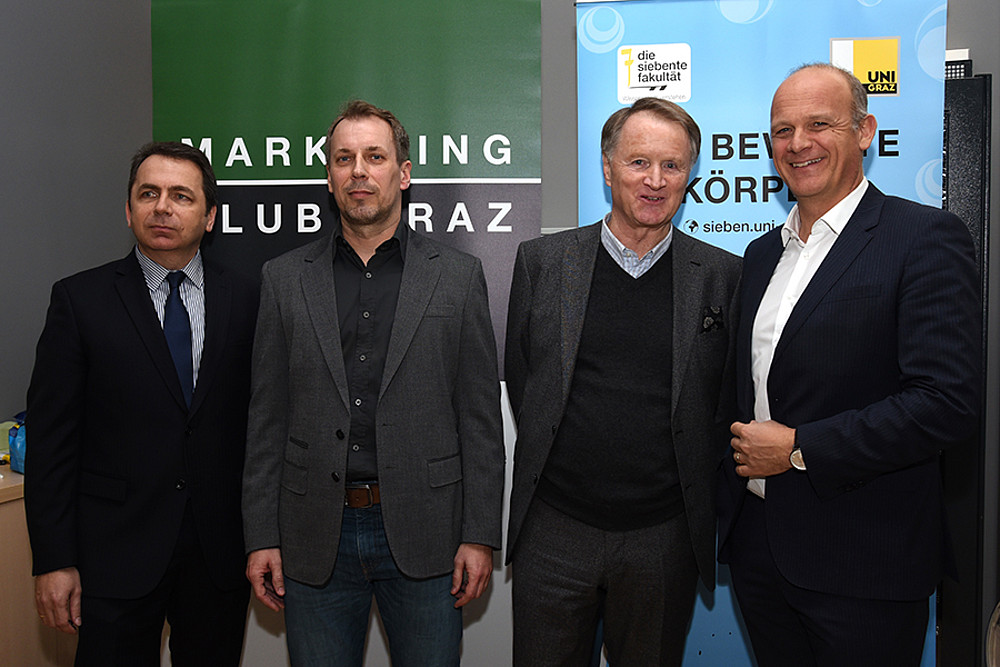
Foscht, Tschakert, Pildner-Steinburg und Straka (v.l.) diskutierten die Verknüpfung von Sport und Wirtschaft. Foto: Uni Graz/Schweiger

Foscht, Tschakert, Pildner-Steinburg und Straka (v.l.) diskutierten die Verknüpfung von Sport und Wirtschaft. Foto: Uni Graz/Schweiger

Event-Manager Straka, IV-Präsident Pildner-Steinburg und Marketing-Professor Foscht über die ökonomische Rolle von Sport

Das Firmenlogo auf dem Renndress. OlympiasiegerInnen als WerbeträgerInnen. Sport und Wirtschaft bilden immmer öfter eine Symbiose: Die Uni-Graz-Reihe „Der Bewegte Körper“ – in Kooperation mit dem „Marketing Club Graz“ und den „Grazer Wirtschaftsgesprächen“ – befasste sich am 12. Jänner 2016 mit den ökonomischen Dimensionen des Sports. Auf dem Podium diskutierten unter der Moderation des Sportwissenschafters Ass.-Prof. Dr. Gerhard Tschakert prominente und fachkundige Gäste.

Mag. Herwig Straka, Veranstalter mehrerer nationaler und internationaler Großevents, begann seine Laufbahn in den 1990er-Jahren mit dem Klassiker „Tennis am Dach“: „Eine ideale Verknüpfung von Sport und Wirtschaft.“ Es sei heute ungleich schwieriger, Sponsoringgelder aufzutreiben, so Straka, der sich daher mit seiner Agentur verstärkt international positioniert. Er verortete zudem einen Trend zu Massenevents, wie Marathon, Dolomiten-Mann und Iron-Man: „Hier tragen die TeilnehmerInnen mit ihrem Beitrag zur Finanzierung bei.“

Univ.-Prof. Dr. Thomas Foscht, Marketing-Forscher und Dekan der Sozial- und Wirtschaftswissenschaftlichen Fakultät der Uni Graz, belegte die ökonomische Rolle des Sport: „Der Sektor leistet eine Wertschöpfung in der Höhe von vier Prozent.“ Auch Sportbekleidung spiele eine verstärkte Rolle: „Wir wissen, dass sich Personen, die Sportmarken tragen, auch fitter fühlen.“ Einen wesentlichen Faktor stelle der Image-Transport dar. „Vor allem Product-Placement wird nicht als klassische Werbung wahrgenommen und kommt dadurch besser an“, so Forscht.

Mag. Jochen Pildner-Steinburg, Präsident der Industriellenvereinigung Steiermark, sponsert unter anderem den Eishockey-Club „Graz 99-ers“, zerstreute Illusionen, mit einem Sportverein Geld zu verdienen. Sein Motiv für die Förderung erklärte er so: „Investitionen in Sport sind auch ein soziales Projekt. Wir bilden zurzeit im Club etwa 300 Jugendliche aus.“ Zudem werde der gesundheitliche Aspekt von Bewegung volkswirtschaftlich gesehen nach wie vor stark vernachlässigt: „Da ist noch viel zu machen.“

Die Podiumsdiskussion war Teil des „Bewegten Körper“, eine Reihe der 7. fakultät – Zentrum für Gesellschaft, Wissen und Kommunikation der Uni Graz, und wurde in Kooperation mit dem „Marketing Club Graz“ und den „Grazer Wirtschaftsgesprächen“ durchgeführt.

created by Andreas Schweiger

Related news

"Mathematics explains the world"

How can life be quantified? And what can science reveal that remains hidden from the naked eye? The 14th European Conference on Mathematical and Theoretical Biology at the University of Graz is dedicated to these questions. From 13 to 17 July, around 1,300 researchers from all over the world will gather on campus to discuss models, biological processes and the future of data-driven medicine. Klemens Fellner, Dean of the Faculty of Natural Sciences and Mathematics and a mathematician, talks about the language that explains the world

Internationally up-to-date: University of Graz offers new degree programmes in art studies

From the Old Masters to AI art – three newly designed degree programmes offer students at the University of Graz fresh perspectives on artistic production. In addition to historical art, the programmes place a greater emphasis on contemporary and global developments. The registration period is open.

The Nazi elite school Napola: Historian seeks memories and personal documents

They were to be brought up to become the future elite of National Socialism: boys and girls aged ten and over who, following the ‘Anschluss’ of Austria to the German Reich, attended a so-called Napola (short for Nationalpolitische Lehranstalt; also known as NPEA, Nationalpolitische Erziehungsanstalt). There were nine such institutions in what is now Austria between 1939 and 1945.

Heat-resistant: Eva Preinfalk explains how cities can protect their residents

Certain demographic and some occupational groups are particularly vulnerable to high temperatures. A range of measures is needed to provide relief for everyone, explains climate economist Eva Preinfalk.

Begin of page section:
Additional information:

University of Graz
Universitaetsplatz 3
8010 Graz
Austria
  • Contact
  • Web Editors
  • Moodle
  • UNIGRAZonline
  • Imprint
  • Data Protection Declaration
  • Accessibility Declaration
Weatherstation
Uni Graz

End of this page section. Go to overview of page sections

End of this page section. Go to overview of page sections

Begin of page section:

End of this page section. Go to overview of page sections