Begin of page section:
Page sections:

  • Go to contents (Accesskey 1)
  • Go to position marker (Accesskey 2)
  • Go to main navigation (Accesskey 3)
  • Go to sub navigation (Accesskey 4)
  • Go to additional information (Accesskey 5)
  • Go to page settings (user/language) (Accesskey 8)
  • Go to search (Accesskey 9)

End of this page section. Go to overview of page sections

Begin of page section:
Page settings:

English en
Deutsch de
Search
Login

End of this page section. Go to overview of page sections

Begin of page section:
Search:

Search for details about Uni Graz
Close

End of this page section. Go to overview of page sections


Search

Begin of page section:
Main navigation:

Page navigation:

  • University

    University
    • About the University
    • Organisation
    • Faculties
    • Library
    • Working at University of Graz
    • Campus
    Developing solutions for the world of tomorrow - that is our mission. Our students and our researchers take on the great challenges of society and carry the knowledge out.
  • Research Profile

    Research Profile
    • Our Expertise
    • Research Questions
    • Research Portal
    • Promoting Research
    • Research Transfer
    • Ethics in Research
    Scientific excellence and the courage to break new ground. Research at the University of Graz creates the foundations for making the future worth living.
  • Studies

    Studies
    • Prospective Students
    • Students
  • Community

    Community
    • International
    • Location
    • Research and Business
    • Alumni
    The University of Graz is a hub for international research and brings together scientists and business experts. Moreover, it fosters the exchange and cooperation in study and teaching.
  • Spotlight
Topics
  • Sustainable University
  • Researchers answer
  • Work for us
Close menu

End of this page section. Go to overview of page sections

Begin of page section:
You are here:

University of Graz News Universitätsrat der Uni Graz konstituiert: Herbert Beiglböck als Vorsitzender gewählt

End of this page section. Go to overview of page sections

Friday, 26 May 2023

Universitätsrat der Uni Graz konstituiert: Herbert Beiglböck als Vorsitzender gewählt

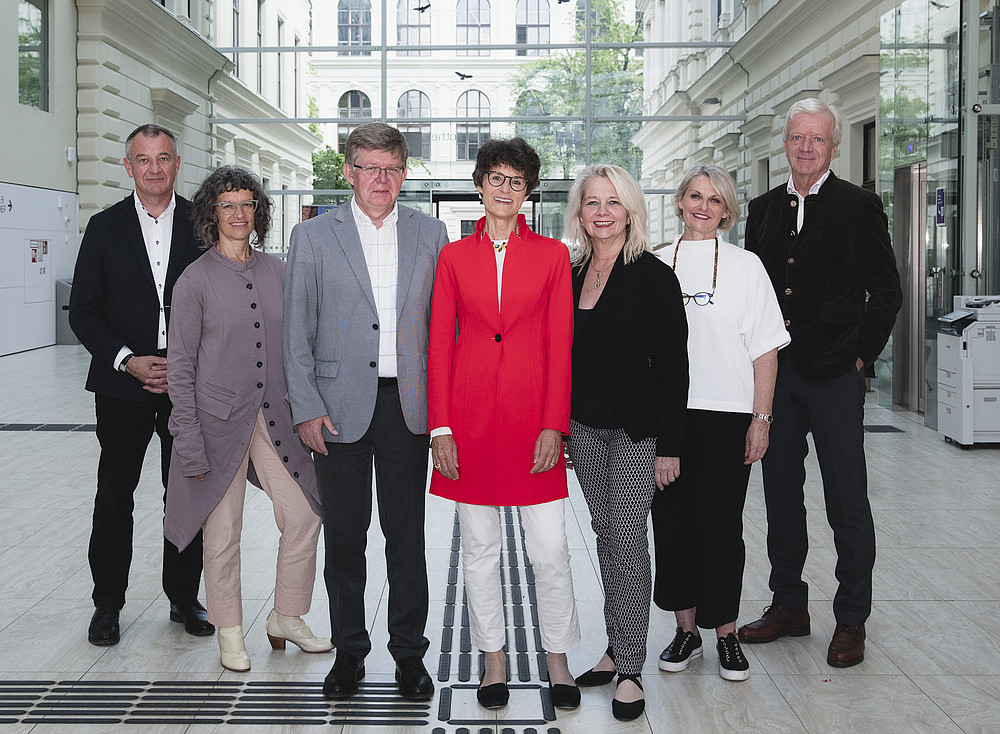
Sieben der insgesamt neun Uniräte der Universität Graz ©Uni Graz/Tzivanopoulos

Sieben der insgesamt neun Uniräte der Universität Graz (v.l.): Peter Koren, Heidrun Primas, Herbert Beiglböck (Vorsitzender), Angelika Vollmar (stellvertretende Vorsitzende), Ada Pellert, Regina Friedrich und Gerhard Fabisch. Nicht am Bild: Eva Eckkrammer und Gottfried Musger. Foto: Uni Graz/Tzivanopoulos

Der Universitätsrat der Universität Graz hat neue Mitglieder und einen neuen Vorsitzenden.

Der Universitätsrat der Universität Graz hat Mag. Herbert Beiglböck, MBA als neuntes Mitglied bestellt und zum Vorsitzenden an die Spitze dieses wichtigen Leitungsgremiums gewählt. Stellvertretende Vorsitzende ist Prof. Dr. Angelika Vollmar.

Beiglböck freut sich, gemeinsam mit den Mitglieder des Universitätsrats einen Beitrag für die Universität Graz leisten zu können. Herbert Beiglböck war bis vor kurzem als Caritasdirektor der Diözese Graz-Seckau tätig und wurde von den vom Senat und der Bundesregierung bestellten Mitglieder einstimmig in diese Funktion gewählt.

Folgende vier Mitglieder entsandte der Senat der Universität Graz:

  • Eva Eckkrammer, Professorin für Romanische Sprach- und Medienwissenschaft an der Universität Mannheim
  • Gerhard Fabisch, Vorstandsvorsitzender der Steiermärkische Bank und Sparkassen AG
  • Gottfried Musger, Senatspräsident des Obersten Gerichtshofes
  • Angelika Vollmar, Professorin für Pharmazeutische Biologie, Département Pharmazie der LMU München 

Folgende vier Mitglieder bestellte die Bundesregierung:

  • Regina Friedrich, Unternehmerin
  • Ada Pellert, Rektorin der Fernuniversität Hagen
  • Heidrun Primas, langjährige Leiterin des Forum Stadtpark
  • Peter Koren, Vize-Generalsekretär der Industriellenvereinigung Österreich

Fotos: https://cloud.uni-graz.at/s/BoGYFHjctaiE9t3

Bildtext: Sieben der insgesamt neun Uniräte und Unirätinnen der Universität Graz (v.l.): Peter Koren, Heidrun Primas, Herbert Beiglböck (Vorsitzender), Angelika Vollmar (stellvertretende Vorsitzende), Ada Pellert, Regina Friedrich und Gerhard Fabisch. Nicht am Bild: Eva Eckkrammer und Gottfried Musger

Fotocredit: Universität Graz/ Tzivanopoulos


Weitere Informationen:

Gerlinde Tuscher

Kommunikation und Öffentlichkeitsarbeit | Communications and Public Affairs

Universität Graz | University of Graz

gerlinde.tuscher(at)uni-graz.at

+43 664 8569028

Related news

Master's degree in psychotherapy in Graz: registration opens in March

Graz is becoming a hotspot for psychotherapy: from 2026, the University of Graz and the Medical University of Graz will jointly offer the new master's programme. Registration for the admission procedure for the 140 study places will start in March.

PFAS: Uni-Graz-Studie zeigt, dass Verbote von Ewigkeitschemikalien wirken

Forschende der Universität Graz zeigen: PFAS-Verbote senken die Belastung in der Natur nachweislich. Doch die Industrie weicht auf andere Verbindungen aus, die für Menschen ebenso gefährlich sind.

Neues Kapitel für das Graz Center of Physics: Fachwerkteile angeliefert

Architektonischer Meilenstein für das künftige Grazer Physik-Center: Die ersten Fachwerkteile wurden angeliefert und mit dem Kran auf die richtige Stelle im ersten Obergeschoß platziert. Bis Mai folgen 33 weitere Lkw-Transporte und bringen insgesamt 64 Stück. In Summe werden so 16 große Stahlfachwerke vor Ort zusammengeschraubt. Die acht Meter hohen und teilweise bis zu 30 Meter langen Fachwerke geben dem ganzen Gebäude eine notwendige Stabilität und dienen der Lastabtragung der oberen Geschoße.

New groundbreaking computation method for climate extremes

How much will heat, flooding, drought and storms increase as a result of human-induced climate change? In a groundbreaking study, climate researcher Gottfried Kirchengast and his team at the University of Graz have developed a new method for computing the hazards from extreme events: it can compute all relevant hazard metrics for events such as heat waves, floods and droughts in any region worldwide with unprecedented information content. Using it for Europe, the researchers found that anthropogenic climate change has caused a tenfold increase in extreme heat in recent decades. The study, published in the journal Weather and Climate Extremes, also provides a basis for better quantifying the damage to people, ecosystems and infrastructure.

Begin of page section:
Additional information:

University of Graz
Universitaetsplatz 3
8010 Graz
Austria
  • Contact
  • Web Editors
  • Moodle
  • UNIGRAZonline
  • Imprint
  • Data Protection Declaration
  • Accessibility Declaration
Weatherstation
Uni Graz

End of this page section. Go to overview of page sections

End of this page section. Go to overview of page sections

Begin of page section:

End of this page section. Go to overview of page sections