



Begin of page section:
Page sections:

  • Go to contents (Accesskey 1)
  • Go to position marker (Accesskey 2)
  • Go to main navigation (Accesskey 3)
  • Go to sub navigation (Accesskey 4)
  • Go to additional information (Accesskey 5)
  • Go to page settings (user/language) (Accesskey 8)
  • Go to search (Accesskey 9)

End of this page section. Go to overview of page sections

Begin of page section:
Page settings:

English en
Deutsch de
Search
Login

End of this page section. Go to overview of page sections

Begin of page section:
Search:

Search for details about Uni Graz
Close

End of this page section. Go to overview of page sections


Search

Begin of page section:
Main navigation:

Page navigation:

  • University

    University
    • About the University
    • Organisation
    • Faculties
    • Library
    • Working at University of Graz
    • Campus
    Developing solutions for the world of tomorrow - that is our mission. Our students and our researchers take on the great challenges of society and carry the knowledge out.
  • Research Profile

    Research Profile
    • Our Expertise
    • Research Questions
    • Research Portal
    • Promoting Research
    • Research Transfer
    • Ethics in Research
    • Commission for Scientific Integrity
    Scientific excellence and the courage to break new ground. Research at the University of Graz creates the foundations for making the future worth living.
  • Studies

    Studies
    • Prospective Students
    • Students
    • Welcome Weeks for First Year Students
  • Community

    Community
    • International
    • Location
    • Research and Business
    • Alumni
    The University of Graz is a hub for international research and brings together scientists and business experts. Moreover, it fosters the exchange and cooperation in study and teaching.
Topics
  • Sustainable University
  • Researchers answer
  • Work for us
Close menu

End of this page section. Go to overview of page sections

Begin of page section:
You are here:

University of Graz News Uni Graz goes mobile

End of this page section. Go to overview of page sections

Thursday, 21 April 2016

Uni Graz goes mobile

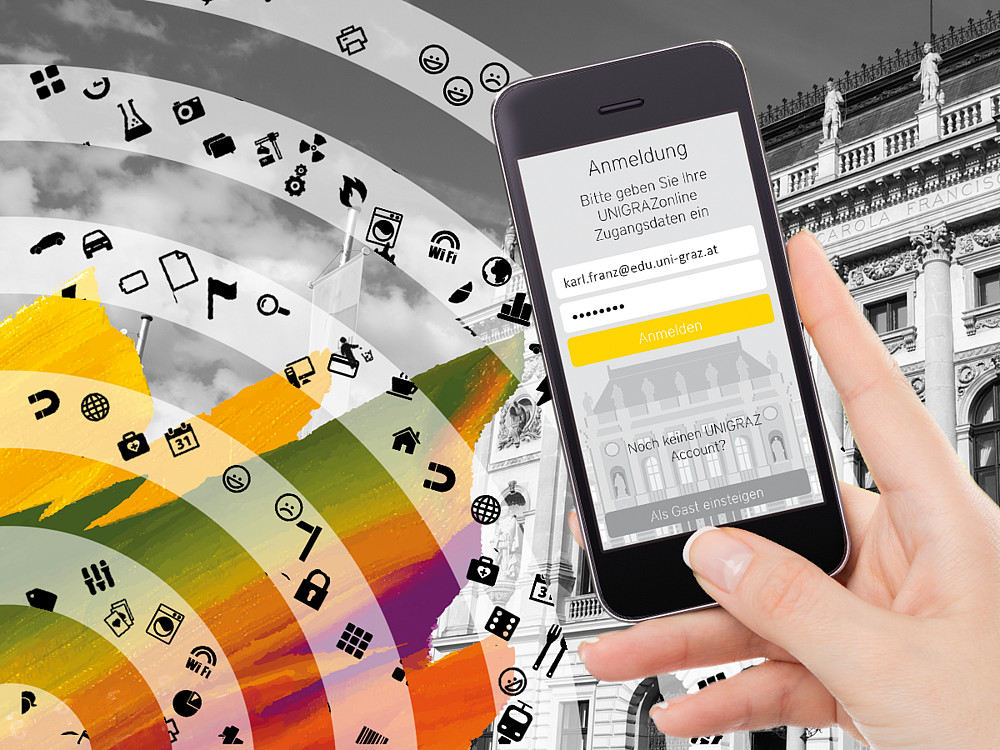
Am 10. Mai ist es soweit: die Uni-Graz-App soll das Licht der Welt erblicken. Präsentiert wird sie im Rahmen der ICT@UNIVERSITY. Das Event der UNI-IT wartet mit spannenden Themen und Vorträgen auf. Foto Montage: Uni Graz/Peter Langmann

Am 10. Mai ist es soweit: die Uni-Graz-App soll das Licht der Welt erblicken. Präsentiert wird sie im Rahmen der ICT@UNIVERSITY. Das Event der UNI-IT wartet mit spannenden Themen und Vorträgen auf. Foto Montage: Uni Graz/Peter Langmann

Erste Uni-Graz-App erblickt bei der Tagung ICT@UNIVERSITY 2016 am 10. Mai das Licht der Welt.

In wenigen Wochen ist es nun soweit. Die Karl-Franzens-Universität Graz hebt ihre erste Smartphone-App namens „UniGrazMobile“ aus der Taufe. Um 13 Uhr, wenn Entwickler Dieter Schäfer das neue Produkt mit all seinen Features offiziell der Öffentlichkeit vorstellt, startet zeitgleich die Freischaltung im Apple App-Store und im Google Play-Store. Dann darf kräftig runtergeladen werden. Einmal im Jahr rückt die UNI-IT im Rahmen der Tagung ICT@UNIVERSITY Neuerungen und Highlights aus ihrer Branche ins Rampenlicht. Exklusives Zuckerl: BesucherInnen der Tagung können die App bereits ein paar Stunden vor dem offiziellen Start auf ihre Smartphones laden. Das IT-Event, welches Studierende und Bedienstete aller Grazer Universitäten als Zielgruppe hat, geht in diesem Jahr zum dritten Mal über die Bühne.

Der große Showdown der App wird von interessanten Key-Notes und Vorträgen, die von 9 bis 16 Uhr das Programm bestimmen und das Motto „Digitalisierung & Mobilität“ trägt, begleitet: Armand Martin, Chairman of the Board of Directors bei Infocentric Research AG, spricht in der ersten Keynote des Tages einmal mehr über den „Arbeitsplatz der Zukunft“. Alexandra Grohmann, Trendone, erklärt den BesucherInnen „die Welt in 2025“. Neben den hochkarätigen Keynote-SpeakerInnen zeigen auch Experten der UNI-IT, welche Lösungen es an der Uni Graz gibt, um den Studien- und Arbeitsalltag praktikabler zu gestalten.

Uni-Graz-App
Die neue Uni-Graz-App wurde im Hause entwickelt und auf die Bedürfnisse von MitarbeiterInnen und Studierenden zugeschnitten. So findet sich neben den wesentlichsten Informationen aus UNIGRAZonline auch eine volle Integration des Campusplans mit Routenplanung. Per QR-Code-Reader können künftig Informationen zu Hörsälen – Buchung, Barrierefreiheit und Ausstattung – sowie den uniFLOW-Druckern abgerufen werden. Lehrende können über die Uni-Graz-App beispielsweise im Hörsaal direkt Infos zur Mediensteuerung runterladen. Übersichtlich gestaltet ist auch die Studien- und Personensuche sowie der Überblick über den Servicekatalog der UNI-IT. Registrierte UserInnen können ihre Wunsch-Features bei den EntwicklerInnen deponieren und abstimmen. Ein besonderes Goody der Anwendung: NutzerInnen stellen ihre persönlichen Nachrichtenkanäle zusammen. Auch der bekannte Menüplan der umliegenden Gastro-Szene ist in die App, die für iOS und Android verfügbar sein wird, integriert.

Firmenpräsentationen, Kabarett & Buffet
Auch für diese Veranstaltung konnte die UNI-IT wertvolle FirmenpartnerInnen gewinnen, die ihre Produkte an den Ständen zur Schau stellen. Es können Anwendungen und Geräte getestet werden. Krönender Abschluss ist ein kulinarisches come together, dem das IT-Kabarett „Einer wird den Stecker ziehen“ von Thomas Sulak vorangeht. Studierende der Uni Graz können an einem Gewinnspiel teilnehmen und eines von zwei Smartphones gewinnen.

Die Veranstaltungsreihe ICT@UNIVERSITY wendet sich vor allem an die akademische Community des steirischen Hochschulraums. Sie will aktuelle IT-Trends im Hochschulbereich aufzeigen, Lust auf Neues wecken, zur kritischen Diskussion anregen und den Blick in die Zukunft richten.


ICT@UNIVERSITY 2016
Ort: Aula der Universität Graz, Universitätsplatz 3, 8010 Graz
Zeit: 10. Mai 2016, 9:00, Ende der Vorträge: ca. 17:00, Ende der Veranstaltung: ca. 19 :00

Programm und Details zur Veranstaltung auf der Website: http://ict.uni-graz.at/

Anmeldung zur ICT@UNIVERSITY über it.uni-graz.at/Anmeldung/

created by Konstantinos Tzivanopoulos

Related news

Jurassic Sounds: Biologist reconstructs insect songs from 165 million years ago

It was apparently not just the roars of the dinosaurs that made up the soundscape of the animal world during the Jurassic period. Crickets and grasshoppers communicated through a variety of songs and high-pitched sounds, as Thorin Jonsson from the Institute of Biology at the University of Graz discovered together with colleagues from the universities of Lincoln, Bristol (UK), Beijing (China) and Tempe (USA). The findings on what are so far the oldest traces of sound on Earth have just been published in the journal PNAS.

EU funding boosts international exchange between universities

The University of Graz is further expanding its international study opportunities through the European university alliance Arqus and is taking the lead in two key projects. In future, students will benefit from even more joint degree programmes and from simplified recognition of academic achievements through the Joint European Degree Label.

Rescue and risks: Researchers have surveyed public perceptions of AI

The use of artificial intelligence has had to be made transparent since 2 August 2026. The EU’s AI Act, which has been in force since then, also sets out how risky an application is and which security measures apply as a result. However, the assessment of risks by the legislation differs in some cases significantly from the perceptions of the Austrian public. This is the finding of a representative study carried out by data scientist Stefan Thalmann from the University of Graz and his team.

The Healing Sea: Researchers discover new approaches to treating chronic inflammation in sponges

Chronic inflammation plays a key role in many diseases, ranging from metabolic disorders and cardiovascular diseases to tissue damage following injuries or infections. “Normally, the body is able to resolve inflammation on its own. If this process becomes unbalanced, immune cells remain permanently active and continue to drive negative changes in the tissue,” explains Andreas Koeberle, a pharmacist at the University of Graz.

Begin of page section:
Additional information:

University of Graz
Universitaetsplatz 3
8010 Graz
Austria
  • Contact
  • Web Editors
  • Moodle
  • UNIGRAZonline
  • Imprint
  • Data Protection Declaration
  • Accessibility Declaration
Weatherstation
Uni Graz

End of this page section. Go to overview of page sections

End of this page section. Go to overview of page sections

Begin of page section:

End of this page section. Go to overview of page sections