Begin of page section:
Page sections:

  • Go to contents (Accesskey 1)
  • Go to position marker (Accesskey 2)
  • Go to main navigation (Accesskey 3)
  • Go to sub navigation (Accesskey 4)
  • Go to additional information (Accesskey 5)
  • Go to page settings (user/language) (Accesskey 8)
  • Go to search (Accesskey 9)

End of this page section. Go to overview of page sections

Begin of page section:
Page settings:

English en
Deutsch de
Search
Login

End of this page section. Go to overview of page sections

Begin of page section:
Search:

Search for details about Uni Graz
Close

End of this page section. Go to overview of page sections


Search

Begin of page section:
Main navigation:

Page navigation:

  • University

    University
    • About the University
    • Organisation
    • Faculties
    • Library
    • Working at University of Graz
    • Campus
    Developing solutions for the world of tomorrow - that is our mission. Our students and our researchers take on the great challenges of society and carry the knowledge out.
  • Research Profile

    Research Profile
    • Our Expertise
    • Research Questions
    • Research Portal
    • Promoting Research
    • Research Transfer
    • Ethics in Research
    Scientific excellence and the courage to break new ground. Research at the University of Graz creates the foundations for making the future worth living.
  • Studies

    Studies
    • Prospective Students
    • Students
  • Community

    Community
    • International
    • Location
    • Research and Business
    • Alumni
    The University of Graz is a hub for international research and brings together scientists and business experts. Moreover, it fosters the exchange and cooperation in study and teaching.
  • Spotlight
Topics
  • Our digital Advent calendar
  • Sustainable University
  • Researchers answer
  • Work for us
Close menu

End of this page section. Go to overview of page sections

Begin of page section:
You are here:

University of Graz News University of Graz is researching better algorithms for social media

End of this page section. Go to overview of page sections

Monday, 16 September 2024

University of Graz is researching better algorithms for social media

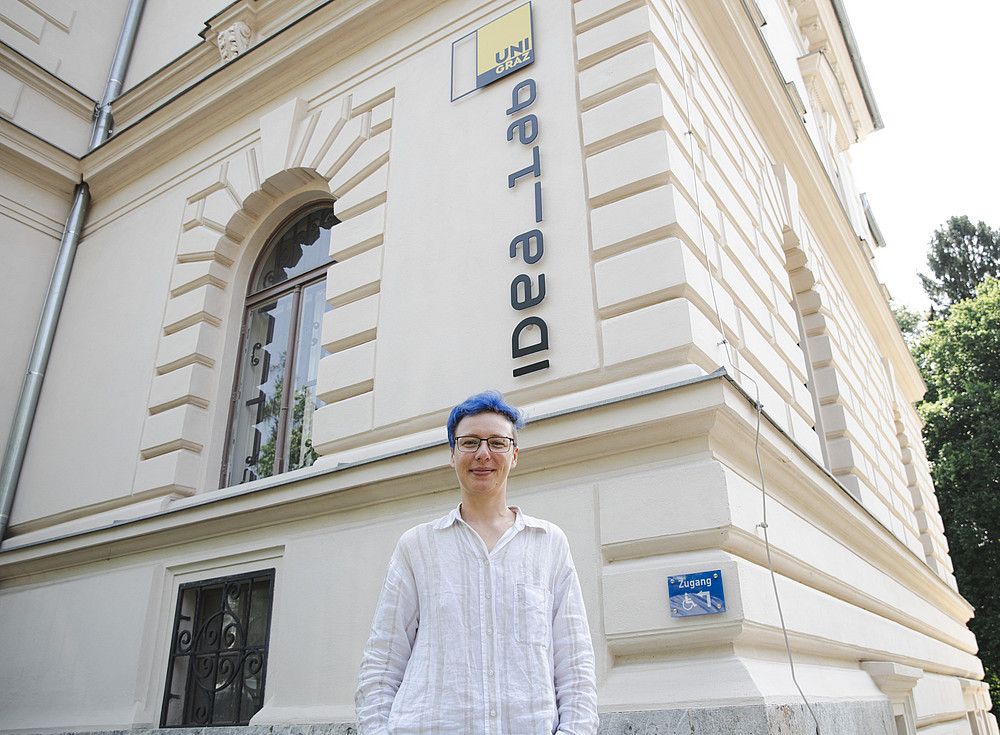
A young woman with short blue hair stands in front of an old building and smiles at the camera. The building is labeled “IdeaLab”. She is wearing a white linen shirt, jeans and glasses. ©Uni Graz/Tzivanopoulos

Jana Lasser wants to research how algorithms in social media can be changed so that they support democracy Photo: Uni Graz/Tzivanopoulos

Jana Lasser, a professor at the IDea_Lab of the University of Graz, is developing new algorithms for social media that promote constructive discussions as part of an ERC Starting Grant. With the help of ‘digital twins’ of existing social media platforms, these alternatives are to be tested to create the basis for deciding how to regulate the algorithms of Instagram, TikTok and others.

2024 is an important election year. Social media such as Instagram, TikTok or X will play a major role in this. Their algorithms often select from the flood of available content those that are exciting in order to keep their users on the platform longer. Many of these posts are not exactly true. How should we deal with this?

Jana Lasser, professor of data analysis at the University of Graz, is addressing this question. She is conducting research into how to improve social media and has been awarded an ERC Starting Grant for her work. ‘The goal is to develop algorithms that promote constructive discussions instead of stirring up excitement.’

Digital Twins

This is not a theoretical task. Lasser wants to develop and test real alternatives. To do this, she wants to build digital twins of social media such as X or Reddit. ‘We can test and optimise our ideas on these copies. Based on this, we can give politicians recommendations for adapting the algorithms.’

But why should social media providers comply? It's quite simple: with the Digital Services Act, which came into force at the beginning of the year, the EU has created a law that forces these companies to examine the risks of their algorithms for democracy and to change them if necessary. Lasser's research could be a basis for this.

‘But this is not about censorship,’ Lasser emphasises. ‘Currently, algorithms tend to ensure that the content that gets the most attention and causes the most outrage is the content that gets the most clicks.‘ A video promoting an extreme conspiracy theory will therefore tend to be shown to many more people than a well-researched news video. This is because the platforms’ monetary interests are currently the determining factor in the recommendation of content, and not the interests of society, e.g. in maintaining a healthy democracy.

Constructive discourse

‘One goal of research is to develop algorithms that are more likely to display content that is conducive to constructive discourse,’ says Lasser. One idea would be to use machine learning to check posts for hate speech or polarisation and to give them a little less reach accordingly, or to give a bonus to news sites that work according to journalistic standards. ’This doesn't delete posts, but rather redistributes attention.’

This approach could also solve another problem: current algorithms often don't recognise whether a post is art or satire. ‘Social media currently deletes anything that resembles a female breast, even if it's a famous work of art.’ Alternatively, you could program the algorithm so that this post is simply not shown as often. ‘This way, we avoid censorship while still taking action based on risk.‘ Posts that violate criminal law must, of course, continue to be removed immediately.’

Lasser emphasises: ‘There is no perfect solution. The world of social media is constantly changing.’ Political actors would quickly learn how to circumvent filtering. ‘Every algorithm has its limits here.’ In the end, real people are still needed to decide on critical cases.

Jana Lasser will be speaking about her research as a keynote speaker at the DELPHI conference from September 16 to 18 at the University of Graz and at the Technology Impact Summit on October 10 at IdeaLab, University of Graz.

created by Roman Vilgut

Related news

Chemical Christmas show at the University of Graz: An explosive evening at the Schauspielh

At the beginning of December, the University of Graz transformed the theater into a laboratory: as part of “Chemical Life,” teacher training students staged a chemical Christmas show for Styrian school classes—complete with ethanol rockets, nitrogen snow, and glowing effects. An evening designed to inspire interest in studying chemistry.

Train by train: Koralm railway accelerates exchange between the Universities

Lectures at the University of Klagenfurt in the morning, seminars at the University of Graz in the afternoon: Austria's longest tunnel and a journey time of around 45 minutes make it easy. The Koralm railway increases the speed of networking between the two university locations. The collaboration builds on existing cooperation - for example in the areas of teacher training, Slavic studies and as employers, the universities are well coordinated.

On the trail of the Big Bang: University of Graz receives 1.5 million euros for doctoral programmes

The Austrian Science Fund FWF has selected the Doctoral Programme in Theoretical Particle Physics at the University of Graz for funding from the Doc.funds. Six young scientists will be funded for 3.5 years. They will gain fundamentally new insights into the origins of the world.

From trans women and knee prostheses: sports science prizes awarded

Walking better with a prosthesis, successfully getting rid of excess weight, training more effectively, more fairness for trans people in sport: these were the topics addressed by the students at the University of Graz who were awarded the sports science prizes for their Master's theses on 3 December 2025.

Begin of page section:
Additional information:

University of Graz
Universitaetsplatz 3
8010 Graz
Austria
  • Contact
  • Web Editors
  • Moodle
  • UNIGRAZonline
  • Imprint
  • Data Protection Declaration
  • Accessibility Declaration
Weatherstation
Uni Graz

End of this page section. Go to overview of page sections

End of this page section. Go to overview of page sections

Begin of page section:

End of this page section. Go to overview of page sections