Begin of page section:
Page sections:

  • Go to contents (Accesskey 1)
  • Go to position marker (Accesskey 2)
  • Go to main navigation (Accesskey 3)
  • Go to sub navigation (Accesskey 4)
  • Go to additional information (Accesskey 5)
  • Go to page settings (user/language) (Accesskey 8)
  • Go to search (Accesskey 9)

End of this page section. Go to overview of page sections

Begin of page section:
Page settings:

English en
Deutsch de
Search
Login

End of this page section. Go to overview of page sections

Begin of page section:
Search:

Search for details about Uni Graz
Close

End of this page section. Go to overview of page sections


Search

Begin of page section:
Main navigation:

Page navigation:

  • University

    University
    • About the University
    • Organisation
    • Faculties
    • Library
    • Working at University of Graz
    • Campus
    Developing solutions for the world of tomorrow - that is our mission. Our students and our researchers take on the great challenges of society and carry the knowledge out.
  • Research Profile

    Research Profile
    • Our Expertise
    • Research Questions
    • Research Portal
    • Promoting Research
    • Research Transfer
    • Ethics in Research
    • Commission for Scientific Integrity
    Scientific excellence and the courage to break new ground. Research at the University of Graz creates the foundations for making the future worth living.
  • Studies

    Studies
    • Prospective Students
    • Students
  • Community

    Community
    • International
    • Location
    • Research and Business
    • Alumni
    The University of Graz is a hub for international research and brings together scientists and business experts. Moreover, it fosters the exchange and cooperation in study and teaching.
  • Spotlight
Topics
  • Sustainable University
  • Researchers answer
  • Work for us
Close menu

End of this page section. Go to overview of page sections

Begin of page section:
You are here:

University of Graz News Radiantly hot

End of this page section. Go to overview of page sections

Friday, 15 November 2019

Radiantly hot

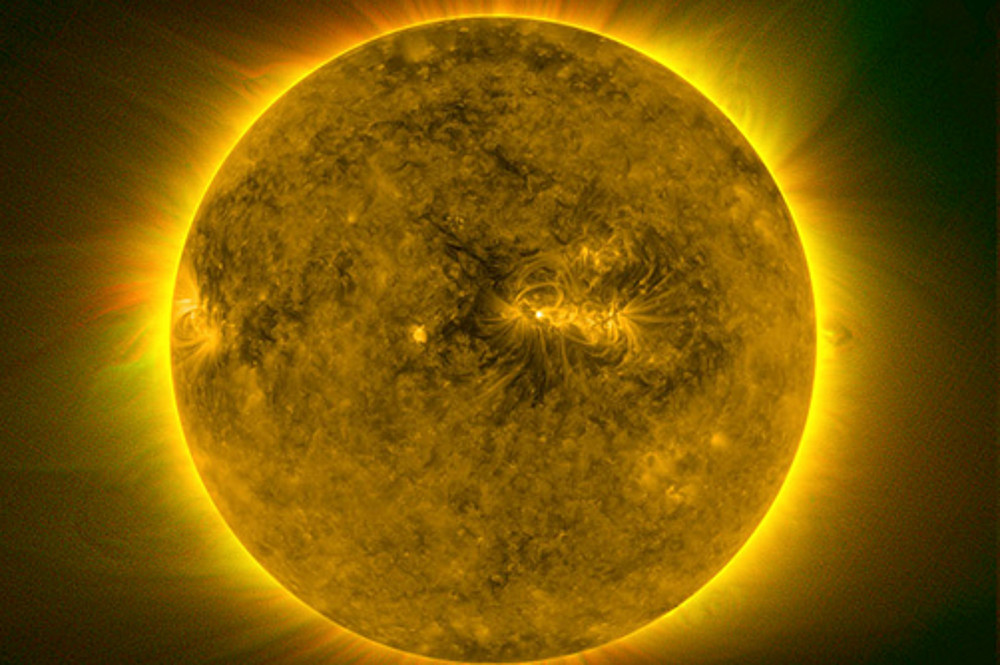
Radiant riddle: Scientists have found out why the corona is hotter than the solar surface.

Radiant riddle: Scientists have found out why the corona is hotter than the solar surface.

International team finds key to explaining the extraordinary temperature increase in the outer atmosphere of the sun

The outer atmosphere of the Sun, which extends outward for several million kilometers beyond the solar surface, is called the corona. The temperature there reaches one million degrees and more. The solar surface on the contrary is a mere 5700 degrees “cool”. What causes this coronal temperature increase was one of the biggest yet-to-be-solved mysteries in astrophysics. “To give an analogy, you expect to get colder as you move away from a hot oven, not hotter,” Dominik Utz explains. He is physicist at the University of Graz and part of the international team that has just found an explanation for this phenomenon. The findings have been published in the latest issue of the magazine „Science“.

Magnetic Geysers
From the solar surface so-called spicules, narrow columns of plasma, dynamically shoot upward to heights of about 5,000 km. “It is estimated that at any given moment in time there are about one million of these geyser-like jets in the solar atmosphere,”, Utz says. Now, new high-spatial-resolution and high-time-cadence observations have unveiled ground-breaking insight into the generation mechanism of many spicules, and into the possible contribution of spicules to coronal heating. The scientists have found out that the jets arise where the magnetic field on the solar surface changes dynamically. The hot streams of plasma that thus reach into the atmosphere are responsible for the unusual heating of the corona. “Complex simulations and theoretical studies basing on the latest observations should now enable us to finally solve the mystery of the coronal heating,” the scientists ascertain.

Publication:
Tanmoy Samanta, Hui Tian, Vasyl Yurchyshyn, Hardi Peter, Wenda Cao, Alphonse Sterling,
Robertus Erdélyi, Kwangsu Ahn, Song Feng, Dominik Utz, Dipankar Banerjee, Yajie Chen: „Generation of solar spicules and subsequent atmospheric heating“, Science Vol 366, Issue 6467


 

created by Dagmar Eklaude

Related news

Higher Education Strategy 2040: Austria’s universities on course for the future

Austria has 77 higher education institutions, which is above the EU average – but does this really make sense? The new Higher Education Strategy 2040 focuses on cooperation rather than mergers. As one of the six largest universities in Austria, the University of Graz plays a central role in this.

Climate research in Greenland: Old data provides new insights

The polar explorer and University of Graz professor Alfred Wegener left behind a unique collection of climate data from Greenland. A research team from the University of Graz is now analysing this 100-year-old treasure trove of data and comparing it with current measurements.

Diversity in nature and science: How we talk about plants and each other

Ginkgo, kiwi, hemp: they exist as male and female plants. Anyone who paid attention in biology class will confirm this. But is this categorisation, established by Carl von Linné almost 300 years ago, still valid today? An interdisciplinary team at the University of Graz is questioning these attributions and using this as a starting point to provide food for thought for gender-sensitive interaction between students, scientific and teaching staff.

Around the world in eight stops: the Long Night of Research at the University of Graz

On 24 April from 5 pm, you can take a short trip around the globe at the University of Graz, discovering pecularities of foreign countries or new local features in the entrance hall of the University Library. The itinerary takes you through introduced animal species, political attitudes and the omnipotence of algorithms. There will also be a programme in the historic reading hall, as well as at the UniGraz@Museum and the University Archive.

Begin of page section:
Additional information:

University of Graz
Universitaetsplatz 3
8010 Graz
Austria
  • Contact
  • Web Editors
  • Moodle
  • UNIGRAZonline
  • Imprint
  • Data Protection Declaration
  • Accessibility Declaration
Weatherstation
Uni Graz

End of this page section. Go to overview of page sections

End of this page section. Go to overview of page sections

Begin of page section:

End of this page section. Go to overview of page sections