



Begin of page section:
Page sections:

  • Go to contents (Accesskey 1)
  • Go to position marker (Accesskey 2)
  • Go to main navigation (Accesskey 3)
  • Go to sub navigation (Accesskey 4)
  • Go to additional information (Accesskey 5)
  • Go to page settings (user/language) (Accesskey 8)
  • Go to search (Accesskey 9)

End of this page section. Go to overview of page sections

Begin of page section:
Page settings:

English en
Deutsch de
Search
Login

End of this page section. Go to overview of page sections

Begin of page section:
Search:

Search for details about Uni Graz
Close

End of this page section. Go to overview of page sections


Search

Begin of page section:
Main navigation:

Page navigation:

  • University

    University
    • About the University
    • Organisation
    • Faculties
    • Library
    • Working at University of Graz
    • Campus
    Developing solutions for the world of tomorrow - that is our mission. Our students and our researchers take on the great challenges of society and carry the knowledge out.
  • Research Profile

    Research Profile
    • Our Expertise
    • Research Questions
    • Research Portal
    • Promoting Research
    • Research Transfer
    • Ethics in Research
    • Commission for Scientific Integrity
    Scientific excellence and the courage to break new ground. Research at the University of Graz creates the foundations for making the future worth living.
  • Studies

    Studies
    • Prospective Students
    • Students
    • Welcome Weeks for First Year Students
  • Community

    Community
    • International
    • Location
    • Research and Business
    • Alumni
    The University of Graz is a hub for international research and brings together scientists and business experts. Moreover, it fosters the exchange and cooperation in study and teaching.
Topics
  • Sustainable University
  • Researchers answer
  • Work for us
Close menu

End of this page section. Go to overview of page sections

Begin of page section:
You are here:

University of Graz News Sinnliche Erkenntnis

End of this page section. Go to overview of page sections

Thursday, 07 November 2013

Sinnliche Erkenntnis

Wahrnehmen – Erkennen – Medialität: Die Episteme der Sinne. Tagung von 6. bis 9. November 2013 an der Uni Graz

Wahrnehmen – Erkennen – Medialität: Die Episteme der Sinne. Tagung von 6. bis 9. November 2013 an der Uni Graz

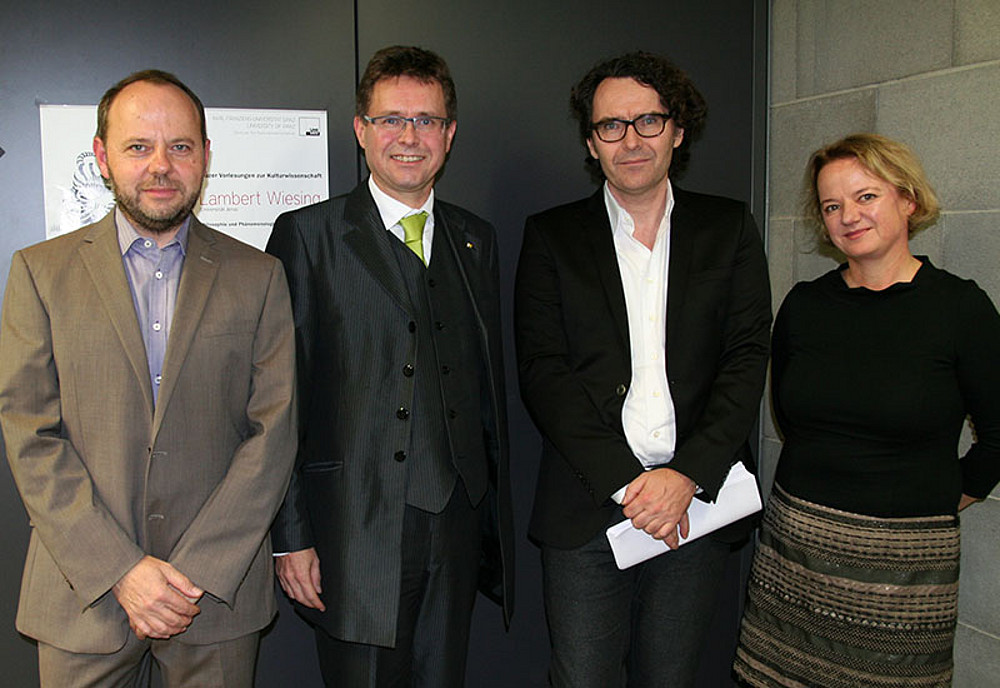
V.l.: Robert Vellusig, Vizerektor Martin Polaschek, Lambert Wiesing und Hildegard Kernmayer

V.l.: Robert Vellusig, Vizerektor Martin Polaschek, Lambert Wiesing und Hildegard Kernmayer

Interdisziplinäre Tagung am Zentrum für Kulturwissenschaften und am Institut für Germanistik

Mit einem Vortrag des Philosophen und Bildtheoretikers Prof. Dr. Lambert Wiesing von der Universität Jena wurde am 6. November 2013 an der Uni Graz die interdisziplinäre Tagung „Wahrnehmen – Erkennen – Medialität: Die Episteme der Sinne“ eröffnet. Im Mittelpunkt der dreitägigen Veranstaltung stehen Vorträge und Diskussionen, die sich mit der Frage nach der Erkenntnisleistung der Sinne und der sinnlichen Erkenntnis der Kunst beschäftigen.

Das von Assoz. Prof. Dr. Hildegard Kernmayer vom Zentrum für Kulturwissenschaften und Priv.-Doz. Dr. Robert Vellusig vom Institut für Germanistik konzipierte und organisierte Symposium soll die Erkenntnisse, die in den verschiedenen Wissenskulturen über das Phänomen der Wahrnehmung gewonnen wurden, vernetzen.

Vizerektor Martin Polaschek unterstrich bei der Eröffnung der Veranstaltung die Bedeutung der interdisziplinären Auseinandersetzung mit dem Thema, das auch im Hinblick auf die Rechtswissenschaften besonders spannend sei, so der Jurist. „In der Justiz geht es darum, Wahrnehmung in Regeln zu pressen und aufgrund von Wahrgenommenem gerechte Entscheidungen zu treffen.“

„Die Sinne erschließen uns die Welt, aber sie sind in ihrer Erkenntnisfähigkeit an ein schmales Spektrum der Wirklichkeit angepasst“, beschreiben Kernmayer und Vellusig das Problem der Wahrnehmung. "Das mikro- und makrokosmisch Dimensionierte wird nur mit Hilfe technischer Medien anschaulich oder lässt sich überhaupt nur mathematisch fassen."

Mittelfristiges Ziel, so die WissenschafterInnen, sei der Aufbau einer interdisziplinären Wahrnehmungsforschung, die Ergebnisse und Einsichten, die in den empirisch-experimentell, philosophisch-begriffsgeschichtlich, kunst-, literatur- und medientheoretisch verfahrenden Disziplinen und in der Kunst über das Phänomen der Wahrnehmung gewonnen werden, dialogisiert.

>> nähere Informationen zur Tagung

created by Hildegard Kernmayer & Gudrun Pichler

Related news

Rescue and risks: Researchers have surveyed public perceptions of AI

The use of artificial intelligence has had to be made transparent since 2 August 2026. The EU’s AI Act, which has been in force since then, also sets out how risky an application is and which security measures apply as a result. However, the assessment of risks by the legislation differs in some cases significantly from the perceptions of the Austrian public. This is the finding of a representative study carried out by data scientist Stefan Thalmann from the University of Graz and his team.

The Healing Sea: Researchers discover new approaches to treating chronic inflammation in sponges

Chronic inflammation plays a key role in many diseases, ranging from metabolic disorders and cardiovascular diseases to tissue damage following injuries or infections. “Normally, the body is able to resolve inflammation on its own. If this process becomes unbalanced, immune cells remain permanently active and continue to drive negative changes in the tissue,” explains Andreas Koeberle, a pharmacist at the University of Graz.

Well prepared: start your studies with the Welcome Weeks

A new academic year, new degree programmes, new students. The University of Graz is kicking off the 2026 winter semester with a modern range of courses. Several new programmes are being launched this year, including the Bachelor’s degree in Early Years Education, which combines vocational training with academic research. Three newly designed degree programmes in art history offer contemporary perspectives on artistic production – from the Old Masters to AI art. First-year students in particular can immerse themselves in university life and gather all the essential information even before the semester begins: during the Welcome Weeks starting on 1 September.

Hot and hotter: Weather station records record-breaking summer temperatures

It has been an exceptionally hot summer so far. The meteorological station at the University of Graz has also reported record temperatures. Unprecedented in the history of weather records dating back to 1894: 44 days above 30 degrees within a single year, six of which were above 35 degrees!

Begin of page section:
Additional information:

University of Graz
Universitaetsplatz 3
8010 Graz
Austria
  • Contact
  • Web Editors
  • Moodle
  • UNIGRAZonline
  • Imprint
  • Data Protection Declaration
  • Accessibility Declaration
Weatherstation
Uni Graz

End of this page section. Go to overview of page sections

End of this page section. Go to overview of page sections

Begin of page section:

End of this page section. Go to overview of page sections