Begin of page section:
Page sections:

  • Go to contents (Accesskey 1)
  • Go to position marker (Accesskey 2)
  • Go to main navigation (Accesskey 3)
  • Go to sub navigation (Accesskey 4)
  • Go to additional information (Accesskey 5)
  • Go to page settings (user/language) (Accesskey 8)
  • Go to search (Accesskey 9)

End of this page section. Go to overview of page sections

Begin of page section:
Page settings:

English en
Deutsch de
Search
Login

End of this page section. Go to overview of page sections

Begin of page section:
Search:

Search for details about Uni Graz
Close

End of this page section. Go to overview of page sections


Search

Begin of page section:
Main navigation:

Page navigation:

  • University

    University
    • About the University
    • Organisation
    • Faculties
    • Library
    • Working at University of Graz
    • Campus
    Developing solutions for the world of tomorrow - that is our mission. Our students and our researchers take on the great challenges of society and carry the knowledge out.
  • Research Profile

    Research Profile
    • Our Expertise
    • Research Questions
    • Research Portal
    • Promoting Research
    • Research Transfer
    • Ethics in Research
    • Commission for Scientific Integrity
    Scientific excellence and the courage to break new ground. Research at the University of Graz creates the foundations for making the future worth living.
  • Studies

    Studies
    • Prospective Students
    • Students
    • Registration for Study Programme (Winter semester 2026/27)
  • Community

    Community
    • International
    • Location
    • Research and Business
    • Alumni
    The University of Graz is a hub for international research and brings together scientists and business experts. Moreover, it fosters the exchange and cooperation in study and teaching.
Topics
  • Sustainable University
  • Researchers answer
  • Work for us
Close menu

End of this page section. Go to overview of page sections

Begin of page section:
You are here:

University of Graz News Schumpeter Lectures

End of this page section. Go to overview of page sections

Friday, 04 November 2016

Schumpeter Lectures

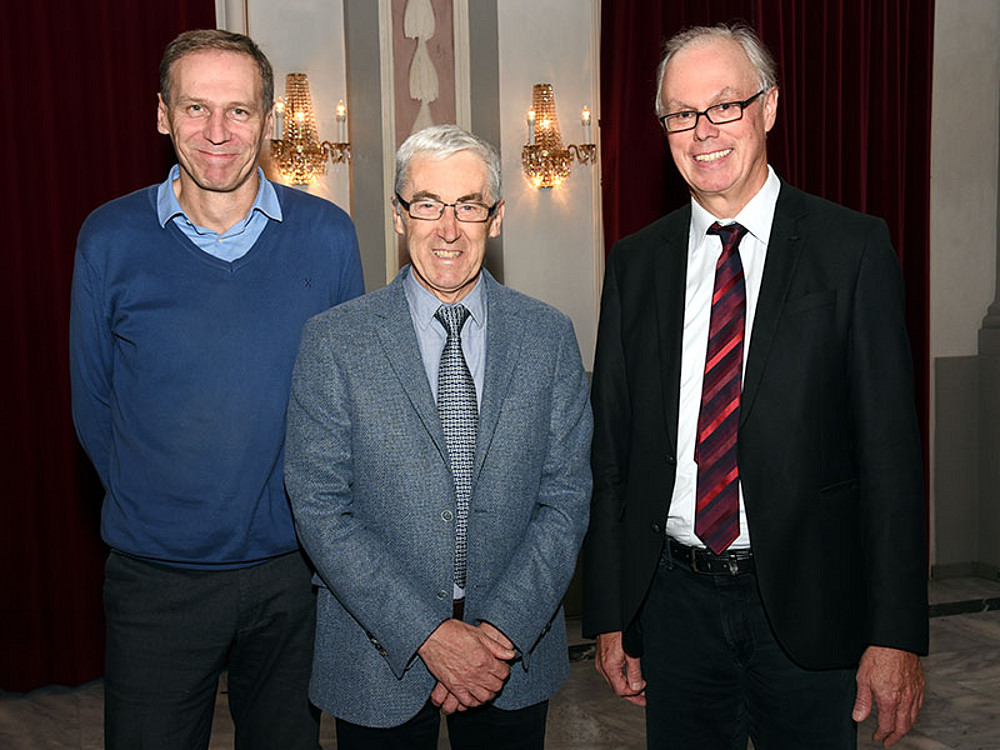
Vortragender Paul De Grauwe (Mitte) mit Richard Sturn (r.), Vorsitzender der Grazer Schumpeter Gesellschaft (GSG), und Christian Gehrke, Schriftführer der GSG. Foto: Uni Graz/Pichler

Vortragender Paul De Grauwe (Mitte) mit Richard Sturn (r.), Vorsitzender der Grazer Schumpeter Gesellschaft (GSG), und Christian Gehrke, Schriftführer der GSG. Foto: Uni Graz/Pichler

Paul De Grauwe von der London School of Economics eröffnete die Vorlesungsreihe an der Uni Graz

„Behavioural macroeconomics“ sind das Thema der diesjährigen Schumpeter Lectures, die von 3. bis 8. November an der Uni Graz stattfinden. Eröffnet wurden sie gestern im Meerscheinschlössl mit einem Vortrag von Paul De Grauwe, Professor für internationale Wirtschaft an der Katholieke Universiteit Leuven/Belgien und der London School of Economics.

Während in der Mainstream-Ökonomie und vor allem in der Neukeynesianischen Makroökonomik davon ausgegangen wird, dass Konjunkturschwankungen das Resultat externer Schocks sind, stellt Paul De Grauwe ein Modell vor, das diese Schwankungen durch endogene, also systeminterne Mechanismen zu erklären versucht. Indem er ein Verhaltensmodell entwickelt, das vom Optimismus und Pessimismus bzw. den „animal spirits“ der Individuen angetrieben wird, schafft er einen neuen, dynamischeren makroökonomischen Ansatz, der ein besseres Verständnis von Schwankungen in Output und Inflation ermöglicht.
De Grauwes Forschungsschwerpunkte sind Währungssysteme, Währungsintegration und die Theorie und empirische Analyse von Devisenmärkten.

Die Graz Schumpeter Lectures werden seit 1995 jährlich von der Grazer Schumpeter Gesellschaft veranstaltet. Ihr Ziel ist, die wirtschafts- und sozialwissenschaftliche Forschung an der Karl-Franzens-Universität zu fördern und gleichzeitig Spitzenforschung einer breiteren interessierten Öffentlichkeit näherzubringen. Die schriftliche Fassung der Vorträge wird anschließend in der Reihe „The Graz Schumpeter Lectures“ veröffentlicht.
>> mehr Informationen

created by Mila Jonjic, Luise Wimmler & Gudrun Pichler

Related news

Adhesive force: Researchers demonstrate how cells determine their function

How does a single cell develop into an organism with skin, muscles, intestines, a heart and other specialised tissues? Two studies published in leading journals have identified a mechanism that links genes, chemical signals and the physical properties of tissues. Scientists from London, Heidelberg and Graz were involved in the research.

Vitamin E is the key: a pharmacist has discovered a substance that ‘switches off’ inflammation

Alzheimer’s, obesity or atherosclerosis: many lifestyle-related diseases are driven by or accompanied by inflammation. “Treatments usually aim to halt the progression of inflammation. However, for a long-term cure, it must be completely resolved,” explains Andreas Koeberle, a pharmacist at the University of Graz. Normally, the body carries out this work itself. However, if this process does not function properly, chronic inflammation can develop, which can contribute to conditions such as cardiovascular disease or cancer.

Sport beyond the World Cup: the TV channel “Welt der Wunder” features diabetes research from the University of Graz

Keeping blood sugar levels in check during physical exertion is a particular challenge for people with type 1 diabetes. Othmar Moser examines how those affected manage to balance physical activity, sport and their metabolic disorder.

"Mathematics explains the world"

How can life be quantified? And what can science reveal that remains hidden from the naked eye? The 14th European Conference on Mathematical and Theoretical Biology at the University of Graz is dedicated to these questions. From 13 to 17 July, around 1,300 researchers from all over the world will gather on campus to discuss models, biological processes and the future of data-driven medicine. Klemens Fellner, Dean of the Faculty of Natural Sciences and Mathematics and a mathematician, talks about the language that explains the world

Begin of page section:
Additional information:

University of Graz
Universitaetsplatz 3
8010 Graz
Austria
  • Contact
  • Web Editors
  • Moodle
  • UNIGRAZonline
  • Imprint
  • Data Protection Declaration
  • Accessibility Declaration
Weatherstation
Uni Graz

End of this page section. Go to overview of page sections

End of this page section. Go to overview of page sections

Begin of page section:

End of this page section. Go to overview of page sections