Begin of page section:
Page sections:

  • Go to contents (Accesskey 1)
  • Go to position marker (Accesskey 2)
  • Go to main navigation (Accesskey 3)
  • Go to sub navigation (Accesskey 4)
  • Go to additional information (Accesskey 5)
  • Go to page settings (user/language) (Accesskey 8)
  • Go to search (Accesskey 9)

End of this page section. Go to overview of page sections

Begin of page section:
Page settings:

English en
Deutsch de
Search
Login

End of this page section. Go to overview of page sections

Begin of page section:
Search:

Search for details about Uni Graz
Close

End of this page section. Go to overview of page sections


Search

Begin of page section:
Main navigation:

Page navigation:

  • University

    University
    • About the University
    • Organisation
    • Faculties
    • Library
    • Working at University of Graz
    • Campus
    Developing solutions for the world of tomorrow - that is our mission. Our students and our researchers take on the great challenges of society and carry the knowledge out.
  • Research Profile

    Research Profile
    • Our Expertise
    • Research Questions
    • Research Portal
    • Promoting Research
    • Research Transfer
    • Ethics in Research
    • Commission for Scientific Integrity
    Scientific excellence and the courage to break new ground. Research at the University of Graz creates the foundations for making the future worth living.
  • Studies

    Studies
    • Prospective Students
    • Students
  • Community

    Community
    • International
    • Location
    • Research and Business
    • Alumni
    The University of Graz is a hub for international research and brings together scientists and business experts. Moreover, it fosters the exchange and cooperation in study and teaching.
Topics
  • Sustainable University
  • Researchers answer
  • Work for us
Close menu

End of this page section. Go to overview of page sections

Begin of page section:
You are here:

University of Graz News

End of this page section. Go to overview of page sections

Tuesday, 18 June 2024

Rote Karte für japanische Fruchtfliege: neues Biozid gegen Schädling im Obstbau
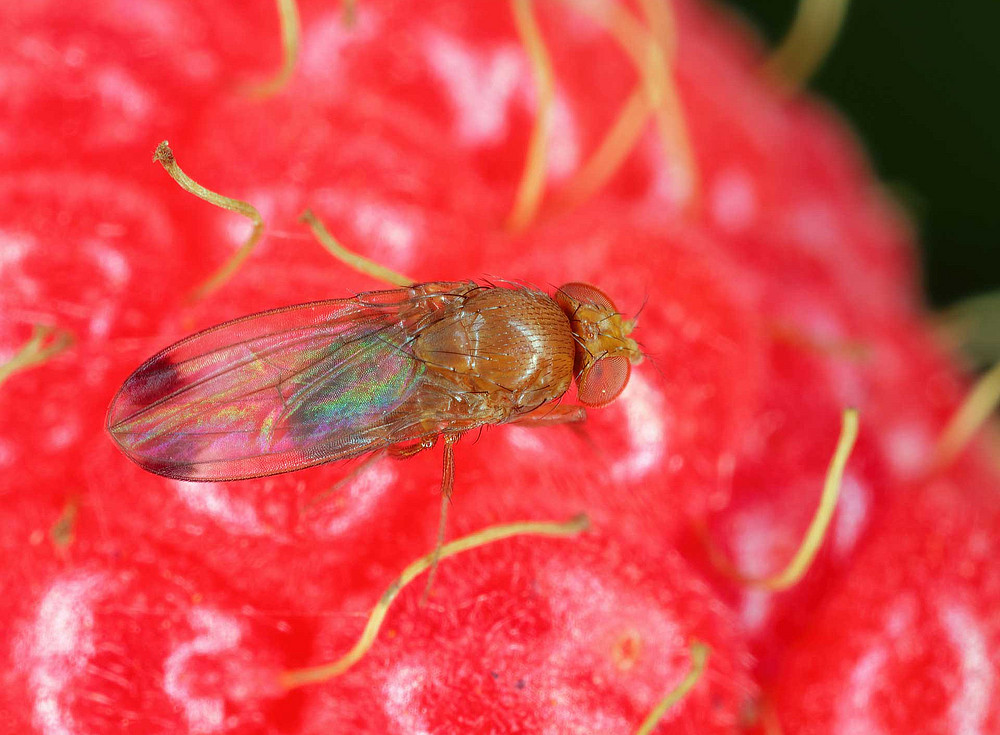
Fruchtfliege sitzt auf Himbeere ©TOMASZ KLEJDYSZ

Die japanische Fruchtfliege legt ihre Eier bevorzugt in rote Früchte, das bedroht nun den heimischen Obstbau. Foto: Tomasz - stock.adobe.com

Sie leuchten derzeit auf Sträuchern und Bäumen appetitlich rot: Erdbeeren, Kirschen und Himbeeren. Doch nicht nur wir Menschen haben es auf die süßen Früchte abgesehen. Die japanische Fruchtfliege, auch als Kirschessigfliege bezeichnet, befällt immer mehr heimische Obst- und Weingärten und bedroht die Ernte. Manfred Hartbauer vom Institut für Biologie hat aus Orangenschalen ein umweltfreundliches Mittel entwickelt, das die Insekten erfolgreich, kostengünstig und ohne schädliche Chemie bekämpft.

Rot sehen Bäuerinnen und Bauern mittlerweile bei Kirschen, Erd- und Himbeeren, Holunder sowie roten Trauben. Denn die vor einigen Jahren aus Asien eingeschleppte Fliege legt nämlich ihre Eier vorzugsweise in rote Früchte, die dann absterben.
Manfred Hartbauer hat bereits gegen andere Insekten wie die Baumwanze innovative Methoden entwickelt. Im Kampf gegen die winzige Kirschessigfliege nutzt er mit seinem Team deren natürliches Verhalten aus. Das neuartige Biozid lockt diese Insekten mit dem Duft von Orangenschalen an, weil sie sich dort vor ihren Hauptfeinden, einer Mini-Schlupfwespe, sicher fühlen. „Denn diese Mini-Wespen meiden das ätherische Öl in der Zitrusfrucht, das vielfach als natürliches Insektizid wirkt“, schildert der Wissenschaftler.
Substanzen aus Orangenschalen – ein Abfallprodukt aus der Fruchtsaftherstellung – sowie eine Salzlösung werden in kleine Fallen gefüllt, in die diese Fruchtfliegen bevorzugt gehen. Hartbauer ist überzeugt: „Das kann die Landwirtschaft umweltfreundlich von den Schädlingen befreien.“

created by Andreas Schweiger

Related news

Superti-Furga will becomefounding director of the CORI Institute in Graz

The Austrian Academy of Sciences (ÖAW) is establishing a new flagship centre for research into metabolic diseases in collaboration with the three universities in Graz. This innovative research approach combines mathematics and experimental biology with artificial intelligence

A match for life

Stem cell donations save lives. However, the only way to determine who is ultimately compatible with whom is through a testing process. Pharmacist Marion Mußbacher explains the mechanisms behind this. On 6 May 2026, the ÖH and the charity “Geben für Leben” are calling for people to come forward for typing at the University of Graz.

Mild Research Night: Around 750 visitors travelled around the world at the university

Lovely weather and a wide range of research topics drew visitors to the University of Graz last Friday. Highlights included a journey around the globe in eight stops, a ‘speed-dating’ session with books, insights into Alfred Wegener’s Greenland expedition, and guided tours of the democracy exhibition at the UniGraz@Museum.

Baumwanze bedroht Obstbau: mit Roboter und Drohne den Schädling bekämpfen

Dass ihr Sekret penetrant riecht, ist noch das geringste Übel. Denn die marmorierte Baumwanze bedroht massiv den heimischen Obstbau. An der Universität Graz wird eine Methode entwickelt, um den eingeschleppten Insekten Herr zu werden – ganz ohne Chemie, mit Hilfe von Robotern, Drohnen und Künstlicher Intelligenz.

Begin of page section:
Additional information:

University of Graz
Universitaetsplatz 3
8010 Graz
Austria
  • Contact
  • Web Editors
  • Moodle
  • UNIGRAZonline
  • Imprint
  • Data Protection Declaration
  • Accessibility Declaration
Weatherstation
Uni Graz

End of this page section. Go to overview of page sections

End of this page section. Go to overview of page sections

Begin of page section:

End of this page section. Go to overview of page sections