Begin of page section:
Page sections:

  • Go to contents (Accesskey 1)
  • Go to position marker (Accesskey 2)
  • Go to main navigation (Accesskey 3)
  • Go to sub navigation (Accesskey 4)
  • Go to additional information (Accesskey 5)
  • Go to page settings (user/language) (Accesskey 8)
  • Go to search (Accesskey 9)

End of this page section. Go to overview of page sections

Begin of page section:
Page settings:

English en
Deutsch de
Search
Login

End of this page section. Go to overview of page sections

Begin of page section:
Search:

Search for details about Uni Graz
Close

End of this page section. Go to overview of page sections


Search

Begin of page section:
Main navigation:

Page navigation:

  • University

    University
    • About the University
    • Organisation
    • Faculties
    • Library
    • Working at University of Graz
    • Campus
    Developing solutions for the world of tomorrow - that is our mission. Our students and our researchers take on the great challenges of society and carry the knowledge out.
  • Research Profile

    Research Profile
    • Our Expertise
    • Research Questions
    • Research Portal
    • Promoting Research
    • Research Transfer
    • Ethics in Research
    Scientific excellence and the courage to break new ground. Research at the University of Graz creates the foundations for making the future worth living.
  • Studies

    Studies
    • Prospective Students
    • Students
    • Welcome Weeks for First Year Students
  • Community

    Community
    • International
    • Location
    • Research and Business
    • Alumni
    The University of Graz is a hub for international research and brings together scientists and business experts. Moreover, it fosters the exchange and cooperation in study and teaching.
  • Spotlight
Topics
  • Sustainable University
  • Researchers answer
  • Work for us
Close menu

End of this page section. Go to overview of page sections

Begin of page section:
You are here:

University of Graz News Rewriting literary history: ERC Starting Grant for Markus Hafner
End of this page section. Go to overview of page sections

Tuesday, 05 September 2023

Rewriting literary history: ERC Starting Grant for Markus Hafner

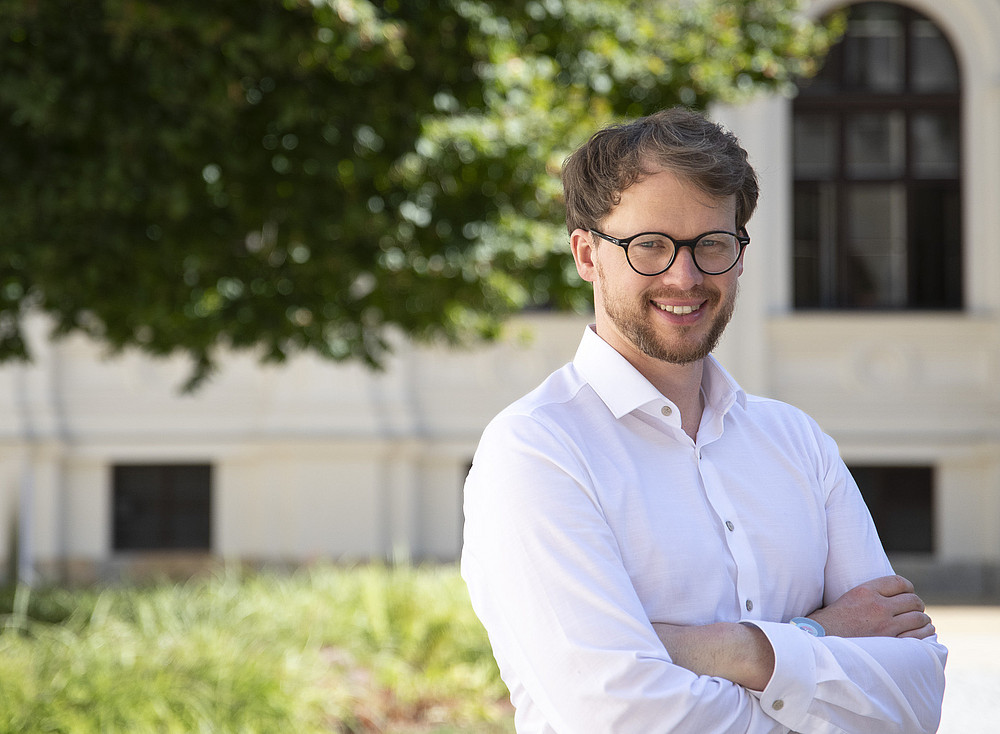
Markus Hafner

Born in Bavaria, Markus Hafner studied at the universities of Munich and Athens, among others. Photo: Uni Graz/Angele

With the ERC grant, Markus Hafner aims to address questions of anonymous and collective authorship in antiquity and, for the first time, to give space to the unheard voices of Greek texts in the fields of poetry, religion and technology.

In many cases, the tradition and especially the authors of ancient texts have not been clearly clarified and still receive little attention. "While modern literary history is dominated by big author names, in antiquity nameless texts also had an intrinsic value," says Markus Hafner, a classical philologist from Graz. On Tuesday, 5 September 2023, the Bavarian-born Dr. Hafner, who teaches and researches at the Department of Classics at the University of Graz, was selected by the European Research Council (ERC) of the European Commission as the winner of a Starting Grant worth 1.5 million for the project "COLLAPSE – Collaboration and Pseudepigraphy. Facing the Anonymous in Imperial Greek Literature". Together with an international research group, Dr. Hafner wants to take a closer look at hitherto unnoticed texts from ancient Greece over the next few years, reassess them and define their role in literary history.

"In times of artificial intelligence and omnipresent digitalisation, we often forget that anonymously written texts have always existed," Dr. Hafner emphasises. With the ERC funding, he wants to address questions of anonymous and collective authorship in antiquity and, for the first time, give space to the unheard voices of Greek texts in the fields of poetry, religion and science writing. "Some writings – comparable to the wiki texts we are familiar with – were written rather collaboratively. Many authors sometimes worked together on one text," says the researcher. Unfortunately, so far attention has only been paid to works by well-known authors, so that writings written collectively have not been taken into account.

The project, which will run from January 2024 to the end of 2028, aims to change this. To this end, four doctoral students and two postdocs will work with Markus Hafner to research the sources anew.

About the principal investigator
Markus Hafner studied Classical Philology, Philosophy and Education at the LMU Munich and the University of Athens. After his doctorate, he taught various classes and carried out research at universities in Germany and the USA. Since 2020 he has been an Assistant Professor, and since 2022 a professor of Classical Philology (esp. Greek) at the University of Graz.

created by Konstantin Tzivanopoulos

Related news

Master's degree in psychotherapy in Graz: registration opens in March

Graz is becoming a hotspot for psychotherapy: from 2026, the University of Graz and the Medical University of Graz will jointly offer the new master's programme. Registration for the admission procedure for the 140 study places will start in March.

PFAS: Uni-Graz-Studie zeigt, dass Verbote von Ewigkeitschemikalien wirken

Forschende der Universität Graz zeigen: PFAS-Verbote senken die Belastung in der Natur nachweislich. Doch die Industrie weicht auf andere Verbindungen aus, die für Menschen ebenso gefährlich sind.

Neues Kapitel für das Graz Center of Physics: Fachwerkteile angeliefert

Architektonischer Meilenstein für das künftige Grazer Physik-Center: Die ersten Fachwerkteile wurden angeliefert und mit dem Kran auf die richtige Stelle im ersten Obergeschoß platziert. Bis Mai folgen 33 weitere Lkw-Transporte und bringen insgesamt 64 Stück. In Summe werden so 16 große Stahlfachwerke vor Ort zusammengeschraubt. Die acht Meter hohen und teilweise bis zu 30 Meter langen Fachwerke geben dem ganzen Gebäude eine notwendige Stabilität und dienen der Lastabtragung der oberen Geschoße.

New groundbreaking computation method for climate extremes

How much will heat, flooding, drought and storms increase as a result of human-induced climate change? In a groundbreaking study, climate researcher Gottfried Kirchengast and his team at the University of Graz have developed a new method for computing the hazards from extreme events: it can compute all relevant hazard metrics for events such as heat waves, floods and droughts in any region worldwide with unprecedented information content. Using it for Europe, the researchers found that anthropogenic climate change has caused a tenfold increase in extreme heat in recent decades. The study, published in the journal Weather and Climate Extremes, also provides a basis for better quantifying the damage to people, ecosystems and infrastructure.

Begin of page section:
Additional information:

University of Graz
Universitaetsplatz 3
8010 Graz
Austria
  • Contact
  • Web Editors
  • Moodle
  • UNIGRAZonline
  • Imprint
  • Data Protection Declaration
  • Accessibility Declaration
Weatherstation
Uni Graz

End of this page section. Go to overview of page sections

End of this page section. Go to overview of page sections

Begin of page section:

End of this page section. Go to overview of page sections