Begin of page section:
Page sections:

  • Go to contents (Accesskey 1)
  • Go to position marker (Accesskey 2)
  • Go to main navigation (Accesskey 3)
  • Go to sub navigation (Accesskey 4)
  • Go to additional information (Accesskey 5)
  • Go to page settings (user/language) (Accesskey 8)
  • Go to search (Accesskey 9)

End of this page section. Go to overview of page sections

Begin of page section:
Page settings:

English en
Deutsch de
Search
Login

End of this page section. Go to overview of page sections

Begin of page section:
Search:

Search for details about Uni Graz
Close

End of this page section. Go to overview of page sections


Search

Begin of page section:
Main navigation:

Page navigation:

  • University

    University
    • About the University
    • Organisation
    • Faculties
    • Library
    • Working at University of Graz
    • Campus
    Developing solutions for the world of tomorrow - that is our mission. Our students and our researchers take on the great challenges of society and carry the knowledge out.
  • Research Profile

    Research Profile
    • Our Expertise
    • Research Questions
    • Research Portal
    • Promoting Research
    • Research Transfer
    • Ethics in Research
    Scientific excellence and the courage to break new ground. Research at the University of Graz creates the foundations for making the future worth living.
  • Studies

    Studies
    • Prospective Students
    • Students
    • Welcome Weeks for First Year Students
  • Community

    Community
    • International
    • Location
    • Research and Business
    • Alumni
    The University of Graz is a hub for international research and brings together scientists and business experts. Moreover, it fosters the exchange and cooperation in study and teaching.
  • Spotlight
Topics
  • Sustainable University
  • Researchers answer
  • Work for us
Close menu

End of this page section. Go to overview of page sections

Begin of page section:
You are here:

University of Graz News PFAS on ski slopes: How a researcher tracks down environmental toxins

End of this page section. Go to overview of page sections

Tuesday, 06 February 2024

PFAS on ski slopes: How a researcher tracks down environmental toxins

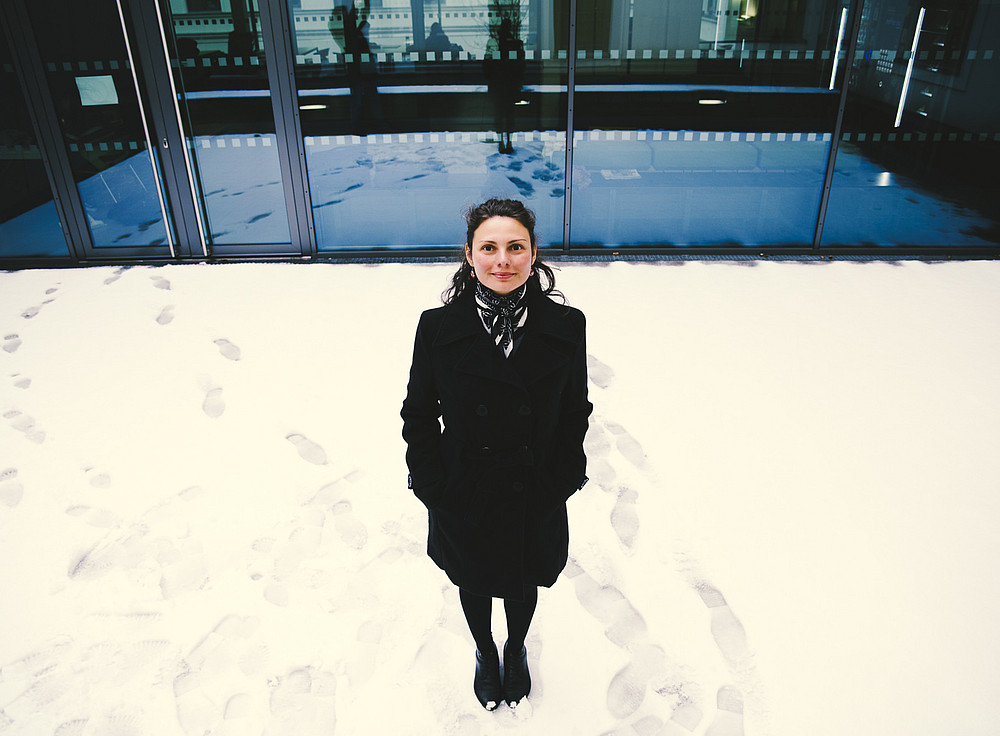
Viktoria Müller im Chemie-Gebäude der Uni Graz ©Uni Graz/Tzivanopoulos

Viktoria Müller untersucht die Ewigkeits-Chemikalien PFAS. Foto: Uni Graz/Tzivanopoulos

Per- and polyfluoroalkyl compounds (PFAS) are extremely persistent organofluorine compounds that are also used in ski wax. Researcher Viktoria Müller from the University of Graz has found residues of these environmental toxins on the slopes of ski resorts in Styria and Carinthia. Skiers can counteract this by choosing the right wax.


PFAS are found in textiles, fire extinguishers and paper products and have been used for decades, for example as moisture protection or extinguishing agents. However, the consequences have only been investigated for a few years. They are suspected of causing cancer, can damage the liver and can also lead to reproductive problems.

However, the quantities above which this has health consequences and what these consequences are have not yet been clarified. "Unfortunately, we are still lagging behind when it comes to toxicological data," explains researcher Viktoria Müller.

Forever Chemicals

She has set herself the goal of searching for residues of these substances, which are known as "forever chemicals". The Hungarian-born scientist studied at the University of Aberdeen in Scotland. Jörg Feldmann, Professor of Analytical Chemistry at the University of Graz, inspired her to research PFAS and brought her to the University of Graz.

Müller has already been able to prove that residues of the substances can be found in the River Mur. Müller has now been able to show that ski resorts in southern Austria are also contaminated with these persistent environmental toxins.

Specifically, Müller took samples of snow, meltwater and soil from several ski resorts towards the end of the ski season (March/April). The collection of samples in the ski resorts was viewed critically, says Müller: "In winter, we were often asked why we were taking samples." In summer, however, nobody took interest in her activities.

Residues found

PFAS residues were found in varying concentrations in both the snow and the melt water. The cause: certain types of ski wax with fluorine compounds. "Fluorinated waxes are usually used when the snow is a little slushy," explains the chemist. "They provide better gliding properties. It offers less advantage on icy slopes"

She was also able to find residues of the fluorine compound in the soil in all areas. However, the type of PFAS differed from those in the wax. Müller concludes from that there is a large variety of the type of PFAS in the different waxes and not al compounds can be measured. "But just because we can't measure them doesn't mean that they are not present and could have a negative impact on the environment," explains the researcher. Ski wax with fluorine is labelled with an "F". Skiers therefore influence the load on the floor with their choice of wax.

This is because plants can also absorb these PFAS from the soil. And the substances then enter grazing animals such as cattle and sheep via the grass in summer. And these toxic degradation products can then also enter the human food chain via dairy products. Müller now wants to conduct further research into the consequences of the use of PFAS at the University of Graz.

Publication

Per and polyfluoroalkylated substances (PFAS) target and EOF analyses in ski wax, snowmelts, and soil from skiing areas. Viktoria Müller, Larissa Cristine, Andrade Costa, Filipe Soares Rondan, Eleonora Matic, Marcia Foster Mesko, Andrew Kindness and Jörg Feldmann

https://pubs.rsc.org/en/content/articlelanding/2023/em/d3em00375b


created by Roman Vilgut

Related news

Master's degree in psychotherapy in Graz: registration opens in March

Graz is becoming a hotspot for psychotherapy: from 2026, the University of Graz and the Medical University of Graz will jointly offer the new master's programme. Registration for the admission procedure for the 140 study places will start in March.

PFAS: Uni-Graz-Studie zeigt, dass Verbote von Ewigkeitschemikalien wirken

Forschende der Universität Graz zeigen: PFAS-Verbote senken die Belastung in der Natur nachweislich. Doch die Industrie weicht auf andere Verbindungen aus, die für Menschen ebenso gefährlich sind.

Neues Kapitel für das Graz Center of Physics: Fachwerkteile angeliefert

Architektonischer Meilenstein für das künftige Grazer Physik-Center: Die ersten Fachwerkteile wurden angeliefert und mit dem Kran auf die richtige Stelle im ersten Obergeschoß platziert. Bis Mai folgen 33 weitere Lkw-Transporte und bringen insgesamt 64 Stück. In Summe werden so 16 große Stahlfachwerke vor Ort zusammengeschraubt. Die acht Meter hohen und teilweise bis zu 30 Meter langen Fachwerke geben dem ganzen Gebäude eine notwendige Stabilität und dienen der Lastabtragung der oberen Geschoße.

New groundbreaking computation method for climate extremes

How much will heat, flooding, drought and storms increase as a result of human-induced climate change? In a groundbreaking study, climate researcher Gottfried Kirchengast and his team at the University of Graz have developed a new method for computing the hazards from extreme events: it can compute all relevant hazard metrics for events such as heat waves, floods and droughts in any region worldwide with unprecedented information content. Using it for Europe, the researchers found that anthropogenic climate change has caused a tenfold increase in extreme heat in recent decades. The study, published in the journal Weather and Climate Extremes, also provides a basis for better quantifying the damage to people, ecosystems and infrastructure.

Begin of page section:
Additional information:

University of Graz
Universitaetsplatz 3
8010 Graz
Austria
  • Contact
  • Web Editors
  • Moodle
  • UNIGRAZonline
  • Imprint
  • Data Protection Declaration
  • Accessibility Declaration
Weatherstation
Uni Graz

End of this page section. Go to overview of page sections

End of this page section. Go to overview of page sections

Begin of page section:

End of this page section. Go to overview of page sections