



Begin of page section:
Page sections:

  • Go to contents (Accesskey 1)
  • Go to position marker (Accesskey 2)
  • Go to main navigation (Accesskey 3)
  • Go to sub navigation (Accesskey 4)
  • Go to additional information (Accesskey 5)
  • Go to page settings (user/language) (Accesskey 8)
  • Go to search (Accesskey 9)

End of this page section. Go to overview of page sections

Begin of page section:
Page settings:

English en
Deutsch de
Search
Login

End of this page section. Go to overview of page sections

Begin of page section:
Search:

Search for details about Uni Graz
Close

End of this page section. Go to overview of page sections


Search

Begin of page section:
Main navigation:

Page navigation:

  • University

    University
    • About the University
    • Organisation
    • Faculties
    • Library
    • Working at University of Graz
    • Campus
    Developing solutions for the world of tomorrow - that is our mission. Our students and our researchers take on the great challenges of society and carry the knowledge out.
  • Research Profile

    Research Profile
    • Our Expertise
    • Research Questions
    • Research Portal
    • Promoting Research
    • Research Transfer
    • Ethics in Research
    • Commission for Scientific Integrity
    Scientific excellence and the courage to break new ground. Research at the University of Graz creates the foundations for making the future worth living.
  • Studies

    Studies
    • Prospective Students
    • Students
    • Registration for Study Programme (Winter semester 2026/27)
  • Community

    Community
    • International
    • Location
    • Research and Business
    • Alumni
    The University of Graz is a hub for international research and brings together scientists and business experts. Moreover, it fosters the exchange and cooperation in study and teaching.
Topics
  • Sustainable University
  • Researchers answer
  • Work for us
Close menu

End of this page section. Go to overview of page sections

Begin of page section:
You are here:

University of Graz News Lost Space?

End of this page section. Go to overview of page sections

Tuesday, 26 April 2016

Lost Space?

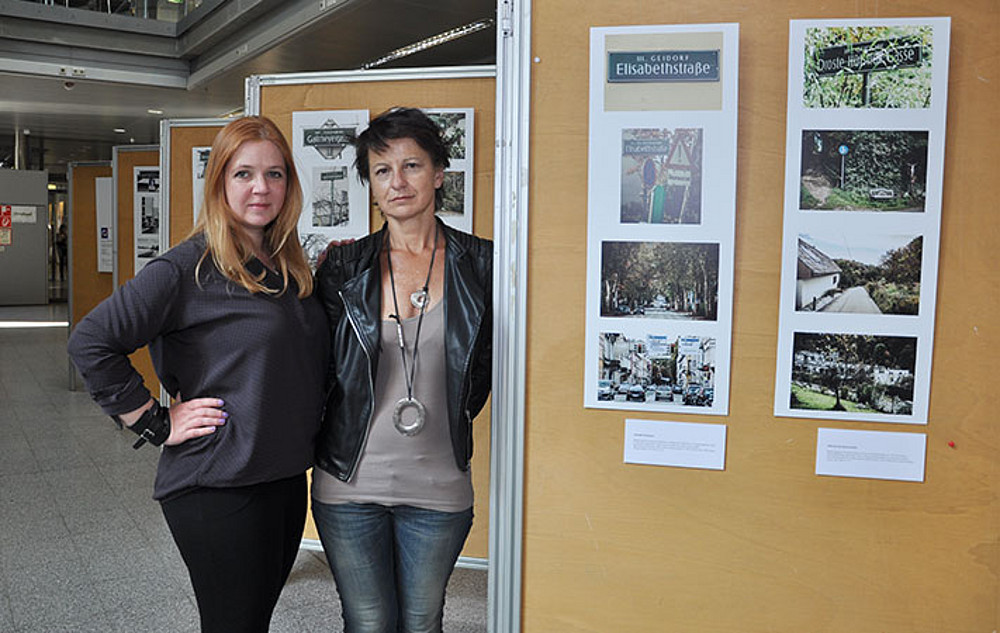
Die Initiatorin der Ausstellung Ina Mastnak (l.) und die Fotografin Ulrike Rauch bei der Eröffnung der Ausstellung "Lost Space?". Foto: Uni Graz/Kastrun. ©Uni Graz/Kastrun
©Uni Graz/Kastrun

Die Initiatorin der Ausstellung Ina Mastnak (l.) und die Fotografin Ulrike Rauch bei der Eröffnung der Ausstellung "Lost Space?". Foto: Uni Graz/Kastrun.

Ausstellung im RESOWI-Zentrum zeigt Grazer Frauenstraßen und -plätze

Über 1600 Straßen und Plätze in Graz sind nach verdienten Persönlichkeiten benannt. Lediglich 46 - das sind 2,5 Prozent - tragen den Namen von (berühmten) Frauen, mit eingerechnet sind dabei übrigens auch Bezeichnungen wie "Annenstraße". Zu diesem Ergebnis kam Sarah Lintschnig in ihrer Masterarbeit "Über die (Un-)Sichtbarkeit von Frauen im öffentlichen Raum - topografische Bezeichnungen in Graz", die sie am Institut für Österreichische Rechtsgeschichte und Europäische Rechtsentwicklung der Uni Graz verfasste. 

Die Recherche haben Ina Mastnak vom Verein "LOST SPACE? die frau im öffentlichen raum!" und die Fotografin Ulrike Rauch in einer Ausstellung, die seit vergangener Woche im RESOWI-Zentrum und noch bis 23. Mai 2016 kostenlos zu sehen ist, umgesetzt. Die fotografische Dokumentation zeigt die Grazer Straßen, Gassen und Orte, die ihre Namen von Politikerinnen, Pionierinnen und anderen berühmten weiblichen Persönlichkeiten erhalten haben.

"Mit dieser Ausstellung möchten wir das Ungleichgewicht zwischen Männern und Frauen bei der Würdigung ihrer Biografien sichtbar machen", erklärten Mastnak und Rauch bei der Eröffnung am 22. April 2016, in deren Rahmen sie auf verschiedene Beispiele eingingen. "Oft ist vielen GrazerInnen gar nicht bewusst, dass Straßen und Plätze in ihrer Stadt nach Frauen benannt sind - wie etwa die Gallmeyergasse, für die die Schauspielerin Josefine Gallmeyer Patin stand."


created by Gerhild Kastrun

Related news

"Mathematics explains the world"

How can life be quantified? And what can science reveal that remains hidden from the naked eye? The 14th European Conference on Mathematical and Theoretical Biology at the University of Graz is dedicated to these questions. From 13 to 17 July, around 1,300 researchers from all over the world will gather on campus to discuss models, biological processes and the future of data-driven medicine. Klemens Fellner, Dean of the Faculty of Natural Sciences and Mathematics and a mathematician, talks about the language that explains the world

Internationally up-to-date: University of Graz offers new degree programmes in art studies

From the Old Masters to AI art – three newly designed degree programmes offer students at the University of Graz fresh perspectives on artistic production. In addition to historical art, the programmes place a greater emphasis on contemporary and global developments. The registration period is open.

The Nazi elite school Napola: Historian seeks memories and personal documents

They were to be brought up to become the future elite of National Socialism: boys and girls aged ten and over who, following the ‘Anschluss’ of Austria to the German Reich, attended a so-called Napola (short for Nationalpolitische Lehranstalt; also known as NPEA, Nationalpolitische Erziehungsanstalt). There were nine such institutions in what is now Austria between 1939 and 1945.

Heat-resistant: Eva Preinfalk explains how cities can protect their residents

Certain demographic and some occupational groups are particularly vulnerable to high temperatures. A range of measures is needed to provide relief for everyone, explains climate economist Eva Preinfalk.

Begin of page section:
Additional information:

University of Graz
Universitaetsplatz 3
8010 Graz
Austria
  • Contact
  • Web Editors
  • Moodle
  • UNIGRAZonline
  • Imprint
  • Data Protection Declaration
  • Accessibility Declaration
Weatherstation
Uni Graz

End of this page section. Go to overview of page sections

End of this page section. Go to overview of page sections

Begin of page section:

End of this page section. Go to overview of page sections